

Blog

Race in the Workplace: Resources for Leaders that Want to Build More Inclusive Work Cultures
It’s 2020, and recent events in our country have reopened discussions about racism in the United States. This racism exists everywhere, even at work. In fact, most complaints processed by the US Equal Employment Opportunity Commission are racially-based, and yet only 15% of those cases end in success for the employee. Here are some resources and other things to keep in mind to help you build a more inclusive workplace.

Photo by Christina @ wocintechchat.com on Unsplash
Events that have unfolded over the past week in the United States have reopened a lot of conversations about racism in our country.
Like many others, I have been reflecting on my whiteness and what role someone like me can play in working to dismantle racism. One thing I kept going back to is how to combat it in the workplace.
As a leader, there are steps you can take to combat racism and better support current and future colleagues of color. These steps will help you create a more inclusive workplace with happier employees and, ultimately, stronger customer relationships.
Keep in mind that I am white, and in this post I am hoping to bring certain issues to light to my fellow white professionals. If you’re also white, I would encourage you to do some additional reading of articles and books by people of color to better understand their perspective and solutions. I have some links to these resources later in the post.
Racism at work still exists in 2020.
Although workplace discrimination is illegal in our country, the US Equal Employment Opportunity Commission (EEOC) receives hundreds of thousands of complaints each year. Granted, these complaints range from all types of discrimination other than race, such as gender, sexuality, religion, and more. Vox reported in 2018 that of these over 100,000 closed cases, only 18% of workers receive some sort of assistance, such as financial compensation or a change in work conditions. Additionally, race claims are the most commonly filed complaints and have the lowest success rate at just 15%. This is due to the lack of funding and resources available to the EEOC for properly investigating claims.
Keep in mind that these complaints aren’t always overt threats or racial slurs; workplace discrimination can manifest in more subtle ways as well. Differences in compensation, certain work assignments, or performance reviews can sometimes be examples of discrimination.
Racial bias exists in terms of what many in our country view as “professional” standards as well. As a white person, what comes to mind when you think of “professional” dress code or speech?


Traditional Western views of professional attire are often built around white appearances: straight, “neat” hair and suits, which excludes minorities with natural hair or dreadlocks, or people that wear hijabs or saris. These implicit biases have deep roots in the history of the American workforce, and cannot be conquered overnight. However, addressing these biases and being more inclusive in dress codes and other workplace policies can be a great start.
Build an inclusive workplace.
I will be honest: creating a workplace that is more inclusive and that celebrates diversity can take some time, and it definitely takes buy-in from multiple leaders and stakeholders of your company.
Unfortunately I don’t have a simple six-step process for transforming your company’s culture to be more inclusive. I do, however, recommend starting with your company policies, as stated above. Are there any words or phrases that exclude minorities? Even something as simple as making a certain phrase more inclusive will go a long way in making people from more diverse backgrounds feel more welcome in your workplace.
Diversity training with your employees will also help you get on the right track. Look for companies in your area that specialize in this. This will make for a fun and engaging experience for your staff. Plus, it will make them feel more bought-in to you as their employer working to improve the culture of your workplace.
Be open to discussion and—most importantly—listening.
As white people, it’s important now more than ever to sit down with people of color and listen to their stories. Just be mindful that not all people of color will inherently be open to discourse, especially during a traumatic time like this.
However, if you find yourself in a discussion with a person of color, make sure to listen. Don’t feel like you need to respond to every single thing they say with your own experiences. Listening to their stories will help you better understand why building an inclusive and diverse work culture is so important.

Photo by Christina @ wocintechchat.com on Unsplash
Be open to this type of discourse in the workplace as well. Understand that it’s so much easier for white people to ignore or tune out what is happening in the world than it is for a person of color. Make it clear to your colleagues that you are available to lend an open ear and open mind if they want to talk about what has been happening, but don’t single anyone out either.
Do some reading.
Take advantage of any spare time you have to do some research on racism, particularly from black writers and other content creators. Here is a very brief list of things you can dive right into to learn more:
Books
White Fragility: Why It's So Hard for White People to Talk About Racism by Robin DiAngelo
So You Want to Talk About Race by Ijeoma Oluo
We Can’t Talk About That at Work! by Mary-Frances Winters
The New Jim Crow: Mass Incarceration in the Age of Colorblindness by Michelle Alexander
Articles
The Bias of ‘Professionalism’ Standards by Aysa Gray (June 4, 2019)
Who Gets to be Afraid in America? by Dr. Ibram X Kendi (May 12, 2020)
Podcasts
Code Switch by NPR
1619 by The New York Times
No Bad News by Dom Davis
Strong Black Lead by Tracy Clayton and Netflix
Films/Documentaries
When They See Us (Available to watch on Netflix)
Kingdom Men Rising (Available to watch for free on IMDb)
The Hate U Give (Available to watch on Hulu)
Understand that you may never understand.
Many of the struggles that American people of color face on a daily basis are struggles that we as white people will never experience. This isn’t anything that we should feel guilty about, but that we should acknowledge and accept.
We also need to recognize that just because we don’t see or feel the pain that they feel, that doesn’t mean that it isn’t valid. In times like this, it’s so important and helpful for all of us to come together to enact change—the type of change that every single one of us can benefit from.
By creating a workplace that is more culturally diverse and welcoming to people of color, you are doing your part in creating a more level playing field for all Americans. These changes will not happen overnight, but will help make the American workplace leaps and bounds better than it was yesterday, which is progress to be celebrated.
Special thanks to my friend Dom Davis of the No Bad News podcast for reviewing this post for accuracy.

Why You Should Hire Employees That Have a Side Hustle (And How to Support Them)
Almost half (45%) of the US workforce say they have a “side hustle” outside of their regular job. Traditionally, this doesn’t sit well with employers. They’re afraid the employee would be distracted or leave their company. The reality is that the best employees I’ve ever had were freelancers. Here’s why you should hire employees that have a side hustle, and how to support them.

Photo by Trevor Brown on Unsplash
I have been freelancing on and off ever since I graduated college in 2013. It has helped me make some extra cash, follow my passion, and also has held me over between full-time jobs.
Not to mention, the things I have learned while freelancing have helped me become a better employee for my full-time employers.
I’m a millennial, and it’s no surprise that us millennials are known as the “side hustle generation”. A 2019 survey by Bankrate showed that 48% of millennials make extra money on the side, outside of their regular job.
This survey also showed that out of the total US workforce, almost half (45%) say they have a side gig.
If you’re a business owner or manager, how would you react if you found out that one of your employees had a side hustle? More traditionally, employers have frowned upon this action—also known as “moonlighting”—out of concern that it would distract from that employee’s regular duties or that the employee would make their side hustle a full-time responsibility and leave.
I’m here today to tell you why that is wrong; truthfully, the best employees I have ever managed were freelancers on nights and weekends. They were ambitious, entrepreneurial, and taught me a lot. Below are some other reasons why you should encourage your employees to have side hustles.
They are self-starters.
Side hustlers make the best employees because as freelancers, they will run into problems that they will need to solve on their own. These employees are more likely to tackle issues at work in a creative way, without throwing their hands up in defeat so easily. Also, if their side hustle is a solo gig, they will flourish in a collaborative environment where they can work on projects and solve problems through discussion.
They’re improving their craft outside of work.
Employees with side gigs are constantly learning and improving, and they’re doing this both on and off the clock. Freelancers and other side hustlers are gaining new skills that will help them be better at what they’re doing for you, on the clock. Think of it like sending them to a conference to improve their skills and develop their professional life. (That’s not to say you don’t need to send these employees to professional development conferences to help empower them, because you should still make that investment too.)

You can learn from them.
In my opinion, the worst leaders are ones that don’t believe there is something to learn from every single one of their employees. If you’re someone that falls into this category, take this as a wake-up call. As a leader, you should always be willing to learn new things from anyone you meet—especially the people you employ.
I learned every single day from the people on my team that had a side hustle. They taught me how they approached interacting with clients, maintaining work life balance, and managing multiple projects. These were things that we were also able to implement to improve our team’s workflow because we knew that it worked well for them already.
They are extremely disciplined.
If you’re not a side hustler, think about what it might feel like to work a full, mentally draining day, go home, and keep working on more projects. Having a side gig along with a full-time job is super tough, so you know that if someone is juggling both things at once—and successfully so—they practice a level of discipline and balance that you’re probably already looking for in a strong employee.

Photo by Bonnie Kittle on Unsplash
Supporting your side hustlers.
If you have someone on your team that freelances, you will benefit from supporting them and their side gig. Not only will they become more empowered, they will trust you as their leader much more and understand that you’re more interested in their professional success than having them work for you forever.
Here are some ways to support your side hustlers.
Show you genuinely care by asking how their projects outside of work are going. Actually pay attention and follow up as a way of holding them accountable to keep pursuing this passion of theirs.
Ask them if they have learned any new skills or processes that can be implemented at work to make their job easier or more fulfilling.
Make it clear that you expect them to move up or leave someday for something better. Don’t say this in a threatening way, though! This is just so they understand that you’re dedicated to their success.
Allow them to have “Professional Development” time during their day to break things up and learn new skills. This is especially beneficial for creative employees, and can be anything from 1-5 hours each week.
Avoiding conflicts of interest.
If there are any side gigs or freelance work that would be a conflict of interest, it’s important for you as the employer to clearly define those boundaries. For example, if I started working full-time for a web design firm, I would probably be asked to discontinue my web design services that I offer my freelance clients, since this would be in direct competition with my employer.
Make sure to have this discussion with your employees or potential employees, regardless if you know that they have a side gig or not. That kind of transparency will create more trust on both sides of the table.
Now that you understand what makes side hustlers such strong employees, go hire some, and encourage your current employees to pursue their passion on the side as well.

11 Free Marketing Courses That You Can Do While Staying Safe at Home
Health officials have asked Americans to stay home to help prevent the spread of COVID-19. This has left many business owners and marketers with much more time on their hands. One way to come out of all of this better is to use this extra time to continue learning. Thankfully, there are a ton of free marketing courses available online. Here are some that are on my “quarantine list".

Photo by Christian Lambert on Unsplash
The COVID-19 pandemic has resulted in so many drastic changes in the past few months, and one of the biggest adjustments that working Americans have had to face is staying home in order to practice social distancing. This had led businesses of all sizes to see a drop in sales, cutbacks to their workforce, or having to shutter their doors altogether.
Let’s face it: we’re all going to have to stay home in order to flatten the curve of cases of COVID-19 and to stay safe. For introverted homebodies like me, this hasn’t been much of a problem (so far). Those that are more extroverted, however, may be getting a little stir-crazy already.
A lot of people are finding themselves with a lot more time on their hands right now, and one way marketers like me can help pass that time is to take advantage of the free online resources and learning opportunities offered by big names in the marketing industry. After all, we might as well use this extra time to sharpen our minds and come out of all of this stronger than ever!
Whether you’re a marketing professional looking to learn a new skill or a small business owner building a re-launch plan for once this all passes, here are 11 free marketing courses that you can do in your pajamas during your extra time at home.
HubSpot Academy Certifications
HubSpot is the leading name in marketing automation platforms, and I’m obsessed with the free marketing and sales courses and certifications offered on HubSpot Academy. These lessons can be taken individually, or as part of a full lesson plan to get certified in a particular subject matter. Here are some great certifications:
Inbound Marketing Certification: I would recommend taking these lessons first, as they give a great explanation of HubSpot’s marketing methodology and why it can be so successful. I’m a huge fan of inbound marketing myself, and earning this certification helped me understand how to deploy inbound strategies for my clients to help them increase their marketing ROI.
Content Marketing Certification: “Content” is a huge word when it comes to marketing because it encompasses so many different tactics. This certification goes over how to build and launch a strong content marketing strategy, step-by-step.
Social Media Marketing Certification: Another hugely important term in digital marketing, these lessons on social media teach you how to leverage social media to complement the rest of your inbound marketing strategy.

HubSpot Academy Inbound Marketing Certification Course
SEMrush Academy Courses
SEMrush was introduced to me by a colleague as a great SEO tool for marketers, even for those like me that are just beginning to learn about SEO. Here are two lessons that I really enjoyed taking from the platform:
SEO Fundamentals: If the concept of SEO is completely new to you, this is a great course that provides an overview of what SEO is and how it can drive more organic website traffic for your business or your client’s business.
Keyword Research: Keyword Research is an important step in building a strong SEO strategy, and this course, taught by Greg Gifford, breaks down some best practices for building a list of keywords that you’d like to rank for.

SEMrush Academy Keyword Research Course
Skillshare Courses
Skillshare offers some free courses on their platform that are great for people looking for an introduction on new marketing tactics (and even some other creative skills like video and graphic design). You can also sign up for a free trial to access all of the courses in their library. Here are two courses in their “free” section:
Getting Started with Email Marketing: Mailchimp’s Senior Marketing Manager, Allyson Van Houton, teaches viewers how to implement an effective email marketing strategy with lessons on best practices.
Growth Marketing Essentials: Build Effective Acquisition Funnels: Cam Lay teaches this course that is great for entrepreneurs that want to understand what the marketing funnel is and how to approach this process for their business.

Skillshare Email Marketing Course with Mailchimp
Codecademy Courses
Codecademy is an amazing platform for developers looking to learn more programming languages and perfect their craft. However, learning HTML and CSS can help marketers become more well-rounded in their skillset, especially if you’ll be looking for a new job this year. Like Skillshare, Codecademy offers some free introductory courses as well as a free trial of their Pro subscription.
Introduction to HTML: This course reviews the most common HTML tags used to build web pages. There are also three “projects” to help you put what you learn to practice.
Learn CSS: This is another hands-on course that builds off of the HTML course with CSS rules. CSS allows you to stylize web pages with colors, typography, and more.
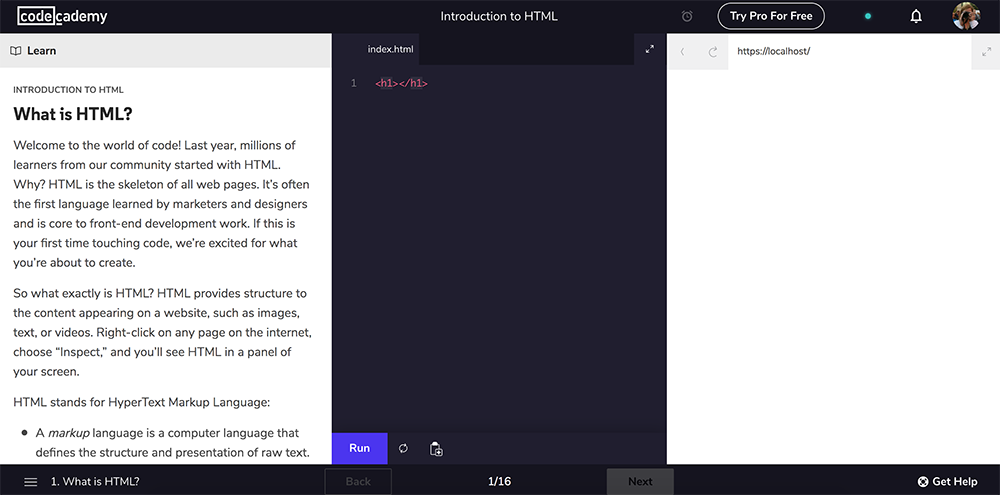
Codecademy Introduction to HTML Course
Facebook Blueprint Courses
We know that Facebook is the largest social media platform in the world, as well as a powerful tool used by marketers everywhere. Facebook offers free courses and certifications to help marketers and business owners learn how to run ads, retarget customers, and more.
Guide to Creating Facebook Ads from Your Page: This course is perfect for someone that has never used Facebook Ads before. It walks through the entire process, step-by-step.
How to Advertise on Instagram: Instagram, which is owned by Facebook, is the social media platform known for its high engagement rates. If you’d like to learn how to run ads specifically for Instagram, this course is for you.

Facebook Blueprint Instagram Advertising Course
Most of these lessons are courses that I have either completed myself or that are on my “quarantine list”, but I’m always looking for more! If you have any suggestions on free online courses or certifications that you would recommend, drop a comment below.

How to Lead a Team While Working from Home (From Someone Who’s Done it)
With everything going on in the world lately surrounding COVID-19 and avoiding its spread through social distancing, working from home is becoming more and more relevant. Studies show that employers that offer this flexibility to their team members will see an increase in productivity. If you’re a team leader that is nervous about being asked to work from home, here are some pointers to put your mind at ease.

Photo by Mimi Thian on Unsplash
With all of the media coverage of COVID-19 lately, you’ve probably seen a lot of articles about “social distancing” and “self quarantine”. Many states and local governments are enacting temporary bans on large assemblies of people. This means that if you work for a company with 100 or more employees in one space, you may be asked to work from home for the time being.
Working from home sounds very appealing to some. You can sleep a bit longer, roll out of bed, and work in your pajamas. For others, working remotely may seem kind of intimidating, especially for leaders. What if you run into distractions? What if you struggle to stay efficient? What if your team members are hitting roadblocks and you’re not there to help them?
As someone who not only worked from home for three years, but remotely led a team of creatives for two of those years, I’d like to put your mind at ease by sharing some of the strategies that helped me stay focused and motivated, even with distractions at home.
Nothing Works Without Trust
If you’re nervous about your team working from home because you don’t trust them to actually work, I have a legitimate question for you: Why did you even hire them in the first place?
Unless you’re leading a team of middle-schoolers, you should be able to trust them to do their job, no matter where they’re working. If you’re a manager that thinks your team won’t be as productive if they work from home, I have some news for you. A 2019 study showed that 85% of businesses that switched to a more flexible work-from-home policy saw an increase in productivity. Working from home also increases morale and reduces stress in employees.
Learn to trust your employees. They’re adults, and they will appreciate being trusted to do their job from home.
A Little Structure Goes a Long Way
One thing that employees working from home for the first time might miss is a bit of structure in their schedules. Even if your team doesn’t typically hold many meetings in the office, it might help to schedule a quick conference call a few times a week to catch up on each other’s progress and support each other in your projects.
It might be worth building a habit of tracking your time if you don’t do so already. When I first started working remotely, I used Toggl to track the time I spent on each project and give my supervisors peace of mind regarding my productivity. Now, my whole team uses it to track their time spent on each client. It’s a great habit to build to hold yourself and your team accountable.
Set a Good Example
Another good habit to build when you work from home, aside from working a consistent schedule, is to get up and get ready for “work” the same way you would if you were going to the office. If your morning ritual includes showering, doing your hair and makeup, and getting dressed, it helps to do that even if you’re just going to be working from your couch for the day.
It may not sound as much fun to work from home if you’re still wearing your office clothes and getting up around the same time, but it will really help you stay focused on work and set a good example for your team.
People were always amazed to hear that I got up and got ready for work every day during my three years of working from home. Truthfully, it really helped me get in the “working” mindset and stay productive during my workday!
Be Strategic About Distractions
Surprisingly enough, having a distraction might help you be more productive. As Erik Devaney writes for HubSpot:
It's like Newton's law of inertia: If you're in motion, you'll stay in motion. If you're at rest, you'll stay at rest. And busy people are in fast-enough motion that they have the momentum to complete anything that comes across their desk.
If you’re dealing with a distraction, such as a child (or, in my case, a furbaby!), you can use breaks like kids’ naps or loads of laundry to go into ultra-efficiency mode with your work. Just make sure you’re focusing on one “distraction” at a time!

Photo by Sincerely Media on Unsplash
Think About Your Work Environment
If you’ll be working from home long-term, you’ll benefit greatly from creating a dedicated space to work. No need to invest in office furniture if you don’t have a desk; even just a spot at your dining room table will help you be more productive if you use it as your “working space”.
However, some creative-types will benefit from switching things up now and again. I will sometimes take meetings off-site or allow the creatives on my team work from home if they’re needing some inspiration.
If you find that your work environment is getting stale, go to a quiet coffee shop or your local library for a refreshing change. This is especially helpful if you tend to feed off of productive environments, like me.
Force Some Social Interaction & Communication Using Technology
The one thing I really missed when I was working remotely was the in-person collaboration that occurs with my team. I had to heavily rely on technology to still be able to communicate effectively with them to brainstorm new ideas, help each other through roadblocks, and really just avoid losing my sanity. Regular phone and video calls, daily emails, and group chat messages helped me navigate this. Here are some of the tools that helped me:
Google Hangouts for chats and video calls with the team
Zoom for meetings with outside clients
Slack for messaging with large groups of people and teams
Taskworld for assigning and collaborating on specific creative projects
Putting it All Together
The thought of being a leader while working from home shouldn’t feel so daunting, but it also shouldn’t be seen as a vacation. Some people will really thrive as both an employee and as a leader when they are asked to work from home, while others will find they really appreciate working at the office again. As a leader, it’s important to recognize this and to pay attention to which situations work best for your team. After all, providing that flexibility will make you much more valuable as an employer.

Five Struggles You’ll Face as a Female Professional (And How to Face Them)
In honor of International Women’s Day, I wanted to shed some light on some of the struggles that female and nonbinary professionals are still facing in 2020. There are so many women that have paved the way for the rest of us over the past 40 years, but we still have a long way to go.

Photo by Brooke Lark on Unsplash
In honor of International Women’s Day today, I wanted to shed some light on some of the issues that women face while advancing their career, in any industry. I have faced many of these struggles myself, but I wasn’t always so sure how to deal with them.
Whether you’re a fellow female or nonbinary professional that faces these struggles, or a male professional that is looking to support more of your fellow coworkers, here are just a few of the struggles women face in the workplace, and how to deal with them.
1. The “double bind”.
In a 2019 interview with the New York Times, Katherine Phillips discusses the “double bind” that working women face:
If they’re perceived as nice and warm and nurturing, as they’re expected to be, they don’t show what it takes to move into a leadership position. But when they take charge to get things done, they’re often seen as angrier or more aggressive than men. It’s like a tightrope women are asked to walk: Veer just a bit one way or the other, and they may fall off.
Although the double bind appears in other aspects of a woman’s career, such as asking for a raise (more on that below), this specific example rings true in leadership. It starts at a young age, too. Young girls that are assertive are seen as “bossy”, while young boys that display the same behaviors are seen as “future leaders”. The result is that female leaders are either seen as competent or likeable, but never both.
How to deal: Be an advocate for other women’s advancement in their own careers. Speak up against words or phrases in the workplace that bolster the bias. In my personal opinion, things like “she’s so emotional” or “she’s very abrasive” require responses like “By ‘emotional’ you must mean ‘passionate’” or “I think ‘assertive’ is a better word.” Also, make sure to celebrate the successes of other women in the workplace. Build (or find) a strong community of women that actively advocate for each other!
2. Experiencing burnout.
“Burnout” is a syndrome related to a lack of motivation and feelings of hopelessness. It’s linked to work-related stress by the World Health Organization (WHO).
Although men work more hours each week on average, women are actually more likely to experience burnout. This is in part due to the frustration that comes from being less likely to be given positions of power.
Burnout can have some damaging effects not only on a woman’s mental health, but also her career. With more women experiencing this syndrome, this means there are more women that choose to change careers and start all over, making it even more difficult to advance their career.
How to deal: Practice self-care and other stress-management activities to prevent bringing work home as much as possible—at least the bad parts. Prioritize yourself in your free time whenever you can.
At the same time, it’s important to recognize when enough is enough. Sharpen your skills and start looking for new opportunities with employers that celebrate women and provide a better work-life balance.
3. Being paid less money for the same work.
Not only are women still getting passed up for promotions more than men, they are still being paid less than their male counterparts that do the same work. It’s 2020 and studies still show that the gender wage gap is still a very real thing, but why?
The answer lies in the double bind we talked about earlier. When negotiating salary, women that ask for more experience social consequences. Less people are willing to be on their team. This doesn’t ring true for men, and it’s why many women just accept what they’re offered rather than negotiating a higher salary.
How to deal: Ask. For. The. Raise. Supporting yourself and knowing your worth is so much more important than being accepted by biased coworkers. Along the same vein, be sure you’re not also practicing this bias; encourage and advocate for your female counterparts that negotiate better pay. As women, we need to work together and do what we can to shrink the gender pay gap.

4. Not having a female mentor.
One thing I regret when I began my career in marketing was not looking for a female mentor sooner. With more men in power than women, it can be tricky to find a strong female mentor that knows you and your goals and will push you to reach them. Although there is nothing wrong with having a mentor in your career who is male, it can be challenging for men to fully understand the struggles that you face as a woman.
How to deal: Freda Lewis-Hall, Executive Vice President and Chief Medical Officer of Pfizer, advises building a “board of directors” for your career. Here is what this board consists of:
Mentors - who “know your heart” and can give you advice not just in your career, but in your personal life too.
Coaches - who “help you close specific gaps” in your skillset.
Sponsors - who will “put their name on the line for you” and advocate for you for new opportunities.
Role Models - who you may not have ever met, but still choose to emulate.
Prioritize networking with other female professionals—both within and outside of your industry—to build this “board of directors”. These roles can be filled by both men and women, and don’t need to be filled by those who “rank” higher than you in your career either!

Photo by Christina @ wocintechchat.com on Unsplash
5. Guilt about your work-life balance and having a family.
Women are still largely seen as caretakers in the household. Sure, we are typically more nurturing than men, but that doesn’t mean we should feel so guilty about working just as many hours (or less hours) than men do!
Men still experience guilt when they’re at work and away from their families or children, but our society doesn’t feed into this guilt with men the way they do with women. Women today are still asked to essentially choose between being a mom or having a successful career, and it doesn’t help that the US has one of the worst maternity leave policies in the world (with a grand total of zero weeks of paid maternity leave).
How to deal: Samantha Walravens, author of Torn: True Stories of Kids, Career & the Conflict of Modern Motherhood, provides some tips in an article for Johnson & Johnson: Set clear boundaries between work and home, and make sure to communicate with your boss or your partner at home if you need help with something. Keep in mind that any time you’re prioritizing the needs of your family, there is no need to feel guilty. Also, don’t compare yourself to other women that you might think are “superwoman”. Instead, cheer her on and support her.
Sometimes the hardest part of dealing with these struggles is thinking you’re alone in fighting these battles. Keep in mind that other women and nonbinary professionals across the country deal with these issues every day. Seek out support from these other professionals by going to female-focused networking events and building a support system. You don’t have to face these issues alone!
Hi! I’m Jennie.
Thank you for visiting my blog! I write about marketing tips for small businesses and how to succeed as a female professional. I write from experience about the things that I love.