

Blog

Four Things You Can Do Right Now for Your Small Business’ Marketing While Closed for COVID-19
If your business is one of the 50% of American small businesses that have closed their doors due to COVID-19, you may be feeling powerless in this situation. Whether you’re using this time to rest, or want to stay occupied, here are some things you can do to help you hit the ground running once you are able to open your doors again.

Photo by Tim Mossholder on Unsplash
Due to COVID-19, we’ve seen a 50% drop in small businesses that are still open in the US. These businesses have closed either out of concern for their employees’ health and safety, or due to local government mandates.
If you have closed your business’ doors (or feel that you might do so soon), you might be feeling pretty powerless, but please know that you are not alone. After looking into these resources through the Small Business Association, you might be wondering what more you can do at this time to enable your business to hit the ground running once you’re able to open up again.
Here are some of my best recommendations on activities you can work on that will bolster your brand and help you in your future marketing efforts.
1. Continue to engage with your followers on social media.
Now more than ever, people are spending a ton of time on social media, either out of boredom or simply because they’re craving social interaction. Feed into this need for them by posting fun, informative, and engaging content on your social media pages.
If you’re feeling kind of lost on social media right now, take a look at this blog post. Here are some other ideas for posts that you can repurpose for social:
Behind the scenes: Snap a picture of some of the goings-on that patrons of your business don’t normally see. This could be a back room on-site, a video detailing your process, or a sneak peak of a new product or service coming soon (more on that later).
Ask a question: If you’ve built a loyal fanbase in your social media followers, they’ll likely engage with a question asking what their favorite thing about your business is. For example, if you’re a restaurant, ask your followers what is the first thing they will order when you open your doors again.


Quarantine life: Give your followers a brief look into your personal life by showing a photo of your family, pets, or other activities that you're spending time on or with while self-isolating. This gives a more human side to your brand and will build stronger relationships with your customers.
Words of encouragement: A lot of people are scared right now. We’re all going through an unprecedented global event, and your followers are probably just as afraid of the unknown as you are. Provide some words of encouragement to build comradery and to, again, give a more human side to your brand.
Remember, just because your business is temporarily closed, that doesn’t mean you need to go radio silent to your customer base online.

2. Adjust your value proposition and offerings, if necessary.
Right now is a good time to take another look at your value proposition. With everything going on right now, will your business’ product or service truly serve the changing needs of your customer base when you open again?
We’re entering a new, very different economic market, and this market will be challenging for many small businesses. Take a good look at your current offering with this in mind. Does it differentiate you from your competitors? Does it help support your goals to scale back up? Does it truly create value in this new market?
If necessary, brainstorm some new products or services. You can also think of some innovative ways to change the way you serve your customers. For example, if you are a retail store, it’s possible that customers will soon prefer to order your products online for shipping or in-store pickup.
3. Do some reading.
If you’re a reader, there are a ton of awesome books out there for small business owners and entrepreneurs that are looking to developing their craft. These books might help you find inspiration for a new value proposition if you struggled with the first step! Here are just a few of my favorites:
The Lean Product Playbook by Dan Olsen: Have you ever heard of the term “minimum viable product”? This book introduces the concept by outlining a framework for launching a product that fits the basic needs of your customer base and evolves based on rapid feedback from this customer base. I read this book a few years ago—it was published in 2015—and I still find myself referencing its concepts today.

Photo by Daria Nepriakhina on Unsplash
Inbound Marketing: Attract, Engage, and Delight Customers Online by Brian Halligan and Dharmesh Shah: You know I have to recommend this book, written by the founders of HubSpot, because inbound marketing strategies can really evolve your business. This book is another older one, written in 2014, but the strategies outlined in it can still be applied today.
Friction by Jeff Rosenblum and Jordan Berg: I haven’t had a chance to read this one yet, but it’s on my “quarantine list”. This book talks about branding in this new age, where consumers are constantly bombarded with advertisements, and how to create a “passion brand” that is more focused on engaging with audiences and building stronger relationships.
If you’re not a reader, check out some of these TED Talks to keep your ideas fresh and your mind motivated.
4. Start writing a blog.
I realize that a blog may be the last thing on your mind right now, but hear me out. We already know that blogs can help you generate more website traffic, which in turn will provide you with more leads and a better ROI for your marketing efforts. If you need a refresher on that, check out this previous post of mine.
This is the perfect time to start writing a blog related to your business for a number of reasons.
You finally have the time to spend on it.
Nobody knows your business / industry / product better than YOU do!
Writing can be extremely therapeutic, especially in tough times.
As stated previously, people are spending more time online. Give them more content!
If you don’t think you’re a writer, just start jotting down ideas. Write what you wish your customers knew about your business, what you can offer, and just focus on tips that they would find helpful as it relates to what you do. You’d be surprised at what you come up with when you just start writing things down. Structure the information into an outline and fill in the gaps with any needed context. Before you know it, you’ll be writing blog posts!
If nothing else, the most important thing you can focus on right now as a small business owner is your health. I’m not just talking about your physical health (even though we’re in the middle of a global pandemic), but also your mental health. If your body is telling you to use this time to get some rest or spend some quality time with your family at home, do it. There is no rule that says you NEED to be working on your business when it’s closed. These tasks will still be available for you to work on when all of this blows over, too.

11 Free Marketing Courses That You Can Do While Staying Safe at Home
Health officials have asked Americans to stay home to help prevent the spread of COVID-19. This has left many business owners and marketers with much more time on their hands. One way to come out of all of this better is to use this extra time to continue learning. Thankfully, there are a ton of free marketing courses available online. Here are some that are on my “quarantine list".

Photo by Christian Lambert on Unsplash
The COVID-19 pandemic has resulted in so many drastic changes in the past few months, and one of the biggest adjustments that working Americans have had to face is staying home in order to practice social distancing. This had led businesses of all sizes to see a drop in sales, cutbacks to their workforce, or having to shutter their doors altogether.
Let’s face it: we’re all going to have to stay home in order to flatten the curve of cases of COVID-19 and to stay safe. For introverted homebodies like me, this hasn’t been much of a problem (so far). Those that are more extroverted, however, may be getting a little stir-crazy already.
A lot of people are finding themselves with a lot more time on their hands right now, and one way marketers like me can help pass that time is to take advantage of the free online resources and learning opportunities offered by big names in the marketing industry. After all, we might as well use this extra time to sharpen our minds and come out of all of this stronger than ever!
Whether you’re a marketing professional looking to learn a new skill or a small business owner building a re-launch plan for once this all passes, here are 11 free marketing courses that you can do in your pajamas during your extra time at home.
HubSpot Academy Certifications
HubSpot is the leading name in marketing automation platforms, and I’m obsessed with the free marketing and sales courses and certifications offered on HubSpot Academy. These lessons can be taken individually, or as part of a full lesson plan to get certified in a particular subject matter. Here are some great certifications:
Inbound Marketing Certification: I would recommend taking these lessons first, as they give a great explanation of HubSpot’s marketing methodology and why it can be so successful. I’m a huge fan of inbound marketing myself, and earning this certification helped me understand how to deploy inbound strategies for my clients to help them increase their marketing ROI.
Content Marketing Certification: “Content” is a huge word when it comes to marketing because it encompasses so many different tactics. This certification goes over how to build and launch a strong content marketing strategy, step-by-step.
Social Media Marketing Certification: Another hugely important term in digital marketing, these lessons on social media teach you how to leverage social media to complement the rest of your inbound marketing strategy.


HubSpot Academy Inbound Marketing Certification Course
SEMrush Academy Courses
SEMrush was introduced to me by a colleague as a great SEO tool for marketers, even for those like me that are just beginning to learn about SEO. Here are two lessons that I really enjoyed taking from the platform:
SEO Fundamentals: If the concept of SEO is completely new to you, this is a great course that provides an overview of what SEO is and how it can drive more organic website traffic for your business or your client’s business.
Keyword Research: Keyword Research is an important step in building a strong SEO strategy, and this course, taught by Greg Gifford, breaks down some best practices for building a list of keywords that you’d like to rank for.

SEMrush Academy Keyword Research Course
Skillshare Courses
Skillshare offers some free courses on their platform that are great for people looking for an introduction on new marketing tactics (and even some other creative skills like video and graphic design). You can also sign up for a free trial to access all of the courses in their library. Here are two courses in their “free” section:
Getting Started with Email Marketing: Mailchimp’s Senior Marketing Manager, Allyson Van Houton, teaches viewers how to implement an effective email marketing strategy with lessons on best practices.
Growth Marketing Essentials: Build Effective Acquisition Funnels: Cam Lay teaches this course that is great for entrepreneurs that want to understand what the marketing funnel is and how to approach this process for their business.

Skillshare Email Marketing Course with Mailchimp
Codecademy Courses
Codecademy is an amazing platform for developers looking to learn more programming languages and perfect their craft. However, learning HTML and CSS can help marketers become more well-rounded in their skillset, especially if you’ll be looking for a new job this year. Like Skillshare, Codecademy offers some free introductory courses as well as a free trial of their Pro subscription.
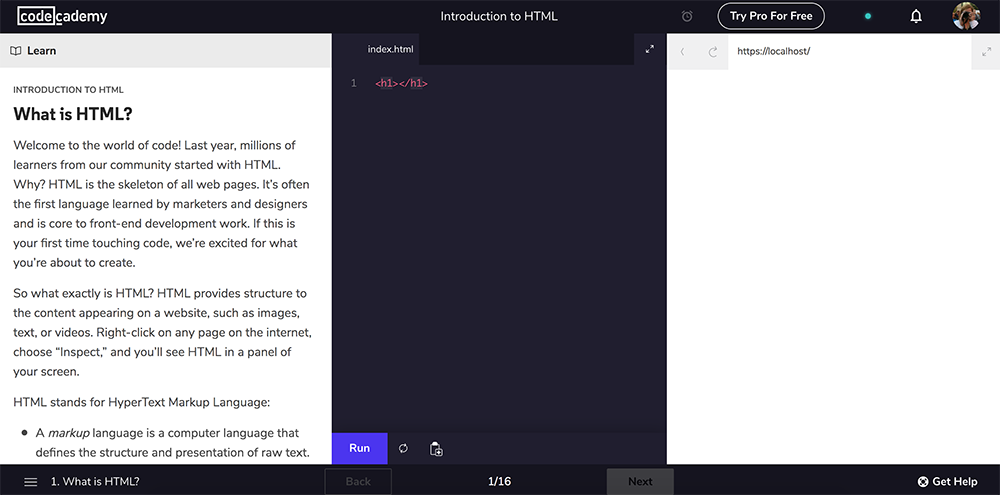
Introduction to HTML: This course reviews the most common HTML tags used to build web pages. There are also three “projects” to help you put what you learn to practice.
Learn CSS: This is another hands-on course that builds off of the HTML course with CSS rules. CSS allows you to stylize web pages with colors, typography, and more.
Codecademy Introduction to HTML Course
Facebook Blueprint Courses
We know that Facebook is the largest social media platform in the world, as well as a powerful tool used by marketers everywhere. Facebook offers free courses and certifications to help marketers and business owners learn how to run ads, retarget customers, and more.
Guide to Creating Facebook Ads from Your Page: This course is perfect for someone that has never used Facebook Ads before. It walks through the entire process, step-by-step.
How to Advertise on Instagram: Instagram, which is owned by Facebook, is the social media platform known for its high engagement rates. If you’d like to learn how to run ads specifically for Instagram, this course is for you.

Facebook Blueprint Instagram Advertising Course
Most of these lessons are courses that I have either completed myself or that are on my “quarantine list”, but I’m always looking for more! If you have any suggestions on free online courses or certifications that you would recommend, drop a comment below.

Adapting Your Marketing and Communication Strategies in Light of COVID-19
This is a scary and uncertain time for small businesses, but the COVID-19 outbreak doesn’t mean you should pause all communication with your customers. You can continue to serve them while supporting yourself and your brand’s reputation. Here are some examples of how some of my favorite local businesses are weathering the storm and adapting.
COVID-19 has already had a major impact on our country’s economy, and it’s likely that small businesses will need to weather this storm for the next few months as we get through this.
With the CDC encouraging consumers to stay home and avoid big groups of people, we’ve seen many small businesses elect to close their brick-and-mortar storefronts for the safety of their staff and customers.
That doesn’t mean that you should stop communicating and serving your audience. Not only is the current situation the perfect time to serve your community, it’s also a great time to review your current tactics and see how you can adapt.
Take a moment to read some tips on how to best adjust your marketing messaging during the coronavirus pandemic. I’ve also included some creative strategies from some of my favorite local brands as examples. Feel free to use some of these tips to implement creative tactics of your own!
Listen to your customer base.
I know that I’m not the only consumer who has received tone-deaf emails from credit card companies or banks in the last week. They sound something to the tune of “We want to let you know that we are dedicated to supporting you during this difficult time. You can pay your bills online!”
What these brands are failing to do is really listen to the concerns of their customer base, think of what their expertise is, and find ways to serve them during this time of uncertainty and confusion.
I’m not saying that you should be giving away all the free things if it would significantly impact your cash flow for the coming months. Your brand can serve your customers and community members by curing something as simple as boredom. Brick Road Pizza Co., a restaurant here in Grand Rapids, Michigan, has begun offering make-your-own pizza kits for pickup in their location. These kits are a great way for families to pass the time and bond with each other while quarantined at home.

Other local pizzerias like Lombardo’s Pizzeria and Vitale’s Hudsonville offer pizza kits as well. I have also seen bakeries offering cookie and cupcake decorating kits that play off of the same idea.
Be helpful, not greedy.
The COVID-19 situation is very serious, but once all of this has passed, people will remember which brands aimed to serve and which brands used fear-mongering tactics to squeeze more money out of people.
Your marketing efforts right now need to be focused on helping your community make the best of the current situation. If you’re a business that typically relies on in-person visits, think about ways you can use technology to continue offering those services, especially if they can be helpful to people right now.
Funky Buddha Yoga Hothouse, one of my favorite hot yoga studios in the area, has been offering free live classes on their Facebook page. This is an awesome way to continue serving their current customers and give a taste of what they offer to non-customers as well.

Another awesome yoga studio offering free live videos of their classes is AM Yoga, who is incorporating positive messaging in their recent social media posts as well.
Go virtual.
Small businesses that sell goods are quickly adjusting their strategies to focus more on their web stores. While many states have discouraged retail shops from staying open, it’s still perfectly safe to order goods online to ship to your house.
Dime & Regal, my favorite local handmade goods store, thought of a creative way to encourage their customers to buy online by holding a daily (virtual) scavenger hunt. They post a clue of a particular product on their website, and visitors that guess the product correctly receive a prize.

One thing that makes this tactic so ingenious is that it not only drives more traffic to their online store, but is a great way for the brand to engage with its customers and break up the monotony of being cooped up inside.
Stay positive.
Again, attempts to ensue panic in your customer base will not end well for the reputation of your brand. Positive, helpful messaging will land well with your audience, even if you sprinkle in a bit of (tasteful) humor.
Bit Baking Co., a local vegan bakery, started offering vegan “Quarantine Survival Kits” with free shipping to those that ordered on their website. Here, they’re playing off of families that are feeling a little “stir-crazy” while staying at home with the kids.

One important thing brands need to be aware of is that many people are scared for their health and that of their loved ones right now. Jokes about the severity of this virus would be seen as tactless, so make sure that any jokes you incorporate in your messaging are in good taste. Just use your best judgement.
If you’re not sure how to adjust your marketing messaging at this time, I’m happy to help. Sign up for a free 30-minute consultation below!

Top 7 Biggest Myths About Social Media Marketing
There are a ton of misconceptions about social media marketing best practices, and what generates the best results. I’m here to debunk some of these myths, as well give you some tips to help you get the most out of your small business’s social media marketing strategy.

It’s 2020, and by now we know that social media isn’t just a fad, but something that is ingrained in the lives of nearly every single person on the planet that has internet access. As a small business, social media can be used to get in front of a new audience and connect with them on a deeper level. Here are some common misconceptions about social media marketing for small businesses, along with some tips to make your social media efforts go even farther.
Myth #1: Your business needs an active presence on every platform.
In the real world, you can’t be everywhere at once, and the same applies to social media. It’s much better to have a strong presence on 2 or 3 platforms where you’re fully engaged rather than 7 or 8 platforms, most of which are not supporting any customers or potential customers that are reaching out to your brand. Decide which platforms are most popular amongst your target audience (here is a post to help you), and work on having a strong, consistent presence on those networks first.
Myth #2: You need to post something every single day.
Notice the word I just used: “consistent”. The secret to social media success doesn’t rely on posting the most often, but the most consistently. Consistency is what creates an audience of captive followers, because over time, they will find that they can rely on you to share something valuable to their feeds.
If your business is just starting out, don’t sweat it. Even one post per week is an improvement from zero. Start there and work up to posting more often as you feel more comfortable with hitting that goal.
Myth #3: You need to use as many hashtags as possible.
Hashtags are a great way to get your posts in front of more people, but sometimes, less is more. Stuffing your posts with tons of hashtags that aren’t all related to the content of your post could end in spam reports of your content, and ultimately, less trust in your brand. Additionally, some platforms like LinkedIn might mark your post as spam right off the bat if you use more than five hashtags in a single post.

A good rule of thumb is to focus on the relevancy in your hashtags. If you were searching for posts with the hashtag #AffordableWeddings, you would want to see content that gives tips and examples on how to save money when planning a wedding, not price lists from drone companies.
Myth #4: You need a call to action in every single post.
Ask yourself this: when YOU are on social media, what are you looking for? More times than not, the answer is interaction and entertainment. Social media users are looking to be entertained, not to be told to buy something. Even so, you can be strategic about the posts from you and your brand on each of the different platforms.
Even if you’re not linking to your website, talking about your products or services, or asking people to give you a call or email, you can create value for your target audience that will (over time) equate to revenue. Share some insights or information that will appeal to them and that aim to create trust. Interact with them by asking questions. Take some time to actively listen to what their daily struggles are. This helps build the strongest business-customer relationships.
Myth #5: You can’t really measure the success of your social media efforts.

Photo by Georgia de Lotz on Unsplash
There are a ton of metrics and KPIs that you can track to help you build a better social media strategy for your small business. Here are just a few of them:
Engagement (likes, shares, comments)
Reach
URL clicks & referrals to your website
Video views
Conversions
You’ll want to track a combination of these metrics for posts on each of your accounts. There might be additional metrics that are unique to your marketing goals, such as mentions of your company in forums that relate to your industry.
As you grow your business, it might be worth investing in additional software, like HubSpot, that will help you track your customers’ acquisition and behavior on your website much more closely.
Myth #6: Posts from your company page will always be the most successful.
This myth may be surprising until you think about it this way: it’s easier for people to connect with other people rather than a faceless business. We see a great example of this on LinkedIn, where individual profiles outshine company pages in terms of both reach and engagement. This is also why 80% of marketers say that they find influencer marketing to be an effective strategy. People listen to people because people like people.
As a small business owner, think of yourself as the “face” of your brand. Switch up some of your social media tactics by sharing content from your individual account, as well as by commenting on other pages and posts relating to your industry.
Myth #7: B2B companies won’t see any success from social media marketing.
Like I said at the beginning of this article: it’s 2020. Your target audience is most likely spending some time on social media, and it’s your job to find them, connect with them, and create enough value to convert them to customers. If you’re a B2B company, there are likely groups or forums on social media where people in your industry connect and share ideas with each other.
It’s still important to have a profile for your company on these networks, but think about having an active presence as an individual as well. Remember what we’ve already talked about: people like people. It will be easier for other business owners to take advantage of your products or services when they see value in what you bring to the conversation as well.

Social media marketing really isn’t a one-size-fits-all solution. Every business will have different goals and strategies for success. One thing that applies for any business, however, is that when you shift your focus to having a presence on social media that is relevant, consistent, and valuable, it will be easier to see a return on the time and money that you invest in social media marketing.

Four Reasons Your Small Business Needs to Start a Blog Tomorrow
According to Quoracreative, more than 3/4 of online users read blogs consistently. Starting a blog is an easy and effective way to attract more visitors to your website, connect with your customer base more closely, and create trust in your brand. You can totally start a blog tomorrow by keeping some important goals and statistics in mind.
Photo by Corinne Kutz on Unsplash
Your next marketing move should be starting a blog.
I know what you’re thinking, but hear me out. According to Quoracreative, more than 3/4 of online users read blogs consistently. People read blog articles to learn more information or gain new insights on things that interest them. You may be wondering what kind of information your business could provide in a blog, and how this could possibly lead to more customers and more revenue.
The simple answer is that the customers will come pouring in when you write to provide value to them. Here are some reasons that 55% of marketers say blogging is their top inbound marketing priority.
It boosts your marketing ROI.
A blog is a great way to increase your return on investment, mostly because it’s low-cost and super easy to get started. According to a 2018 report by Hubspot, businesses who prioritize blogging efforts are 13x more likely to see positive ROI in their marketing efforts.
If you’re in an industry that has a target audience that is hungry for information, and your competitors don’t currently have blogs, you’re in a great spot to get started! Don’t freak out about your writing ability either, there are free tools, like the spelling and grammar check in Google Docs, that will help you improve your skills as a blogger.
It gives your business more credibility.
People that need your business’s products or services are looking for a solution to a problem. Help them realize how you can be their solution by sharing your knowledge and experience within your industry. What is something they don’t know that you can provide insight on?
After learning more about the inbound marketing approach to attracting more customers at a fraction of the cost of traditional marketing tactics, we know that once you identify what issues your customers face on a daily basis, you learn more about how to attract them, convert them, and delight them.

It can be your strongest lead magnet.
Oozlemedia reports that companies with updated and optimized blogs tend to get 67% more leads than those who don’t. Make sure you’re writing your blog posts with a simple goal in mind: you want your reader to take a particular action by the time they’re done reading your post.
To do this, make sure to include a call-to-action (CTA) in every single blog that you write. Your CTAs should be related to the content of your blog and provide even more value to the reader.
You can see an example of a call-to-action a few paragraphs above. I mentioned a previous blog post of mine that can provide more information on inbound marketing in the last section, so I linked to the blog post once again just below that paragraph. That way, it will still catch the attention of anyone that is simply skimming my blog post.
Other examples are free content offers within your posts that your readers can use to help solve their problem. I use these in my blogs too, with a brief form asking for my readers to fill out so that I can track downloads.
To implement a strong CTA, simply brainstorm what other questions your visitors might have while reading your blog. Then, create an action associated with helping them answer that question.

It’s great for search engine optimization (SEO).
When your ideal customers search for solutions to their problems, you want to make sure they land on your website. Search engine optimization (SEO) is a marketing strategy in which you optimize your web pages to rank first organically on search engine results pages (SERPs).
By creating a blog, you’re increasing the number of pages on your website, boosting your site’s authority in search engine algorithms. Additionally, businesses with blogs receive up to 97% more links to their website, or backlinks, which are also an important factor in ranking on SERPs.
Although you may not be ready to start your blog tomorrow, consider these blogging statistics when building your small business’s marketing strategy for 2020.
Hi! I’m Jennie.
Thank you for visiting my blog! I write about marketing tips for small businesses and how to succeed as a female professional. I write from experience about the things that I love.