
Have you ever been on the fence about trying a new local business, only to see your neighbors in your Facebook neighborhood group absolutely raving about it? That is social proof doing its job. A flood of “you HAVE to try this place” comments from people in your own community is often all it takes to get you through the door.
And honestly, it works on me all the time.
So, What is Social Proof?
The term was first coined by Robert Cialdini in his 1984 book Influence: The Psychology of Persuasion. The basic idea is simple: people look at what others are doing, and doing, and use that as a signal for how they should act. When we see other people vouching for something, we are more likely to trust it.
This is especially true when the people doing the vouching are people we already trust, like our neighbors, our friends, or someone we follow online.
Why Social Proof Matters More Than Ever Right Now
Here is the thing about marketing in this day and age: AI can write a polished product description. It can generate a legitimate-sounding, five-star review. It can produce a sleek website with glowing copy from scratch. Consumers know this, and it is making them more skeptical, not less.
That is exactly why authentic social proof has become one of the most powerful marketing tools available to small businesses. A genuine testimonial from a real client, a case study that shows actual results over time, a review from someone in your community… those things cannot be faked as easily. They signal to potential customers that real humans have had real experiences with your business and came away happy enough to say something about it.
According to a report by Chatter Matters, 83% of consumers say that a recommendation from a friend or family member would make them more likely to purchase a product or service. That number has not gone anywhere. If anything, it hits harder now.
How to Build Social Proof for Your Small Business
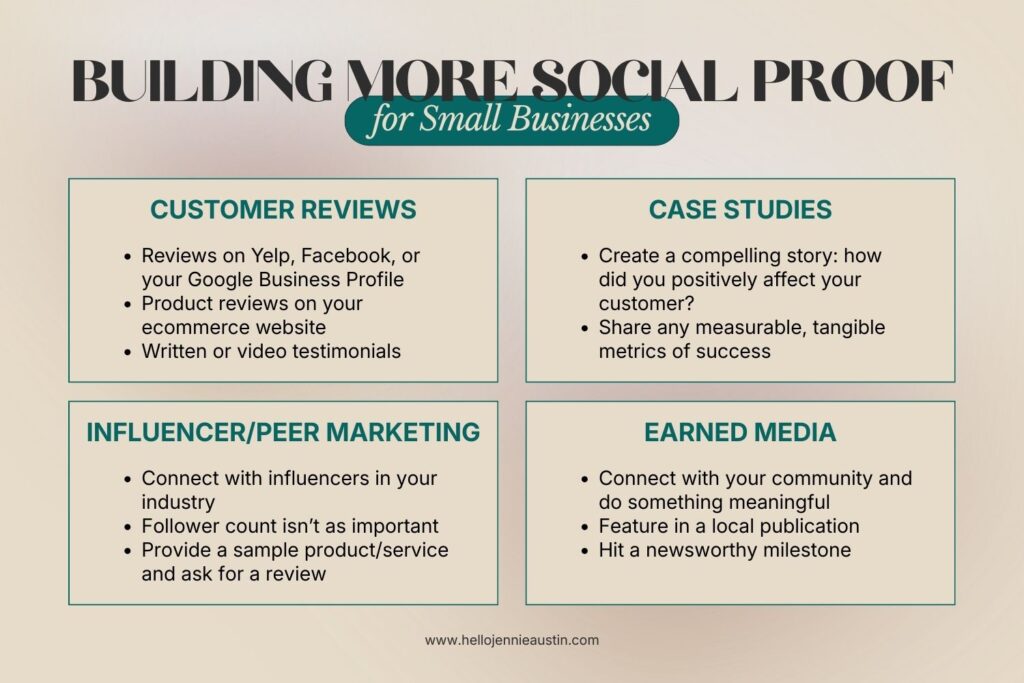
Here are four strategies to invest in, along with some practical ways to actually put them to work.
1. Customer Reviews
Positive reviews from past customers do a lot of heavy lifting for you. When someone is on the fence, seeing that other people have had great experiences is often the nudge they need.
Start by simply asking. If you know a client had a great experience, follow up and ask them to leave a review on Google, Yelp, or Facebook. Most happy customers are glad to help, especially if you frame it around supporting a small business (because it’s true).
Beyond review platforms, think about how you can bring reviews onto your own website. If you sell products, let customers leave reviews at the product level. If you are service-based, ask for testimonials you can feature on your site, in social media content, or in video form. A short video testimonial is especially compelling because it is harder to fake and more personal than text alone.
2. Case Studies
If you work with clients over time and can show real, measurable results, a case study is one of the most powerful pieces of content you can create. This is especially true in a world where AI can generate surface-level content at scale but cannot replicate a documented track record.
A good case study doesn’t have to be long. It just needs to tell the story: here is who the client was, here is what we worked on together, here is what changed. Before-and-after data, screenshots, timelines, those details make it credible in a way that no amount of polished copy can match.
3. Influencer and Peer Marketing
This one does not require a massive budget or a celebrity partnership. Micro-influencers, meaning people with smaller but highly engaged followings in a specific niche, can be incredibly effective. Think about who your target customers already follow and trust.
You could send them your product to try, offer a complimentary service experience, or ask if they would be interested in a social media takeover, where they post to your account for a day and bring their audience along with them. The key is authenticity. Their followers can tell when a recommendation is genuine.
4. Earned Media
Earned media is any coverage or content about your business that you did not pay for or create yourself. Think a feature in a local publication, a mention in a roundup, or a segment on a local news station.
Landing earned media usually means doing something worth talking about. Stay active in your community, take on interesting projects, support a local cause, or hit a notable milestone. When you consistently show up and make moves, you become the kind of story that local media actually wants to cover.
The Bottom Line
Social proof has always mattered in marketing. But right now, as AI makes it easier than ever to generate polished content that looks real, the things that actually are real carry more weight than ever. Genuine reviews, honest testimonials, documented results, and peer recommendations are what set your business apart.
Start with one strategy and build from there. Your future customers are already looking for a reason to trust you. Give them one.
Good ideas are just the beginning.
Let's make something real out of them together.
