

Blog
![[Free Template] How Your Small Business Can Implement Email Drip Campaigns](https://images.squarespace-cdn.com/content/v1/523cf6c4e4b0f6b279e835d3/1588272094110-HQ12VJTFVQ0LHHEUMX3I/free-small-business-drip-campaign-template.jpg)
[Free Template] How Your Small Business Can Implement Email Drip Campaigns
If you’re looking for a way to use email to build stronger customer relationships and drive up to 24x more revenue for your small business, you should consider implementing email drip campaigns. These powerful, automated campaigns can be used to onboard new customers or re-engage with previous customers. I have also included a free drip campaign template for customer re-engagement.

Photo by Georgia de Lotz on Unsplash
When someone gives you their email address, are you adding them to your general newsletter list, or putting them into a campaign based on their relationship with your brand? How are you converting them into loyal customers?
If you’re not sure, or are just adding them to your general email list, keep reading. We’ll introduce one way to further solidify your brand’s relationship with that customer or potential customer, also known as a prospect.
We’ve already discussed some best practices on building, segmenting, and nurturing your small business’ email lists. One way to nurture your prospects is to implement an email drip campaign.
What is a drip campaign?
A drip campaign is a timed series of automated emails sent to a prospective customer that are designed to convert them into customers. Think of it like slowly “dripping” information to them to gradually warm the lead up to your brand by creating trust. Rather than being salesy or assumptive right off the bat, they are designed to inform, educate, and bring value.
If the thought of “automated emails” sounds out of your budget, consider this: automated trigger emails have the potential to drive 24x more revenue than “batch and blast” emails, according to BounceX. This is because these emails are more tailored to the experience of that particular customer.
You should consider a drip campaign for your small business if you want to get the most out of your email marketing strategy. When done right, these types of campaigns are an easy way to boost email engagement, website traffic, and, ultimately, sales.
If you don’t currently use an email platform with automated capability, do some research on pricing. Platforms like Mailchimp, HubSpot, and Drip are affordable options with this capability. If you still feel these are out of budget, you can do a manual drip campaign by keeping track of who is getting the emails you’re sending and when.


How do I implement a drip campaign?
Here are the questions you should answer to create your first drip campaign.
1. What is the goal? Are you trying to promote a new product, service, or event? Do you want to re-engage with previous customers? Do you want to win over new customers? As always, make sure this goal is specific, measurable, and attainable.
2. How will you get the emails? A better question is: what will you give your prospects in return for their email address? This could be from a free content offer on your website, a giveaway on your social media, or from a sign-up sheet at an event. You can also develop a drip campaign that is designed to turn your blog subscribers into customers.
3. How many emails will you send, and how often? You don’t want to send each email too often, as that can come off as spammy. A good place to start is to send an email once a week. You will also need to decide how many emails are in your drip campaign. This number might become more clear once you write the content, but shoot for a number between 4 and 10 to start.
4. What will your emails say? Keeping in mind that your goal is to develop a relationship with the prospect, write your emails as if they were coming directly from you (or one of your salespeople). Scroll to the bottom of this post for a free template to get some ideas. Also, make sure every email you write has a call-to-action that you’d like the recipient to do so that you can answer...
5. How will you remove people from the campaign? One reason you want a call-to-action in every email is so you can understand which recipients you have won over. These people should be removed from your drip campaign once this has been determined. That way, you’re not continuing to send them emails asking them to take an action that they’ve already taken, such as testing out your new product.
Free Template: Sample Customer Re-Engagement Campaign
Here is a sample re-engagement drip campaign that you can repurpose for your small business! Check out the diagram below to see the workflow of this email series.

Email #1: Warm Introduction
Subject: Thank you again for your support!
Hi [Previous Customer],
I just wanted to take the time to reintroduce myself. My name is Maria and I am the owner of Maria’s Events & Gifts.
I wanted to thank you for shopping with us this past [month]. As a small business, each and every purchase helps us to continue supporting and thriving in the [city/town] community.
I hope you continue to think of Maria’s Events & Gifts for your event needs. And with Mother’s Day quickly approaching, we just added some very unique and creative gifts to both our retail and online stores.
Please feel free to give us a call at [phone number], or visit our website at [website] to view our newest gifts and supplies.
Take care!
Maria
Email #2: Cool Resource
Subject: Here’s a little something extra for you!

Photo by John Schnobrich on Unsplash
Hi [Previous Customer],
I hope you’re doing well and enjoying the spring weather!
Since my last email, we added a new post to our blog that I think you might find helpful in your gift search. We’ve listed the top 10 most unique gifts this spring, and they’re great for the whole family!
My personal favorite is this new board game called “The Chameleon”. My friends and I had a blast playing it the other night.
Anyway, I hope you have a fabulous weekend. As always, please give us a call at [phone number], or check out our other blog posts and products on our website!
Best wishes,
Maria
Email #3: Case Study / Testimonial
Subject: Don’t just take it from me...
Hey there [Previous Customer],
Do you have any big events planned for this summer? I’m sure you’ve made the connection, but Maria’s Events & Gifts offers affordable event planning services too!
I started Maria’s Events & Gifts in 2014, with the mission to provide our community with affordable event planning services so that they could focus on the most important part: spending quality time with their family and friends. Event planning is my passion, and I would love to share what I’ve learned with you!
I could go on and on about what we can offer, but I thought you might want to hear from one of our previous customers. Here is a little testimonial from our dear customer Rhonda:
“I wanted to plan a fabulous retirement party for my mother, but I was on a tight budget. I was so glad to have found Maria at Maria’s Events & Gifts! What I loved was that Maria was just as dedicated to staying under budget as I was, but she had some amazing ideas to make my mom’s party an absolute bash!”
If you’re planning an event, please give us a call at [phone number], or fill out the contact form on our website at [website]. Let’s make it an event to remember!
All the best,
Maria
Email #4: Special Offer
Subject: A gift just for you!
Hi [Previous Customer]!
I hope you have been enjoying the emails I’ve been sending over the past few weeks!
As a thank you for your time, I’m giving you a special offer: 30% off any regular-priced gift in our store. You can use this on our website by entering the code, or come visit us in the store and show us this email to redeem your offer.
Code: THX30
Whether you have an event to plan or attend, I hope you keep Maria’s Events & Gifts in mind for your supplies, planning, and gifts.
Please always feel free to reach out to us at [phone number].
Thanks again, and have a great weekend!
Maria

Five Marketing Strategies to Help You Reach and Engage with Your Gen Z Audience
Generation Z, currently defined as those born in 1997 or later, is quickly becoming the most financially influential generation ever. If your small business is looking for more ways to reach this type of audience, it’s important to first understand exactly what makes this age group so unique, and how to best resonate with them.

Photo by Laura Chouette on Unsplash
Generation Z, defined by Statistica as those born in 1997 or later, is the largest generation in the US, making up over 90 million of the population. This group is on track to become the most financially influential generation ever.
Gen Z already has an estimated purchasing power of $44 billion per year, which means now is the time for small businesses to adjust to this group’s behaviors and values in their marketing strategies.
However, it’s important to understand what makes Gen Z-ers unique. As the first generation that was born into this digital age, Gen Z is excellent at shutting out the more traditional, disruptive advertisements that offer them no value or personalized experience.
In general, this group of consumers seem to be much more responsive to:
Genuine reviews from experts or influencers
Personalized ads and experiences
New, interesting, and up-to-date content
Corporate social responsibility
Connectedness (both in-person and digitally)
With this in mind, here are some strategies that your small business can utilize to help you reach a Gen Z audience.
Influencer Marketing
According to a report by Morning Consult, nearly 75% of Gen Z-ers follow at least one influencer on social media. An influencer is loosely defined as anyone with a large following that can, obviously, influence the decisions of that following.
Have you ever seen a YouTube makeup artist do a special unboxing or demo video of a package of product sent to them by a major brand? What about an Instagram post spotlighting a product with the hashtag “#ad” in the caption? These are examples of influencer marketing.
As a small business, you might think that influencer marketing is way out of your budget; this simply isn’t true. You can identify micro-influencers who have a smaller following of people more related to your industry or product to create ads that are much more organic and appealing to your Gen Z audience, who appreciate more personalized and genuine content anyway.

Personalized Communication
Speaking of personalization, this is something to keep in mind when creating content for Gen Z consumers. According to Mobile Marketer, Gen Z prefers to see online ads and communication based on their browsing history.
This might open up the idea of remarketing through Google Ads or another platform, but remember that this generation has been looking at online ads almost their entire life already and have gotten really good at ignoring them.
To cater to Gen Z’s personalization preference, use it as much as possible in email marketing and other communications. Rather than send a newsletter with a list of new products, send a coupon code for a recently viewed item, or spotlight an item related to one that was already purchased.
Video Marketing
What do YouTube, Instagram, and TikTok all have in common? They’re not only three of the most popular social media platforms for Gen Z users, they are primarily video-sharing platforms. Video is a great way to not only grab the attention of your Gen Z audience, but also quickly and effectively communicate with them before they move on to the next thing.
Your small business doesn’t need expensive equipment to start creating video content, either. Even a video shot on a smartphone can get your message across—just make sure you have some sort of tripod or stand to hold it in place.
Create videos that explain your product or service, show customer testimonials, or that simply tell a great story. Don’t be shy—get in front of the camera and tell people how your business can help them.

Photo by Louis Hansel @shotsoflouis on Unsplash
Social Responsibility
Experts report that corporate social responsibility (CSR) is huge for both Millennials and Gen Z. As Sarah Cavill writes for Digital Media Solutions:
Gen Z, in particular, looks at the world with a side-eye stemming from having grown up amid recessions, fractured politics and often unexpected job transitions for their Gen X parents, leading to decreased trust in businesses.
If you’re looking for more ways to appeal to potential Gen Z customers, consider implementing a CSR program for your small business that aligns with your vision. Choose a cause that you or your staff are passionate about, and find ways to contribute and/or bring awareness to that cause that incorporates your mission, products, customers, and employees.
Still not sure where to start? Your cause could be as simple as sourcing your materials or supplies from other local or sustainable businesses. What are other changes you can make to your business model that support this cause? Are there any hands-on opportunities to volunteer with your staff? Is there a way to donate a portion of your sales to this cause?
Once you have that sorted out, make sure to communicate this with your customer base in a variety of ways. Make it clear to all potential customers—not just the Gen Z-ers— that by supporting your business, they are also supporting this cause.
Social Media Marketing
Unsurprisingly, out of all the other generations, Gen Z spends the most time on social media—two hours and 55 minutes each day, on average. This makes social media a great way to reach this age group. However, keep in mind that they’re not logging on to social media with the intention to connect with brands, but to connect with friends, peers, or just for entertainment. This means that your small business’ approach on social media should be less purchase-driven and more focused on one or more of the previously mentioned strategies.
If we know anything about Generation Z, it’s that they can see right past the forced, synthetic messaging that comes with traditional marketing tactics. As children of the digital age, they have the ability to ignore so many types of advertising. One thing to keep in mind when marketing to this very influential age group is to be as genuine, personable, and non-disruptive as possible.
![[Infographic] Four Marketing Metrics to Track During (and After) a Global Crisis](https://images.squarespace-cdn.com/content/v1/523cf6c4e4b0f6b279e835d3/1587670534696-EE2UH458S0T132UBALVI/engagement-metrics.jpg)
[Infographic] Four Marketing Metrics to Track During (and After) a Global Crisis
COVID-19 isn’t just a global pandemic; it is an economic crisis for small businesses. As we work to flatten the curve of cases in the US, so begins the transition to our “new normal”. If you’re a small business, here are four marketing metrics that I would recommend you start monitoring now in order to help you understand where your marketing budget should be.

The coronavirus pandemic has changed the way many small businesses have had to operate over the last month or so. Although there is discussion of some local governments lifting stay-at-home orders soon in order to improve their economies, we will be seeing the effects of this crisis for quite some time.
This “new normal” will be much different from the way things were before. Many small businesses will feel the need to cut back on costs, and may look to marketing costs firsts. As a marketer, this breaks my heart, because as my favorite quote by Henry Ford says:
Stopping your advertising to save money is like stopping your watch to save time.
Nonetheless, your marketing budget will need to change. Here are some metrics that you should start tracking now to help you understand how to evolve your marketing budget in this “new normal”.
Change in Customer Lifetime Value
Customer lifetime value (CLV) is the total amount of money that a customer is expected to spend with your business during their lifetime. CLV can be calculated in different ways based on the type of small business you own, but the basic formula is:
[average value of a purchase] X [number of purchases from a customer per year] X [length of customer relationship in years]
If you have seen a drastic decrease in business from repeat customers, your CLV has probably decreased as well. For example, if you own a small coffee shop, and your regular customers have been coming in less frequently because they are working from home, the average amount of money they spent with you has gone down.
The specific metric you should identify here is the change in CLV that you have seen since the pandemic started affecting our country. This will help you determine how much money you should be spending to acquire new customers (which we will talk about in the next section).
To Track: Use sales numbers from before the year 2020 to see what your CLV was pre-COVID-19. Then calculate CLV using sales numbers from this year to compare the change. As local shelter-in-place mandates are lifted, it would be a good idea to contine tracking this metric as your local economy opens back up.
Change in Customer Acquisition Cost
Customer acquisition cost (CAC) is how much it costs your business to acquire a new customer. This is calculated by by adding up all of the marketing and sales costs associated with earning new customers (or converting existing customers into repeat customers) and dividing that number by the total number of customers won over from those efforts. Here is the formula written out more clearly:
[total amount spent on marketing and sales] / [number of customers won from those efforts]
Again, in the midst of this pandemic, we want to track the change in CAC. When you compare this number to the change in customer lifetime value, you will be able to effectively determine how much money (and time) you should be spending on your marketing efforts to attract new customers.
Going back to the coffee shop example, if your CLV has dropped from $250 to $150, you want to make sure that your CAC hasn’t increased to above that number. So if a $150 Google Ads campaign doesn’t bring you any customers, it’s time to reduce that budget, or look for other ways to spend that money that will be more effective—like SEO!
To Track: First, track all of the hours spent on marketing, as well as the costs associated with that time. Add it to any other marketing costs—think ads on Google or social media, email marketing platforms, etc.—and divide that number by how many customers were won over from those efforts. If you’re not sure, give your best guess based on conversations you or your staff has had with new customers.
Recalculate this number any time you calculate your CLV. These two metrics go hand-in-hand when it comes to developing your marketing budget.
Social Media Engagement
Predictions show that more people are spending time on social media while staying at home, which is why it’s so important to continue communicating with your customers on social.
With this in mind, make sure to keep an eye on your social media engagement. Social engagement is defined as shares, likes, and comments on your posts on social media. This is a great way to measure the success of your social media efforts, even if sales are down. The focus here should be on building and maintaining a relationship with your audience so that when they’re in a better position to buy, your brand will be at the top of their mind.
Nancy Kapoor writes for Social Media Today that interactive content as a digital marketing strategy will skyrocket this year. That’s because interactive content like 360-degree videos, quizzes, and polls are, by nature, a call-to-action. Interactive posts on social media can not only be shoppable, but shareable as well.

Photo by ROBIN WORRALL on Unsplash
To Track: Individually track engagement metrics on each platform that your small business is active on. Additionally, don’t forget about what your goals are for each platform. For example, if you are posting on Instagram to increase awareness from users between the ages of 25-34, don’t roll those engagement numbers in with those of your Facebook posts, where you might be trying to reach a different type of audience.
Stay agile. Find which type of posts are more successful and which ones have lower engagement rates.
Email Opens & Clicks
In March consumers saw a spike in emails sent from all kinds of brands making statements about how they were handling concerns about the pandemic. Most people found this to be kind of annoying.

Unsurprisingly, Salesloft reported that sales emails with “COVID-19” or “Coronavirus” in the subject line saw a 40% reduction in reply rates.
With this in mind, you may be thinking that email is a no-go right now. However, just like social media, email has the potential to help you create a much stronger relationship with your customer base (if you do it with the right intentions). Here are my three best recommendations:
Don’t try to incite fear.
Be positive, but...
...don’t be ignorant.
To Track: If you’re still sending marketing emails at this time, it’s important to keep a close eye on the open rates and click-through rates of your emails. If you’re seeing a significant drop in these metrics from before, you might want to think about changing up the content or just taking a break for a few weeks. Otherwise, you may see your unsubscribe rates shoot up, and those are contacts you may not be able to win over again.

As the economy starts to open back up in your area over the next few months and you adjust to your “new normal”, I hope you use these metrics to make re-budgeting less daunting and easier to understand on the marketing front.
If you’re a small business wondering where to go next, I’m happy to provide a free 30-minute consultation to talk about your goals and develop a plan of attack. Fill out the form below to sign up!

The SECOND Most Basic Introduction to Search Engine Optimization (SEO)
Search engine optimization (SEO) is one of the most complex and misunderstood topics in digital marketing. In this post, I outline six different tools you can use to improve your small business’ website ranking on search engine results pages. These tools range from free to paid plans and are categorized based on each pillar of SEO: content, authority, technical, and user experience.

Photo by Austin Distel on Unsplash
In my previous post we learned about why SEO can be such a powerful tool in attracting new website users, and how search engines rank listings on SERPs. Click here for a refresher.
I previously gave four basic tips that will help you improve your rankings on search engine results pages. I would like to continue this introduction with some tools you can use to implement these tips and jump-start your website’s SEO strategy.
Tools for Creating Content
The first step in developing your SEO strategy is finding keywords that you want to rank for (or that your website is already ranking highly for). You will then use a keyword planning tool to build a list of keywords that have the perfect balance of high search volume and low competition. Here are my favorite keyword research tools.
1. Google Keyword Planner: This is a free tool that is found in your Google Ads account. If you don’t currently have an Ads account, you can create one for free. Once you are logged in to the keyword planner, click on “Discover new keywords” to build a list of phrases that potential website visitors might type into Google.
Start by typing in some products or services that you offer, without being too specific or too broad. The planner will then show related words and phrases. Pick relevant keywords that have higher search volume but low competition. These will likely be long-tail keyword phrases that you can consider a “quick win” to rank for.

You’ll see some very broad keywords with a very high search volume AND high competition. These are known as “fat heads” in the SEO world because of how broad they are. Don’t rule these keywords out right away. You can work to win these over in your long-term plan. You might use these “fat heads” to think of other long-tail keywords that you can add to your short-term strategy.
2. SEMrush: This is another free SEO tool with a paid option to unlock more features. SEMrush’s Keyword Magic Tool takes it a step further than Google’s Keyword Planner with the information that it shares.
The Keyword Magic Tool not only shows a small graph of trends—if there has been a recent spike or drop in search volume—but it also shows the keyword difficulty as a percentage. Think of this as the equivalent of Google Keyword Planner’s “Competition” column. Look for keywords that have a keyword difficulty of 60% or less.
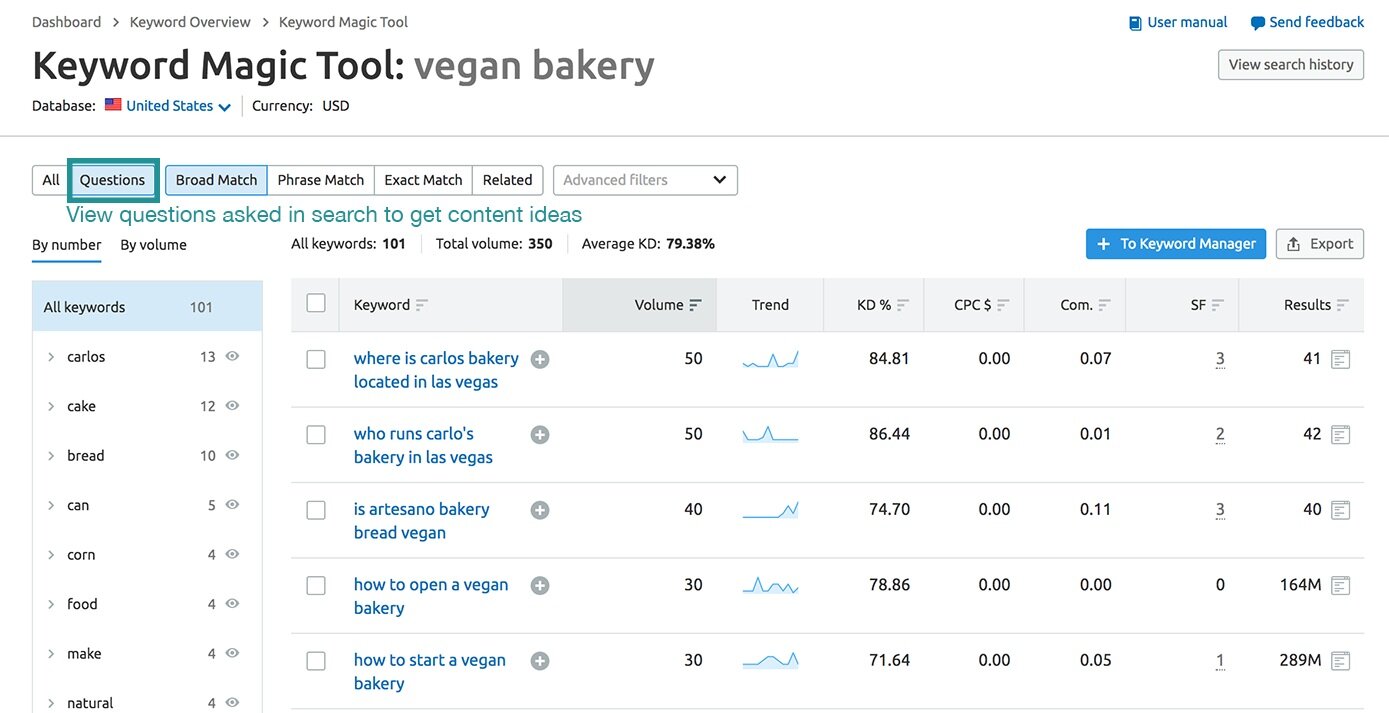
SEMrush has a ton of tools you can explore and use to help with your SEO efforts. One filter in the Keyword Magic Tool that might be useful for content ideas is the Questions filter on the left. Have you ever typed something into Google and had an answer box appear at the top of the results with a blurb pulled from a website? The reason that result is showing is because that website developed content that was designed specifically to answer your question.

Imagine if your website was the first to appear for the query “how to start a vegan bakery”. You can write a blog post that covers the steps you took to start your bakery, which not only gives you more opportunities to rank and gain more website traffic, but also tells a cool story to your customer base.
Tools for Building Authority
The second pillar of SEO is website authority. Your website’s authority is based on a number of factors, but one of these that you can easily improve is the number of backlinks to your site. These are instances where other websites link to your website, bringing you more traffic.
The best tool to use for building your website’s authority and gaining backlinks is a blogging platform for your new blog! People will want to link to your blog posts when you focus on sharing genuinely helpful content, especially if you use the feature in SEMrush listed above to find questions that your target audience is asking.
If you already have a website, chances are that you have the ability to add a blog to this website through your hosting service. If not, here are some blogging platforms that I would recommend.

Photo by Ilya Pavlov on Unsplash
Squarespace: This is the service that I use to host my website and blog. Squarespace is extremely easy to use but still provides you with the control to change the look and feel of your site. I love it because it’s affordable, but the layouts and templates available give a very polished look and feel.
Wordpress: Wordpress is the most popular blogging platform because it provides users with full control over all aspects of your website. There is a bit of a learning curve to use the software, so I wouldn’t recommend this platform to beginners. However, there are a ton of tutorials and forums for Wordpress users to help each other through issues and learn from each other.
Wix: Another easy-to-use platform, Wix is a drag-and-drop website builder that even offers a free plan (with Wix branding) if you’re on a tight budget. You can literally get a website and blog up and running in minutes using Wix.
Once you have a blog up and running, write some posts that will answer your customers’ questions. Unless your customers are seasoned journalists, editors, or English majors, don’t freak out about being a five-star copywriter just yet. As long as you’re truly creating value with your audience, they will love reading your blog! Then, reach out to other active bloggers in your industry to see if you can do a guest post on their blog. Make sure to insert a hyperlink to your website when you write your post for them.
Tools for the Technical Factors
We know that in order for search engines to show your website in search results, they need to have a catalog of all of your webpages. Indexing is when Google and other search engines crawl your website to do this. The easiest way to allow search engines to index your website is to submit a sitemap. This is a file that lists all of the content of your website, including landing pages, images, videos, and other files.If you use one of the website builders listed above, you should be able to look up how to submit your sitemap to search engines like Google and Bing. Here are the tools you will use to do this.
1. Google Search Console: This tool is extremely powerful in notifying you of any optimization errors on your website and how to fix them. Once you log in to your account, enter your website URL and click “Add Property”. You may be required to verify ownership of your website by placing a code in the header section of the website HTML. Again, check with your website platform for confirmation on how to do this. Once your website has been verified, submit your sitemap by entering your sitemap URL in the “Sitemap” section of the search console. This URL ends in “.xml”.

After a few days, Google will have your website indexed and ready to go. Visit the “Coverage” section on the left to check for any errors that would have caused your pages to not index.
2. Bing Webmaster Tools: Once your sitemap has been submitted to Google Search Console, it’s super easy to do the same for Bing. Visit Bing Webmaster Tools and simply connect it to your Google Search Console account. Done!
Tools to Track User Experience
We’ve already covered how to make your website more accessible to search engines’ crawlers. The last pillar of SEO is focused on user experience—making your website more accessible to humans. After all, a search engine’s number one goal is to provide results that humans will see the most value in.
Here is a valuable tool that will help you in the user experience realm of your SEO efforts.
1. Google Analytics: Aside from being able to provide valuable insights and demographics of your website visitors, Google Analytics can help you track certain metrics that can affect your SEO, such as:
Dwell time: Time a user spends viewing a page (In Google Analytics, this metric appears as “Session Duration”)
This should be as long as possible. A good average Session Duration is between 2-4 minutes.
Bounce rate: The percentage of users that enter your site then leave without visiting other pages
This should be as low as possible. A bounce rate between 26-40% is excellent.
Page load times: How long it takes for a page to fully load all images, videos, and other content
This should be as short as possible. Shoot for a page load time that is less than three seconds.
There are other websites that will test some of these metrics and go a bit more in depth. One example that I really like is GTmetrix, which tests the page load time of the URL you enter and provides recommendations on how to improve.
As you can see, there are a ton of tools out there that can help you with your SEO efforts. SEO is a huge concept, and I’ve only scratched the surface here. I’m excited to share more SEO tips for your small business in the next few months, so be sure to subscribe below!

THE Most Basic Introduction to Search Engine Optimization (SEO)
Search engine optimization (SEO) is one of the most complex and misunderstood topics in digital marketing. At its core, SEO aims to rank your website as one of the first organic search results on search engine results pages (SERPs). Search engines like Google are constantly updating their ranking algorithms, but there are things you can do NOW to help your website rank higher on SERPs.

Photo by Benjamin Dada on Unsplash
According to 99 Firms, nearly 93% of all web traffic comes through search engines. Search engine marketing has the potential to generate awareness of your brand among potential customers.
The two types of search engine marketing are paid search marketing (typically using Google Ads) and search engine optimization (SEO).
Interestingly enough, one statistic reported by SmallBizGenius states that 70-80% of internet searchers ignore paid search ads, making SEO a very powerful marketing tactic.
When done correctly, SEO has the potential to drastically increase your website traffic and, in turn, boost your conversion rates over time.
What is SEO?
If you’re a business owner that has never heard of the term “SEO” before, keep reading. If you’re a digital marketer, you may cringe at the mention of the term. It’s a subject that many marketers find difficult to fully understand.
At its core, SEO is the process of ranking your website to show first in the organic search results section of search engine results pages (SERPs). Scroll down to see an example SERP layout to see what I’m talking about.
In order to understand how to optimize your website for search engines, it’s important to first understand how results are ranked.
How do search engines rank results?
Simply put, search engines like Google or Bing aim to provide the best answer to search terms. Their main focus is user intent.
When you search for something in Google, the results page will look something like this:
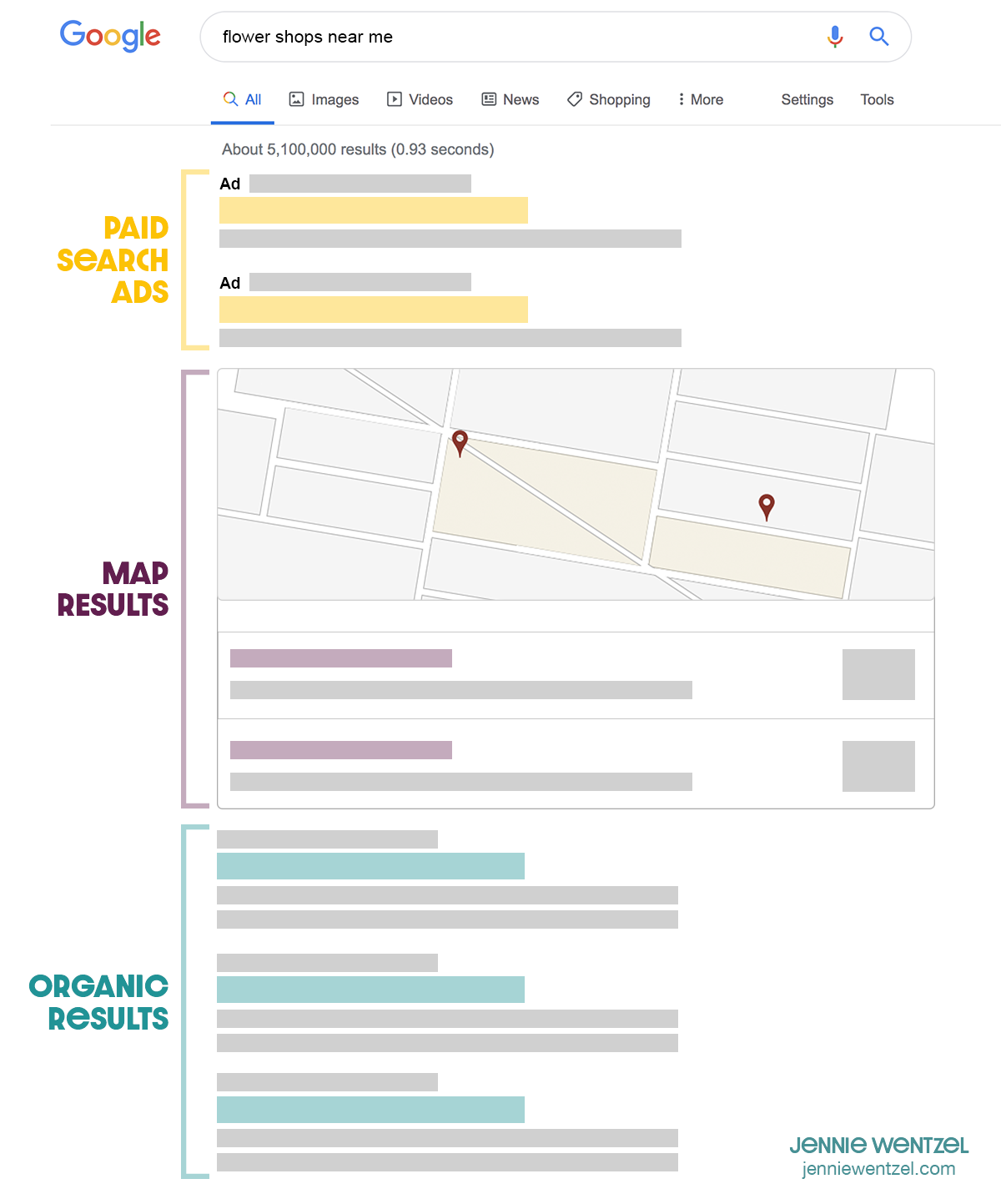
As you can see, there are paid advertisements that show up first. These ad spaces are purchased by companies that bid based on certain keywords. Right now, we’re more focused on the results that show after these spaces: organic results.
Search engines crawl websites for content and catalog the information to be used at a later time. Then, when a search query is entered, the search engine will display results and order them based on a number of factors. The list of these factors is very long and ever-changing, but they can really be summed up in four “pillars” of SEO, according to Leanne Wong:

Photo by Edho Pratama on Unsplash
Website / Page Content: When it comes to developing content for your website, the most important thing to remember is to create content based on user intent. This is more than just using keywords that you think potential customers will type into Google (which can help, but isn’t as important). Google will favor pages that it feels are most relevant and that answer the question that the searcher is asking. Additionally, it will use your website’s meta data, which are words and phrases found within the code of your website, to rank results.
Website Authority: Google ranks websites based on their authority. Authority is based on a number of things, but one way to boost it is through backlinks. A backlink is when another website links to yours organically. You can build backlinks by simply creating awesome content that people want to link to, or by doing a guest post on another blog and hyperlinking to your own website.
Technical Factors: This is where things get a bit more technical. There are a number of things you can do to ensure that Google can find your website in the first place. You need to make sure that Google can crawl your website by having a sitemap readily available. Also, make sure there aren’t any pages on your website that don’t have a link to them (these are called “orphaned pages”). Along the same vein, make sure your website contains no broken links, which are links that lead to pages that no longer exist.
User Experience: This pillar focuses more on making your website more appealing to humans, but is just as important. Things like page speed, bounce rates, and time spent on pages typically correlate with SEO performance.
If you’re feeling kind of lost on how to implement these recommendations, don’t sweat it! I have a great list of tools to help you improve your SEO here.

Hi! I’m Jennie.
Thank you for visiting my blog! I write about marketing tips for small businesses and how to succeed as a female professional. I write from experience about the things that I love.