

Blog
![[FREE Content Calendar] Building an Instagram Strategy for Your Small Business](https://images.squarespace-cdn.com/content/v1/523cf6c4e4b0f6b279e835d3/1590688007335-W9HW1GW8IDV7Y0JQYH6Y/instagram-business-strategy.jpg)
[FREE Content Calendar] Building an Instagram Strategy for Your Small Business
Out of all of the major social media platforms out there, Instagram boasts some of the highest engagement rates for business accounts. If your target customer base is between the ages of 18 and 35, it’s very likely that you can reach them through a brand presence on the app. Here are some of my best tips for building a strategy on Instagram for your small business, along with a free content calendar to get started!

Photo by Katka Pavlickova on Unsplash
With over 1 billion active users and the highest engagement rates in the realm of social media, Instagram has become a very powerful tool for brands big and small to connect with their audience.
Instagram reports that 90% of its users follow a brand account on the platform, which means that if your business caters to customers between the ages of 18-34, it’s a great idea to look into developing a presence on this platform.
In recent years, Instagram has introduced new features that give businesses more opportunities to engage with users and promote their products and services in new ways.
Features in Stories: Although this has been on the platform for some time, there are features within Instagram stories that can help you interact with your customer base in new ways, like polls, questions, and more. Brands with a larger following can also link directly to products or other webpages in their stories as well. You can also build your social proof by re-sharing stories from other accounts that tag your business page.

Here is an example of how to re-share stories that your page is tagged in.


Shoppable Posts: Another feature that brands can enjoy is the ability to upload links to products to create “shoppable posts”. This allows businesses to link to products in their posts that users can access by simply tapping the post. Users can even purchase the product and check out without leaving the app. This makes for a seamless shopping experience for your customers.
Video Posts on IGTV: Before the launch of IGTV, video posts on Instagram were limited to 60 seconds or less. Now, brands can upload longer-form videos to Instagram using this feature. These appear on the profile grid as a regular post where users can watch the beginning and tap to view the full video on IGTV if they want to watch the full segment.

Source: Facebook for Business
Setting Up an Account
To get your business set up on Instagram, you will first need to make sure you have an active Facebook Business page.
Download the Instagram app on your phone and create an account.
Next, you will need to convert this personal account to a business account. You can do this by tapping the menu icon in the top right corner, selecting “Settings”, “Account”, and “Switch to Business Account”.
You’ll then be asked to connect your Facebook page to your Instagram Business Account.
Then, you’ll just need to answer some questions about your business, like your contact info and what type of business you have. Click “Done”, and you’re ready to roll!
Once you have switched to a business account, make sure to customize your profile with your branding, a description, and your website!
Building Your Strategy
Now, it’s time to figure out your small business’ Instagram marketing strategy. First, here are some things to think about that will guide you in the right direction.
Audience: Go back to your target customer profile. What are their interests? What other types of accounts do they follow? What are those accounts doing on Instagram? This will help you better understand how to reach this target audience with engaging content that they will love.
Competition: Are your competitors on Instagram? Visit their profiles and see what kind of content they’re posting, and if it’s getting any engagement from your target customers. If not, look for other small businesses that have similar offerings but are outside of your market. Give them a follow and see what kind of success they might be seeing from the platform.
Hashtags: Using relevant hashtags in your posts will help your account become more discoverable by new audiences. Think of hashtags as search terms that your target customer might type in Google. For example, broad terms like #flowers will return millions of posts that users will need to sort through, but more specific phrases like #grandrapidsflorist or #uniqueweddingflowers will help you reach the people searching for your services or products. There are plenty of theories on hashtag usage, but my best advice is to make sure your hashtags are actually related to the content of your posts. Also, try to use 7 hashtags or less per post. Mix it up and see which ones lead to more followers (and ultimately, more customers).

Timing & Consistency: It’s a good idea to plan how often you will post, and when. Whether you decide to post twice a week or multiple times a day, it’s important to keep it consistent because of the way the feed works. For example, if you don’t post for a month and then decide to post multiple pictures in one day, your followers will suddenly see a bunch of posts from you in their feed, which doesn’t create a positive experience. This is how brands might lose followers. Additionally, make sure you choose the right time of day to post for maximum engagement. Recent studies show that the best times to post on Instagram are Wednesdays and Fridays at 11am. However, you will be able to view when your followers are most active on the platform by visiting your account’s Instagram Insights.
Engagement: In order to boost engagement on your small business’ account, it’s important to spend some time engaging with your followers or other related accounts with likes, comments, and replies to comments (especially comments on your own posts). This shows that there is a real human behind your brand, which people find a lot of value in (...more on that below).
If you’re new to Instagram marketing, understand that there will be some trial and error. Don’t feel like you need to have every single thing figured out before you start posting. After some time, you’ll soon find out what works best for your business.
Posting Great (and Authentic) Content
Once you have your initial goals and strategy nailed down, it’s time to start posting some awesome content! Here are my best tips and trends for small businesses.
Focus on the visuals, but don’t obsess over them. We know that Instagram is a very visual platform, but there has been a recent shift to more authenticity. Earlier this year, Instagram started hiding the number of “likes” on posts for some accounts and regions. One result of this is that people are starting to post more, and their posts are less edited and more organic. This is great news for small businesses, as it means that the days of obsessing over choosing the correct filter are over. Things like overly-filtered images or stock photos won’t perform well on the platform.

Look for micro-influencers or even nano-influencers to partner with. Influencer marketing is HUGE on Instagram, but it can also be expensive for small businesses. Look for micro-influencers (10-100k followers) and—a new term here—nano-influencers (less than 20k followers) that post content related to your industry that you could create a partnership with.
Partner with other local businesses. During times like this, it’s important for small businesses within your community to stick together and support each other. Look for other businesses in your area that you may not be in direct competition with, but that target the same audience as you, to do a giveaway or “Instagram takeover” with. This allows both of your businesses to introduce your followers to each other and promote your products or services to a new audience.
Again, be authentic. Another trend of brands looking to show more authenticity on the platform is writing longer captions. This gives you an opportunity to talk more about your small business’s story, share your mission, and connect with your followers on a deeper level. It will also have your followers spending more time viewing your posts, which helps boost your posts within the algorithm that Instagram uses.
There are hundreds of other things that you can share on your Instagram account—these are just a few ideas to inspire you.
If you’re looking for more inspiration for posts on Instagram, check out the example content calendar below with 30 days of Instagram posts ideas for small businesses.
![[FREE Worksheet] Four Things to Consider Before You Rebrand Your Small Business](https://images.squarespace-cdn.com/content/v1/523cf6c4e4b0f6b279e835d3/1589475277944-EGTWFUIU470JYRC5JRVE/brand-identity.jpg)
[FREE Worksheet] Four Things to Consider Before You Rebrand Your Small Business
If you decide to rebrand your small business, it’s important to remember that all successful rebranding campaigns are more than just a new look. Before you jump in, there are a few things you should ask yourself to get the most out of rebranding and make sure you’re set up for success. Take a look at my free worksheet for rebranding small businesses to get started on the right track!

When you think of your small business’ brand or identity, what do you think of? Do you think of your name and logo? Do you think of the sign in front of your storefront or office?
In truth, your “brand” is so much more than this! Think of your brand as the personality of your business. It’s about how you relate to your customers, and how they feel about your business. It’s about how you stand out from your competition. It’s even about how your employees feel about working for your business.
A rebranding campaign is (and should be) more than just a new logo, location, or name. Although all of these things may play a role in your rebrand, there are plenty of other things to acknowledge and plan if you think you’d like to give your company a bit of a “facelift”.
Start here: Why do you want to rebrand?
There are plenty of reasons why you might be thinking about rebranding. Here are some ways your small business might benefit from a rebrand:
You’ve been in business for a long time, but sales are more recently dwindling. This is an indication that your brand could use a refresh or—as I said before—a bit of a “facelift”. This is especially true if you first opened your doors over 5 or 6 years ago. Sales may be decreasing for a number of different reasons, but one thing that can grab the attention of your target audience again is a new look and feel.
Your business has evolved and you’d like your brand to match. Is your business offering something new or different than it was when you first opened? Maybe you’ve slowly made some changes to your customer-facing processes and feel that your current branding should catch up.
You’d like to better differentiate from your competition. If you notice more potential customers choosing your competitor(s) over your business, think about why. A rebrand may help you better stand out as a better option to those potential customers.
You’re making another massive change to your business. If you’re moving locations or introducing a new product or service, a rebrand can help you make an even bigger splash with that campaign.

You’d like to reach a new audience. If you’ve already captured the attention of a particular target audience and would like to expand, a rebrand can make your business more appealing to a new type of audience, like Gen Z.
Understanding your specific reason for a rebrand will help you create a campaign that makes the most sense for your business and goals.
What are your goals?
Any successful campaign starts with setting SMART goals, because otherwise, how would you know if it was successful? You may remember me talking about SMART goals in my previous post about building a product launch campaign. If not, here is a bit of a refresher.
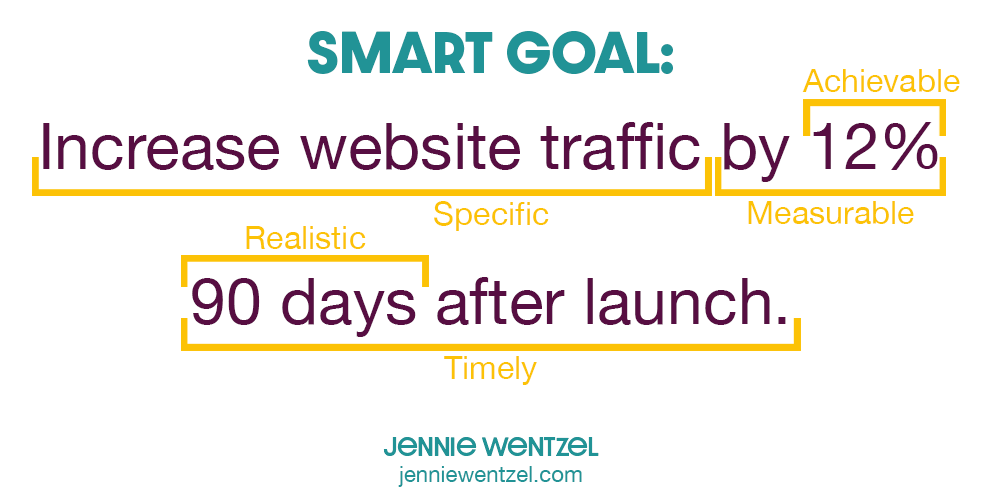
Remember why you chose to rebrand in the first place, and write down goals that are specific, measurable, achievable, realistic, and timely.
After the launch of your rebranding campaign, track the success based on these goals that you’ve written down.
How will this rebrand tie in with your mission statement?
Keep your rebranding true to your original mission and values. How will this help you accomplish the vision you had in mind when you first started on this adventure?
Moreover, if you think that your original mission has changed, make sure to identify and communicate your new mission statement to both your customers and employees.
Having a clearly communicated mission statement helps boost employee engagement. According to a report by Deloitte, 73% of employees that work at a “purpose-driven” company are engaged, compared to only 23% of employees that don’t work at a company with a clear purpose and mission.
A more engaged workforce leads to more productivity and ultimately, better customer service. It’s a win-win for everyone!

Photo by Patrik Michalicka on Unsplash
Why should your customers care?
Speaking of your customers, how will you get them bought into this rebrand? Are there other changes that will improve their experience that you can launch with your campaign? How can a new brand identity help make their lives easier? After all, the goal here should be to convert more sales and maybe even make your customers so pleased that they turn into vocal advocates for your business!
Here are some ideas to get your customers excited for your new brand identity:
Launch a new, more streamlined website that your customers can use to buy your products or book your services.
Introduce a new program that can help them save money, such as a rewards program, referral program, or a recycling program.
Start using supplies or processes that are more environmentally friendly—think recycled packaging or a “go paperless” option for statements and invoices.
Boost engagement and hype on social media by hosting a giveaway or contest related to your upcoming launch.
Remember, your rebrand is more than just a new look and feel; it should be something that truly improves the customer experience, drives employee engagement, and helps you achieve your vision for your small business.
Now that you’ve put some thought into these things, it’s time to plan and launch your rebranding campaign! I have found it’s best to collaborate with your teammates on projects like this because not only does it help them feel more bought in, you can get some great ideas and new perspectives on the direction to head in.
Take a look at my free rebranding worksheet that will help you get started on the right track.
![[Free Template] How Your Small Business Can Implement Email Drip Campaigns](https://images.squarespace-cdn.com/content/v1/523cf6c4e4b0f6b279e835d3/1588272094110-HQ12VJTFVQ0LHHEUMX3I/free-small-business-drip-campaign-template.jpg)
[Free Template] How Your Small Business Can Implement Email Drip Campaigns
If you’re looking for a way to use email to build stronger customer relationships and drive up to 24x more revenue for your small business, you should consider implementing email drip campaigns. These powerful, automated campaigns can be used to onboard new customers or re-engage with previous customers. I have also included a free drip campaign template for customer re-engagement.
Photo by Georgia de Lotz on Unsplash
When someone gives you their email address, are you adding them to your general newsletter list, or putting them into a campaign based on their relationship with your brand? How are you converting them into loyal customers?
If you’re not sure, or are just adding them to your general email list, keep reading. We’ll introduce one way to further solidify your brand’s relationship with that customer or potential customer, also known as a prospect.
We’ve already discussed some best practices on building, segmenting, and nurturing your small business’ email lists. One way to nurture your prospects is to implement an email drip campaign.
What is a drip campaign?
A drip campaign is a timed series of automated emails sent to a prospective customer that are designed to convert them into customers. Think of it like slowly “dripping” information to them to gradually warm the lead up to your brand by creating trust. Rather than being salesy or assumptive right off the bat, they are designed to inform, educate, and bring value.
If the thought of “automated emails” sounds out of your budget, consider this: automated trigger emails have the potential to drive 24x more revenue than “batch and blast” emails, according to BounceX. This is because these emails are more tailored to the experience of that particular customer.
You should consider a drip campaign for your small business if you want to get the most out of your email marketing strategy. When done right, these types of campaigns are an easy way to boost email engagement, website traffic, and, ultimately, sales.
If you don’t currently use an email platform with automated capability, do some research on pricing. Platforms like Mailchimp, HubSpot, and Drip are affordable options with this capability. If you still feel these are out of budget, you can do a manual drip campaign by keeping track of who is getting the emails you’re sending and when.

How do I implement a drip campaign?
Here are the questions you should answer to create your first drip campaign.
1. What is the goal? Are you trying to promote a new product, service, or event? Do you want to re-engage with previous customers? Do you want to win over new customers? As always, make sure this goal is specific, measurable, and attainable.
2. How will you get the emails? A better question is: what will you give your prospects in return for their email address? This could be from a free content offer on your website, a giveaway on your social media, or from a sign-up sheet at an event. You can also develop a drip campaign that is designed to turn your blog subscribers into customers.
3. How many emails will you send, and how often? You don’t want to send each email too often, as that can come off as spammy. A good place to start is to send an email once a week. You will also need to decide how many emails are in your drip campaign. This number might become more clear once you write the content, but shoot for a number between 4 and 10 to start.
4. What will your emails say? Keeping in mind that your goal is to develop a relationship with the prospect, write your emails as if they were coming directly from you (or one of your salespeople). Scroll to the bottom of this post for a free template to get some ideas. Also, make sure every email you write has a call-to-action that you’d like the recipient to do so that you can answer...
5. How will you remove people from the campaign? One reason you want a call-to-action in every email is so you can understand which recipients you have won over. These people should be removed from your drip campaign once this has been determined. That way, you’re not continuing to send them emails asking them to take an action that they’ve already taken, such as testing out your new product.
Free Template: Sample Customer Re-Engagement Campaign
Here is a sample re-engagement drip campaign that you can repurpose for your small business! Check out the diagram below to see the workflow of this email series.

Email #1: Warm Introduction
Subject: Thank you again for your support!
Hi [Previous Customer],
I just wanted to take the time to reintroduce myself. My name is Maria and I am the owner of Maria’s Events & Gifts.
I wanted to thank you for shopping with us this past [month]. As a small business, each and every purchase helps us to continue supporting and thriving in the [city/town] community.
I hope you continue to think of Maria’s Events & Gifts for your event needs. And with Mother’s Day quickly approaching, we just added some very unique and creative gifts to both our retail and online stores.
Please feel free to give us a call at [phone number], or visit our website at [website] to view our newest gifts and supplies.
Take care!
Maria
Email #2: Cool Resource
Subject: Here’s a little something extra for you!

Photo by John Schnobrich on Unsplash
Hi [Previous Customer],
I hope you’re doing well and enjoying the spring weather!
Since my last email, we added a new post to our blog that I think you might find helpful in your gift search. We’ve listed the top 10 most unique gifts this spring, and they’re great for the whole family!
My personal favorite is this new board game called “The Chameleon”. My friends and I had a blast playing it the other night.
Anyway, I hope you have a fabulous weekend. As always, please give us a call at [phone number], or check out our other blog posts and products on our website!
Best wishes,
Maria
Email #3: Case Study / Testimonial
Subject: Don’t just take it from me...
Hey there [Previous Customer],
Do you have any big events planned for this summer? I’m sure you’ve made the connection, but Maria’s Events & Gifts offers affordable event planning services too!
I started Maria’s Events & Gifts in 2014, with the mission to provide our community with affordable event planning services so that they could focus on the most important part: spending quality time with their family and friends. Event planning is my passion, and I would love to share what I’ve learned with you!
I could go on and on about what we can offer, but I thought you might want to hear from one of our previous customers. Here is a little testimonial from our dear customer Rhonda:
“I wanted to plan a fabulous retirement party for my mother, but I was on a tight budget. I was so glad to have found Maria at Maria’s Events & Gifts! What I loved was that Maria was just as dedicated to staying under budget as I was, but she had some amazing ideas to make my mom’s party an absolute bash!”
If you’re planning an event, please give us a call at [phone number], or fill out the contact form on our website at [website]. Let’s make it an event to remember!
All the best,
Maria
Email #4: Special Offer
Subject: A gift just for you!
Hi [Previous Customer]!
I hope you have been enjoying the emails I’ve been sending over the past few weeks!
As a thank you for your time, I’m giving you a special offer: 30% off any regular-priced gift in our store. You can use this on our website by entering the code, or come visit us in the store and show us this email to redeem your offer.
Code: THX30
Whether you have an event to plan or attend, I hope you keep Maria’s Events & Gifts in mind for your supplies, planning, and gifts.
Please always feel free to reach out to us at [phone number].
Thanks again, and have a great weekend!
Maria
![[FREE Worksheet] How to Ask for a Raise in Your Annual Performance Review](https://images.squarespace-cdn.com/content/v1/523cf6c4e4b0f6b279e835d3/1580700797050-CWSNU3UIQ713IUCDRZA9/asking-for-a-raise.jpg)
[FREE Worksheet] How to Ask for a Raise in Your Annual Performance Review
Let’s face it: asking for a raise can be super uncomfortable. We’ve been conditioned to avoid talking about money in our work culture. However, in order to help decrease the gender pay gap, it’s so important for women to ask for that raise each and every year. Learn how to prepare for your annual performance review so that you can confidently earn that raise!

Photo by Freshh Connection on Unsplash
According to Harvard Business Review, men and women ask for raises just as frequently as one another. However, women who ask for a raise are successful 15% of the time, while men are successful 20% of the time. This may seem like a minimal difference, but when you think about this occurring every year, the differences can really add up. It’s more important than ever for women to keep asking for that raise each year (or at the conclusion of a successful project) in order to help close the gender pay gap.
In my personal experience, women feel super uncomfortable with this conversation. At the request of one of my subscribers, I wanted to talk about some best practices for preparing for your annual review, which typically entails asking for a raise. As someone who has been on both sides of the table in this situation, I recommend spending a decent amount of time on preparing for your annual review by answering some questions about what you’ve spent time on since your last review.
Re-evaluate your official responsibilities.
Hopefully you have an official job description that explicitly outlines your responsibilities and metrics for success. How does this description align with what you have been spending time on this past year? Have you been doing more outside of your normal duties? Are there job responsibilities that you should pay more attention to? Don’t be afraid to highlight those as well, as you will want to come out of this review with a clear plan of action and list of goals. Plus, it shows that you’re dedicated to continuous improvement as an employee.
Additionally, take a look at your strong points. What part of your job have you done exceptionally well at? Identify some good characteristics that make you a strong member of the team.
What have you accomplished since your last review?
Take a good look at the major projects you’ve been working on in the past year. Which of these have been completed? What were the results for the organization? How many of these projects did you take a leading role on? Start by listing every project you can think of, then narrowing down the list to 3-5 major accomplishments that you can spend some time discussing.
Many supervisors tend to be data-driven, so highlight the projects that you have successful metrics on. Your managers will be impressed with any data that you’ve collected, especially if it hasn’t already been brought to their attention before. This helps further the case that you deserve a raise.
What goals did you set in your last review? Did you reach them?
If this isn’t your first performance review at your company, you probably have a list of goals that were set in your last review. Which of these goals did you reach? If applicable, you can also talk about how you helped any teammates reach their goals as well.
For the goals that you didn’t reach, why were you unsuccessful? This could be a good opportunity to get some guidance from management. However, there may be circumstances that were outside of your control that prevented you from reaching these goals, which leads us to the next question.
What resources do you need more of to do your job?
Your annual review is as much of a review of your managers’ performance as it is your own. Give honest feedback to your supervisor(s) about what resources or attention you need from them to help you reach your goals for the next year.
This isn’t a time to be passive aggressive or complain about circumstances outside of the company’s control, however. Be respectful and constructive in your feedback, and you can’t go wrong. Any reasonable manager will appreciate honesty and action items of their own.

Photo by Dylan Gillis on Unsplash
What are some goals you can work on in the next year?
You’ll probably finalize these goals in conjunction with your supervisor(s) in your review, but it’s a good idea to go into it with some ideas. Again, this shows that you’ve put some thought and preparation into this review and that you’re dedicated to success.
Bring it all together and ask for the raise!
All that’s left now is to write down and practice how you will ask for a raise. Check out my free worksheet linked below that will help you work through each of these questions. Then, do some research on average salaries of other professionals in your area with similar roles. Use this to base your asking rate off of (and make sure to cite your sources when asking for the raise in your review).
You don’t want to go into your review without a number in mind. This is the time to be aggressive and confident! Your supervisor(s) will probably come back with a counter-offer, so don’t sell yourself short.
Although many people find asking for a raise—or talking about money in general—super uncomfortable. The more you practice and take control of the situation, the easier it will become each year. Trust me, your managers will love when you come into your reviews prepared. It not only helps the meeting run more smoothly, but reminds them why they hired you in the first place!
Free Annual Review Worksheet:
Fill out the form below to grab a free copy of my annual performance review worksheet!

The Ultimate Guide to Inbound Marketing for Small Businesses in 2020
In 2017, Hubspot reported that 71% of the world’s organizations use an inbound marketing strategy to gain new business. That means that if you’re not using an inbound strategy for your small business, 3 of your competitors are. Learn more about how you can increase the ROI of your marketing efforts by adopting an inbound marketing strategy in 2020.

If you’re looking to double down on your marketing efforts and attract more customers in 2020, it’s important to first start thinking like a customer. As a consumer, are you fully engaged when you come across a traditional advertisement, such as a commercial on TV or the radio? What about a billboard?
If you’re like most consumers, it’s likely that you block these types of advertising tactics out, both mentally and literally. Everyone knows that commercial breaks are the best time to refill your bowl of chips. A spam email or call can easily be blocked by your email or phone service provider. As consumers in the digital age, we’ve learned to ignore all types of advertising that is all around us.
That being said, how can businesses advertise to prospects without spending way more money on their marketing efforts? What is the most cost-effective way to win over new business when consumers are already being bombarded with interruption marketing? The answer is to strategically attract these customers to your brand through inbound marketing.
What is inbound marketing?
Rather than interrupting the lives of your target audience with advertisements that they don’t want to see or hear, inbound marketing aims to attract, engage, and delight your customers by creating value and trust in your brand.
How do you do this? Your first focus should be on the issues your customers face on a daily basis—particularly the issues that your business can solve. By changing the focus to what you can help your target audience with, you’ll start to build more credibility, making customers more likely to buy from you, and ultimately, more loyal to your brand.
In 2017, Hubspot reported that 71% of the world’s organizations primarily conduct inbound marketing tactics. That means that if you aren’t currently using an inbound marketing strategy, 3 of your competitors are!
How much do inbound tactics cost?
If this is your first time learning about inbound marketing, you may think that these new tactics will be super expensive and turn your marketing budget on its head. That’s not necessarily true! In fact, inbound marketing tactics have a higher ROI than traditional tactics, according to 53% of marketers surveyed in 2018 (versus 16% of marketers that stated that outbound/traditional tactics give them a higher ROI). Even if implementing these strategies cost more upfront, you’ll see that they are much more effective in reaching more of your target audience and converting them.
Let’s face it: if you’re a small business, you want to make sure you’re getting the most out of every dollar spent on your marketing efforts. Make sure you’re achieving the highest ROI possible with a marketing strategy that targets users that are more qualified to convert into your customers.
What are some examples of inbound tactics?
Here are some elements of a strong inbound strategy:
Pay Per Click (PPC) Ads: When you type something into Google to search, some of the first results you see show “Ad” next to them. These companies have developed paid campaigns on Google Ads to show as the first result, depending on which search keywords they use.

Photo by John Schnobrich on Unsplash
Search Engine Optimization (SEO): If you scroll down a little further on the Google results page, you start to see websites and companies that organically rank for the search keywords. These companies have focused on optimizing their websites and landing pages to include these keywords, and Google has ranked them according to user intent.
Social Media: Consumers, and even other business owners, spend a ton of time on social media platforms. Having a presence for your business on these platforms allow your brand to interact with your target audience where they are already spending time. Social media platforms also allow business pages to run ads to reach an even wider audience.
Content Marketing: You’ll soon learn that in marketing, “content” is a huge word. Broadly speaking, content is the information that your business shares with its audience. This information can be shared in a ton of different ways, like blog posts, videos, newsletters, cases studies, and eBooks. Although your target audience as a whole may have a favorite way that they like to receive your content, you should still try to share information in a variety of ways to make sure you’re reaching more people.
Website Landing Pages: Although landing pages can fall under the content category, it’s worth highlighting that your website is arguably one of your most valuable tools in your content marketing strategy. Your goal should be to transform your website into a hub of information for your prospects and customers.
How can my small business implement an inbound strategy in 2020?
It may be tempting to jump right in and hit the ground running with inbound marketing, but there are some questions that you need to answer first. It’s good to write down some information about your business, your goals, and most importantly, your customers, in order to create the most effective inbound strategy for 2020.

Set Goals.
How do you measure the success of your marketing efforts? Define all of the key performance indicators (KPIs) that you will track to make sure your inbound strategy is on track.
One way of doing this is to work backwards from your revenue goals. To do this, you need to know your lifetime customer value (LTV), which indicates what a customer is worth over the lifetime of your relationship with them. Use this number to work out how many new customers you need to onboard to reach your revenue goal. Then, find your average lead-to-customer conversion rate (what percentage of leads turn into customers?), and use that to determine how many more leads you need to earn. From there, using your average visitor-to-lead conversion rate (what percentage of visitors turn into leads on your website?), determine how many more visitors you need on your website to reach your goal. Check out the diagram above for an example of this formula.Define your ideal customer.
You want to create value with your target audience. This requires some research into what makes them tick—or what gives them headaches. Build a buyer persona around your ideal customer. Document their demographics, psychographics, pain points, values, goals, and anything else that can clearly define this person to someone outside of your organization. Give them a name too!
For example, if you sell handmade teddy bears made from recycled clothing, you don’t want to list your target persona as “anyone in the US that has a small child”. Instead, you want to narrow down that persona to be “Parents in the Midwest who prefer to shop locally, purchase sustainable goods that are higher-priced but last a long time, and have children between the ages of 3 and 9.”
Now, go a little deeper; work with your sales team or survey current customers to determine what problems they face on a daily basis that your company can help them with. Additionally, ask some questions about where they go to get information on solving this problem. This helps you determine not only WHO you are creating content for, but also WHERE you should make that content accessible for them.Conduct keyword research.
Go even further with your questions to your customers. Ask them what specific words or phrases they type in to Google to look for a solution to their problem. In this step, you’re starting to perform some keyword research for your website’s SEO efforts. There are a ton of free SEO tools that you can use to validate some of these search terms as well. Keep in mind that you want to look for keywords that have a high search volume but not a lot of existing content out there (meaning, you want to find keywords that have a keyword difficulty below 60%).
Check out my free worksheet linked below to work yourself through the research and documentation portion of your inbound implementation.
Now that you have your goals, target customers, and keywords, the next step is to develop a full content strategy that focuses on attracting new users to your website, engaging with those users to convert them to customers, and delighting them to keep them coming back for more from your brand. Create content in different formats that accomplishes your goals for each of these stages, and optimize your website to guide visitors through this cycle smoothly. After some time monitoring your success and making the necessary adjustments, you’ll soon find that more and more qualified customers are finding you and learn to trust you. Those usually end up being the longest-lasting and mutually beneficial relationships.
Hi! I’m Jennie.
Thank you for visiting my blog! I write about marketing tips for small businesses and how to succeed as a female professional. I write from experience about the things that I love.