

Blog
![[FREE Worksheet] How to Ask for a Raise in Your Annual Performance Review](https://images.squarespace-cdn.com/content/v1/523cf6c4e4b0f6b279e835d3/1580700797050-CWSNU3UIQ713IUCDRZA9/asking-for-a-raise.jpg)
[FREE Worksheet] How to Ask for a Raise in Your Annual Performance Review
Let’s face it: asking for a raise can be super uncomfortable. We’ve been conditioned to avoid talking about money in our work culture. However, in order to help decrease the gender pay gap, it’s so important for women to ask for that raise each and every year. Learn how to prepare for your annual performance review so that you can confidently earn that raise!

Photo by Freshh Connection on Unsplash
According to Harvard Business Review, men and women ask for raises just as frequently as one another. However, women who ask for a raise are successful 15% of the time, while men are successful 20% of the time. This may seem like a minimal difference, but when you think about this occurring every year, the differences can really add up. It’s more important than ever for women to keep asking for that raise each year (or at the conclusion of a successful project) in order to help close the gender pay gap.
In my personal experience, women feel super uncomfortable with this conversation. At the request of one of my subscribers, I wanted to talk about some best practices for preparing for your annual review, which typically entails asking for a raise. As someone who has been on both sides of the table in this situation, I recommend spending a decent amount of time on preparing for your annual review by answering some questions about what you’ve spent time on since your last review.
Re-evaluate your official responsibilities.
Hopefully you have an official job description that explicitly outlines your responsibilities and metrics for success. How does this description align with what you have been spending time on this past year? Have you been doing more outside of your normal duties? Are there job responsibilities that you should pay more attention to? Don’t be afraid to highlight those as well, as you will want to come out of this review with a clear plan of action and list of goals. Plus, it shows that you’re dedicated to continuous improvement as an employee.
Additionally, take a look at your strong points. What part of your job have you done exceptionally well at? Identify some good characteristics that make you a strong member of the team.
What have you accomplished since your last review?
Take a good look at the major projects you’ve been working on in the past year. Which of these have been completed? What were the results for the organization? How many of these projects did you take a leading role on? Start by listing every project you can think of, then narrowing down the list to 3-5 major accomplishments that you can spend some time discussing.


Many supervisors tend to be data-driven, so highlight the projects that you have successful metrics on. Your managers will be impressed with any data that you’ve collected, especially if it hasn’t already been brought to their attention before. This helps further the case that you deserve a raise.
What goals did you set in your last review? Did you reach them?
If this isn’t your first performance review at your company, you probably have a list of goals that were set in your last review. Which of these goals did you reach? If applicable, you can also talk about how you helped any teammates reach their goals as well.
For the goals that you didn’t reach, why were you unsuccessful? This could be a good opportunity to get some guidance from management. However, there may be circumstances that were outside of your control that prevented you from reaching these goals, which leads us to the next question.
What resources do you need more of to do your job?
Your annual review is as much of a review of your managers’ performance as it is your own. Give honest feedback to your supervisor(s) about what resources or attention you need from them to help you reach your goals for the next year.
This isn’t a time to be passive aggressive or complain about circumstances outside of the company’s control, however. Be respectful and constructive in your feedback, and you can’t go wrong. Any reasonable manager will appreciate honesty and action items of their own.

Photo by Dylan Gillis on Unsplash
What are some goals you can work on in the next year?
You’ll probably finalize these goals in conjunction with your supervisor(s) in your review, but it’s a good idea to go into it with some ideas. Again, this shows that you’ve put some thought and preparation into this review and that you’re dedicated to success.
Bring it all together and ask for the raise!
All that’s left now is to write down and practice how you will ask for a raise. Check out my free worksheet linked below that will help you work through each of these questions. Then, do some research on average salaries of other professionals in your area with similar roles. Use this to base your asking rate off of (and make sure to cite your sources when asking for the raise in your review).
You don’t want to go into your review without a number in mind. This is the time to be aggressive and confident! Your supervisor(s) will probably come back with a counter-offer, so don’t sell yourself short.
Although many people find asking for a raise—or talking about money in general—super uncomfortable. The more you practice and take control of the situation, the easier it will become each year. Trust me, your managers will love when you come into your reviews prepared. It not only helps the meeting run more smoothly, but reminds them why they hired you in the first place!
Free Annual Review Worksheet:
Fill out the form below to grab a free copy of my annual performance review worksheet!

Six Steps to Make Email Marketing Your Small Business’s Most Powerful Tool
Email marketing has the potential to provide small businesses with the highest ROI out of all their digital marketing efforts. Building an email list takes time, but when done with the goal of creating value for subscribers, provides a high return for small businesses in any industry.

Photo by Webaroo.com.au on Unsplash
There are over 3 billion email users worldwide. There is no doubt that email is fully ingrained in both the personal and professional lives of the large majority of the US population. In fact, in a 2017 survey by Campaign Monitor, over 50% of respondents stated that they check their personal email accounts more than 10 times per day.
As a business, however, it can be daunting to think about trying to reach a captive audience using email marketing. After all, when was the last time that you opened a promotional email from another business? How many of those newsletters are sitting unopened and unread in your inbox right now?
The Six-Step Secret to Success
If you want to take your email marketing to the next level in 2020—in a time when it’s easier than ever to block out digital advertisements—it’s important to start your email marketing strategy off on the right foot. Follow these simple steps to grow your email list, and ultimately, your list of happy customers!
1. Do NOT buy an email list.
I know this isn’t technically a step in the process, but I cannot stress enough how much of a bad idea it is to buy a list of contacts to use to build your list. It may seem more efficient to do things this way, but there’s a reason that seasoned marketers cringe at the idea of buying or borrowing email lists. Here’s exactly how you could be shooting yourself in the foot with this strategy:
Your recipients’ first impression of your brand is that you’re spammy.
It skyrockets your unsubscribe rates, which could suspend your account on certain newsletter platforms.
The best emails and contacts are never for sale. It’s likely that these recipients have already been spammed by other businesses and are therefore no longer in use.

These are people that don’t know you or your brand. You can’t even be totally sure that these are real people that meet your target demographics.
If you want to see a higher ROI on your email marketing efforts, you will need to grow your email list organically. It will take time, but you’ll see open rates and click through rates that will convert more email users into valuable customers.
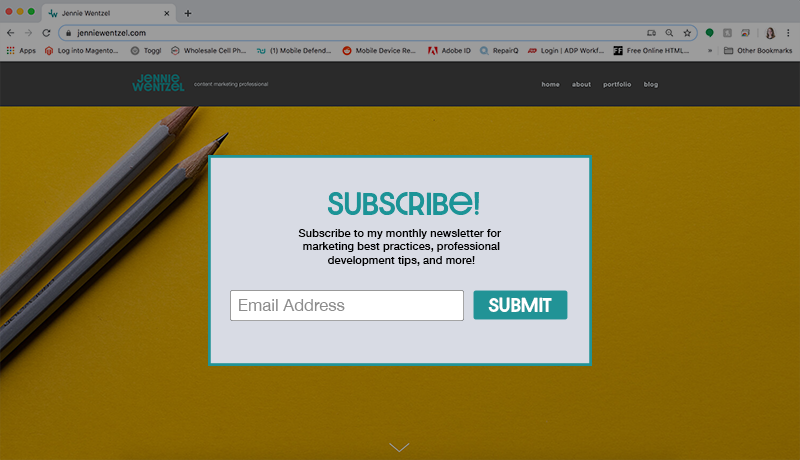
Here is an example newsletter subscription call-to-action.
2. Grab the easy subscribes first.
Start by placing a newsletter subscription box in multiple places on your website. Don’t tuck it at the bottom of your homepage; make it easy for eager potential customers to provide their contact information so you can reach them. This call-to-action, or CTA, should make it clear to users that this is where they can subscribe to your newsletter for offers, information, and important updates.

Photo by Austin Distel on Unsplash
3. Create a free offer.
Now, think of those website visitors that are less eager to fill out your form. Entice them to provide their information by creating something they may be looking for, as it relates to your products or services. If you’re a yoga teacher, for example, you can create a free step-by-step guide or video on how to practice headstands or another complicated pose. Simply ask users for their email address to view or download the guide, and watch your email list grow organically with a much more captive audience.
4. Segment your lists.
As your email lists grow, you’ll find that some subscribers are looking for different types of content. Your subscribers that signed up in a general subscription box might be more prepared to make a purchase or schedule an appointment with you. Subscribers that are captured in your free opt-in offers may need some more nurturing to develop more trust in your brand.
As you learn more about each of your subscribers and what they’re looking for, you should tailor your email content to them. One of my clients saw a 285% increase in revenue generated from emails after we switched to segmented campaigns. That number will only grow more! According to Campaign Monitor, personalized, segmented campaigns can drive up to a 760% increase in revenue.
5. Continue to send valuable content to your subscribers.
Stay at the top of your subscribers’ minds by sending them regular, relevant, and valuable content. Remember, they can unsubscribe from your emails at any time; give them a reason to stick around. For example, if your small business is a hair salon, you can do a weekly or bi-weekly newsletter series where you share quick hair care tips, product reviews, or color trend alerts to your interested subscribers. Make them glad that they handed you their email address! This ultimately creates more and more trust in your brand—the kind of trust that will not only make them want to purchase from you, but tell their friends about you too!
6. Make compliance a priority.
In 2003, an act titled Controlling the Assault of Non-Solicited Pornography And Marketing (CAN-SPAM) was passed to allow email recipients to prevent businesses from sending them unsolicited messaging. As you build out your email list, you should prioritize compliance with CAN-SPAM not only because it’s the law, but also because it’s generally good practice to follow in email marketing. Here are some guidelines to keep in mind:
Include an easy-to-find unsubscribe link at the bottom of every email you send.
Once users unsubscribe, make sure to actually remove them from your list, and don’t add them back.
Display your physical location at the bottom of your emails. This is good practice because it helps build the credibility of your brand.
According to salecycle.com, email marketing has an average return on investment (ROI) of $32 for every $1 spent. 59 percent of marketers say that this is their biggest source of ROI. By organically growing your email subscribers list using valuable and relevant content, your small business can start to see a high return on your email marketing efforts as well.
![[FREE Online Resources] Why Your Website from 2016 Needs a Redesign This Year](https://images.squarespace-cdn.com/content/v1/523cf6c4e4b0f6b279e835d3/1579473444633-I41J9LSHYBTBHJ51I8DR/website-design.jpg)
[FREE Online Resources] Why Your Website from 2016 Needs a Redesign This Year
When was the last time your small business performed a website redesign? Experts recommend that businesses redesign their website every 2-3 years to ensure usability, improve their SEO efforts, and better reach their sales goals. Check out some free tools that you can use to gain valuable insights on the health of your website.

Photo by Damian Zaleski on Unsplash
Let me start this off by saying that there is absolutely nothing wrong if you had a friend of a friend who knows something about websites design your first website for your small business in 2016. I’m a firm believer that having some sort of presence online is better than no website at all. However, if you haven’t updated your website since then, you’ll probably find that it will become more and more difficult to reach your business goals as time goes on.
Many of the experts at Ironistic recommend redesigning your website every 2-3 years. Depending on your industry, you may be able to get away with waiting a little longer between website redesigns. Regardless, it’s important to understand how crucial of a role your website plays in helping you grow your business.
What this really comes down to is trust. You want to make sure that potential customers can find the right information about your products or services online and that they feel right off the bat that they can trust your company. A recent study by Nielsen Norman Group showed that there are four main ways that websites can communicate trustworthiness in a brand: design quality, upfront disclosure, comprehensive and current content, and connection to the rest of the web. These are actually the very same principles identified way back in 1999 by Jakob Nielsen.
So if the principles of a trustworthy website have stayed the same over the past 20-plus years, why should businesses update their website every 2-3 years? The short answer is that the internet, search engines, and even consumer behaviors are constantly changing.
If you are wondering if you need a website update, here are some important questions to ask yourself (along with some free tools to help):
Is your website responsive on mobile?
Statistica reported that in 2018, 52.5% of all website traffic was generated through mobile phones. Take a moment to visit your website in the web browser on your phone. Is it easy to read, use, and navigate? Does it look the way you’d like it to? Chances are, if you haven’t updated your website in the past few years, it may not look very user-friendly on a newer device like an iPhone X.

Check out Responsinator.com to view your website on a number of different devices.
Having a website that is responsive—meaning it automatically optimizes based on the device it’s being used on—is crucial in 2020. Make sure your website users have the same experience on phones and tablets that they would have on their desktop computer.
Free tool: Check out Responsinator to see what your website looks like on different devices. From the newest iPhone to a tablet in landscape orientation, Responsinator will show you all of the different ways that online users may view your website.
Does your website load quickly?
Going along the same vein of usability, it’s important to keep a close eye on the page load times of your website. Google reports that 53% of mobile users will leave a page that takes longer than three seconds to load.
Websites that were built even three to four years ago may not use the best or most up-to-date programming language that prioritizes page speed. Having a slow website can also affect your SEO, or how high your website ranks on Google’s search results pages. Make sure to prioritize usability by keeping your load times low.
Free tool: Google’s Page Speed Tool provides a free analysis of your website page load times, along with some recommendations to better optimize your website speed.

What do your competitors’ websites look like?
When was the last time you visited a competitor’s website? If you were to compare your website against one of your competitors’, would you say that yours looks better and is easier to navigate? If not, potential customers on the web may feel the same way.
Think of it this way: your website is a storefront for your business that is open 24/7, and your potential customers are constantly looking for a solution to a problem that you can solve. They will either visit your website or those of your competitors. Make sure to keep your online “storefront” as updated and professional as possible, the same way you would maintain your physical storefront to appeal to customers.
Free Tool: Sign up for a free trial account on SimilarWeb, where you can compare your website traffic to that of your competitors. If you see that they are getting more traffic on their website, they’re probably also gaining more market share through their online efforts. If that’s the case, it’s time to get to work!

Does your website properly reflect your brand?
This one is a bit trickier to quantify with an online tool, but ask yourself this: does your storefront give off the same vibe that your website does? Again, your website is an online storefront that is open to customers 24/7. You want to make sure that it reflects your brand the same way your physical storefront does. For some customers, your website is their very first interaction with your brand. Is it giving the best first impression?
In inbound marketing, your website essentially functions as the central location for your digital marketing efforts. It’s crucial for this platform of yours to act as not only a hub of information for your potential customers, but also an accurate representation of your brand.
Free tool: The best free tool to analyze your website’s branding is another set of eyes! I am offering a Free Website Analysis to all of my subscribers that sign up. This analysis will help you learn how to
Improve your page load speed
Optimize your website design for mobile devices
Increase your website traffic
Use your website to help you reach your marketing and sales goals
If the thought of a full website design makes you nervous or overwhelmed, I’m here to ease that burden. I’ve helped a number of small businesses increase their customer base and visibility online by creating a simple and effective website for them. Sign up for my Free Website Analysis to get started.

Three Steps to Eliminating Impostor Syndrome
If you’ve ever received praise for your accomplishments, yet still doubt your abilities and achievements, you probably suffer from impostor syndrome. This behavior has been studied by psychology professionals for years, and thankfully, there are ways to overcome it.

Photo by Hailey Reed on Unsplash
If you’re a high-achieving professional that has ever doubted yourself and the accomplishments that you’ve made in your career, you have likely experienced impostor syndrome. First identified by scientists in the 1970s, impostor syndrome refers to a particular form of self-doubt: feeling like you’re unqualified for your current position, or that you’re a fraud or a failure despite evidence that proves otherwise. Even achievers like Maya Angelou and Albert Einstein showed signs of this phenomenon after all that they had accomplished in their lives.
A 2011 study estimates that 70% of people will experience impostor syndrome at some point in their lifetime. Beth Andrix Monaghan, CEO and Co-Founder of InkHouse, points out that this behavior often follows high-achieving women. This is due to an inherited societal prejudice against women in positions of power, causing us to scrutinize ourselves more closely for shortcomings and mistakes.
Since I was promoted to my current position as Marketing Manager at Mobile Defenders, there have been plenty of times where I suffered from impostor syndrome. I felt like I only got where I am because of some sort of quota for women in management positions at the company. I know that no such quota exists, and that my ability to manage projects and connect with our customer base is what got me here. Even so, I would sometimes find myself wanting to perfect every single project that I touched in order to prove to others—and myself—that I earned my place in my leadership position.
What does Impostor Syndrome feel like?
If you Google “impostor syndrome”, you’ll probably stumble across a number of links to quizzes that will tell you if you suffer from this phenomenon. Really, though, it boils down to asking yourself some questions.
Do you feel like you’ve somehow cheated to get to the position that you are in?
Do you feel like you’re not qualified for your current position?
Do you feel like a fraud and that it’s only a matter of time before people find you out?
Do you feel like you’ve gotten where you are in your career because of chance or luck?
If you’ve answered “yes” to any of these questions, it’s likely that you’ve suffered from impostor syndrome.
Dr. Valerie Young is an expert in this phenomenon. She discovered that those suffering from impostor syndrome mainly fall into one of five categories:
The Perfectionist, who focuses on how something is done, and doesn’t rest until the task is 100% completed perfectly.
The Superwoman/man, whose concern is how many roles they can juggle at once, and measures success this way.
The Natural Genius, who cares most about how and when things are completed, but also how easily this success is achieved.
The Soloist, who is focused on who completes the task, and sees success in figuring things out and doing them alone.
The Expert is concerned about what and how much someone knows about something. They are similar to the perfectionist but are more focused on knowing everything about something.
It may not be as obvious to you which type of impostor syndrome you suffer from, and that’s okay. For me, I sometimes feel like I am a combination of all five of these personality types. Thankfully, there is a simple mindset change that can solve for any of these personality types.
How can I overcome Impostor Syndrome?
Kara Loewentheil offers a great three-step process for dealing with impostor syndrome, but first, she explains what doesn’t solve impostor syndrome. Things like validation from others may provide some initial relief, but are typically immediately self-discounted. Additionally, telling yourself positive things like “I am really great at what I do” doesn’t work long-term when you don’t really believe it.
Kara’s solution requires victims of impostor syndrome to rewire their brain and their thoughts to gradually boost their self-confidence. Here is her three-step process, which she calls the Thought Ladder:

Photo by Artem Maltsev on Unsplash
First, pick one thought that you have about yourself. This can be something like “I am unqualified for my job” or “Everyone else in my department is so much smarter and more successful than me.” Stick with only one thought at a time, and put this thought at the bottom of the ladder.
Second, brainstorm your Goal Thought, or what you wish you really believed about yourself. Think of something like “I earned my way to this leadership position” or “I am just as successful, if not more successful, than everyone else in my department.” This Goal Thought goes at the very top of your ladder.
Lastly, think of thoughts you can start to believe right now. These can be a bit more neutral, but they help you work your way to believing your Goal Thought. These thoughts can be things like “I just had a really positive performance review” or “My supervisor promoted me to this position because I work hard.” These thoughts don’t have to make you feel incredible, but they can help you feel better than the thought at the bottom of your ladder. Think of them as a bridge between your current thought and your Goal Thought.
You can repeat this process with as many negative thoughts that you have. Write down your Ladder Thoughts where you can easily remember them, such as on your bathroom mirror or as a reminder on your phone.
I had been a victim of the impostor syndrome without even realizing it. Even when I would receive praise and positive feedback from my peers and supervisors, I still struggled with believing that I was truly deserving of the praise. It helped to finally understand that this behavior is not only common amongst other professionals, but that there are steps that I can take to combat it.
If you think you might have impostor syndrome, you’re not alone! Follow Kara’s three-step Thought Ladder process, and remind yourself every day that you’re better than your mind might have you believe.

The Ultimate Guide to Inbound Marketing for Small Businesses in 2020
In 2017, Hubspot reported that 71% of the world’s organizations use an inbound marketing strategy to gain new business. That means that if you’re not using an inbound strategy for your small business, 3 of your competitors are. Learn more about how you can increase the ROI of your marketing efforts by adopting an inbound marketing strategy in 2020.

If you’re looking to double down on your marketing efforts and attract more customers in 2020, it’s important to first start thinking like a customer. As a consumer, are you fully engaged when you come across a traditional advertisement, such as a commercial on TV or the radio? What about a billboard?
If you’re like most consumers, it’s likely that you block these types of advertising tactics out, both mentally and literally. Everyone knows that commercial breaks are the best time to refill your bowl of chips. A spam email or call can easily be blocked by your email or phone service provider. As consumers in the digital age, we’ve learned to ignore all types of advertising that is all around us.
That being said, how can businesses advertise to prospects without spending way more money on their marketing efforts? What is the most cost-effective way to win over new business when consumers are already being bombarded with interruption marketing? The answer is to strategically attract these customers to your brand through inbound marketing.
What is inbound marketing?
Rather than interrupting the lives of your target audience with advertisements that they don’t want to see or hear, inbound marketing aims to attract, engage, and delight your customers by creating value and trust in your brand.
How do you do this? Your first focus should be on the issues your customers face on a daily basis—particularly the issues that your business can solve. By changing the focus to what you can help your target audience with, you’ll start to build more credibility, making customers more likely to buy from you, and ultimately, more loyal to your brand.
In 2017, Hubspot reported that 71% of the world’s organizations primarily conduct inbound marketing tactics. That means that if you aren’t currently using an inbound marketing strategy, 3 of your competitors are!
How much do inbound tactics cost?
If this is your first time learning about inbound marketing, you may think that these new tactics will be super expensive and turn your marketing budget on its head. That’s not necessarily true! In fact, inbound marketing tactics have a higher ROI than traditional tactics, according to 53% of marketers surveyed in 2018 (versus 16% of marketers that stated that outbound/traditional tactics give them a higher ROI). Even if implementing these strategies cost more upfront, you’ll see that they are much more effective in reaching more of your target audience and converting them.
Let’s face it: if you’re a small business, you want to make sure you’re getting the most out of every dollar spent on your marketing efforts. Make sure you’re achieving the highest ROI possible with a marketing strategy that targets users that are more qualified to convert into your customers.
What are some examples of inbound tactics?
Here are some elements of a strong inbound strategy:
Pay Per Click (PPC) Ads: When you type something into Google to search, some of the first results you see show “Ad” next to them. These companies have developed paid campaigns on Google Ads to show as the first result, depending on which search keywords they use.

Photo by John Schnobrich on Unsplash
Search Engine Optimization (SEO): If you scroll down a little further on the Google results page, you start to see websites and companies that organically rank for the search keywords. These companies have focused on optimizing their websites and landing pages to include these keywords, and Google has ranked them according to user intent.
Social Media: Consumers, and even other business owners, spend a ton of time on social media platforms. Having a presence for your business on these platforms allow your brand to interact with your target audience where they are already spending time. Social media platforms also allow business pages to run ads to reach an even wider audience.
Content Marketing: You’ll soon learn that in marketing, “content” is a huge word. Broadly speaking, content is the information that your business shares with its audience. This information can be shared in a ton of different ways, like blog posts, videos, newsletters, cases studies, and eBooks. Although your target audience as a whole may have a favorite way that they like to receive your content, you should still try to share information in a variety of ways to make sure you’re reaching more people.
Website Landing Pages: Although landing pages can fall under the content category, it’s worth highlighting that your website is arguably one of your most valuable tools in your content marketing strategy. Your goal should be to transform your website into a hub of information for your prospects and customers.
How can my small business implement an inbound strategy in 2020?
It may be tempting to jump right in and hit the ground running with inbound marketing, but there are some questions that you need to answer first. It’s good to write down some information about your business, your goals, and most importantly, your customers, in order to create the most effective inbound strategy for 2020.

Set Goals.
How do you measure the success of your marketing efforts? Define all of the key performance indicators (KPIs) that you will track to make sure your inbound strategy is on track.
One way of doing this is to work backwards from your revenue goals. To do this, you need to know your lifetime customer value (LTV), which indicates what a customer is worth over the lifetime of your relationship with them. Use this number to work out how many new customers you need to onboard to reach your revenue goal. Then, find your average lead-to-customer conversion rate (what percentage of leads turn into customers?), and use that to determine how many more leads you need to earn. From there, using your average visitor-to-lead conversion rate (what percentage of visitors turn into leads on your website?), determine how many more visitors you need on your website to reach your goal. Check out the diagram above for an example of this formula.Define your ideal customer.
You want to create value with your target audience. This requires some research into what makes them tick—or what gives them headaches. Build a buyer persona around your ideal customer. Document their demographics, psychographics, pain points, values, goals, and anything else that can clearly define this person to someone outside of your organization. Give them a name too!
For example, if you sell handmade teddy bears made from recycled clothing, you don’t want to list your target persona as “anyone in the US that has a small child”. Instead, you want to narrow down that persona to be “Parents in the Midwest who prefer to shop locally, purchase sustainable goods that are higher-priced but last a long time, and have children between the ages of 3 and 9.”
Now, go a little deeper; work with your sales team or survey current customers to determine what problems they face on a daily basis that your company can help them with. Additionally, ask some questions about where they go to get information on solving this problem. This helps you determine not only WHO you are creating content for, but also WHERE you should make that content accessible for them.Conduct keyword research.
Go even further with your questions to your customers. Ask them what specific words or phrases they type in to Google to look for a solution to their problem. In this step, you’re starting to perform some keyword research for your website’s SEO efforts. There are a ton of free SEO tools that you can use to validate some of these search terms as well. Keep in mind that you want to look for keywords that have a high search volume but not a lot of existing content out there (meaning, you want to find keywords that have a keyword difficulty below 60%).
Check out my free worksheet linked below to work yourself through the research and documentation portion of your inbound implementation.
Now that you have your goals, target customers, and keywords, the next step is to develop a full content strategy that focuses on attracting new users to your website, engaging with those users to convert them to customers, and delighting them to keep them coming back for more from your brand. Create content in different formats that accomplishes your goals for each of these stages, and optimize your website to guide visitors through this cycle smoothly. After some time monitoring your success and making the necessary adjustments, you’ll soon find that more and more qualified customers are finding you and learn to trust you. Those usually end up being the longest-lasting and mutually beneficial relationships.
Hi! I’m Jennie.
Thank you for visiting my blog! I write about marketing tips for small businesses and how to succeed as a female professional. I write from experience about the things that I love.