When I first got into SEO back in 2020, I was convinced it was some kind of dark art. Like, there were people out there who just knew things the rest of us didn’t, and without their mystical expertise, your website was doomed to live on page four forever. I genuinely believed that.
Fast forward a few years, and here’s what I actually think: SEO isn’t that complicated when you lead with your users. Almost every best practice in search optimization is really just an extension of making your website clear, helpful, and easy to navigate for real people. The robots follow. That’s kind of the whole secret.
Now, the landscape has shifted a bit. It’s not just about ranking on Google anymore. With AI-generated answers showing up at the top of search pages and tools like ChatGPT and Perplexity pulling from websites to answer questions directly, the game has expanded. You might hear terms like GEO (Generative Engine Optimization) or AEO (Answer Engine Optimization). Honestly, that whole space deserves its own post. What I will say for now is this: pages that rank in the top positions on Google are significantly more likely to be cited by AI tools like ChatGPT than pages that rank outside the top 20. So everything we’re covering today still applies, and then some.
First, What Is SEO (And What Shows Up Because Of It)?
SEO stands for Search Engine Optimization. It’s the practice of improving your website so that search engines understand what it’s about and feel confident recommending it to people who are searching for relevant topics.
Organic search accounts for about 53% of all website traffic, making it one of the highest-value channels available to any business with a web presence. And the stakes of ranking well are real: the top result on Google captures 27.6% of all clicks, while less than 1% of users go beyond the first page.
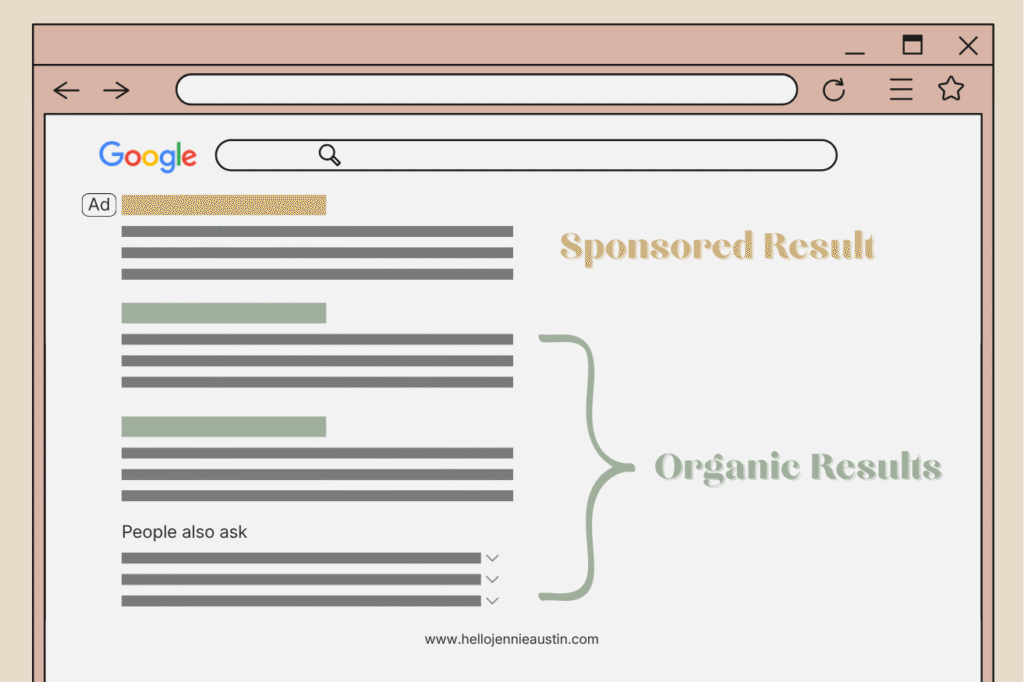
Not everything you see on a results page is driven by SEO. Paid ads are, well, paid. The local map pack has its own set of ranking factors. But the organic listings, featured snippets, and “People Also Ask” boxes? Those are all influenced by SEO, and earning those placements costs you nothing but strategy and effort.
The Pillars of a Solid SEO Strategy
There’s no single thing you can do to make your website rank well. SEO is a combination of factors that work together, and the sites that consistently perform well in search are the ones that have invested in all of them, not just the easy ones. Think of these pillars less like a checklist and more like a foundation: each one supports the others, and a weak spot in any area can limit what’s possible across the rest.
A Site Structure That Makes Sense (For Humans and Robots)
Before a search engine can rank your content, it has to be able to find and understand it. That’s where site structure comes in, and it’s one of the most overlooked foundational pieces of SEO.
Think of your website as a building. Your homepage is the front door, and every page should be reachable through a logical path from there. A clean, organized structure tells search engines what your website is about, how pages relate to each other, and which pages matter most.
Practically speaking, this means having an XML sitemap that you submit to Google Search Console… a literal map of all your important URLs. It also means your navigation reflects a sensible hierarchy. Every important page should be reachable within a few clicks from the homepage. If Google’s crawler has to dig through seven layers of links to find a page, it’s probably not going to rank well.
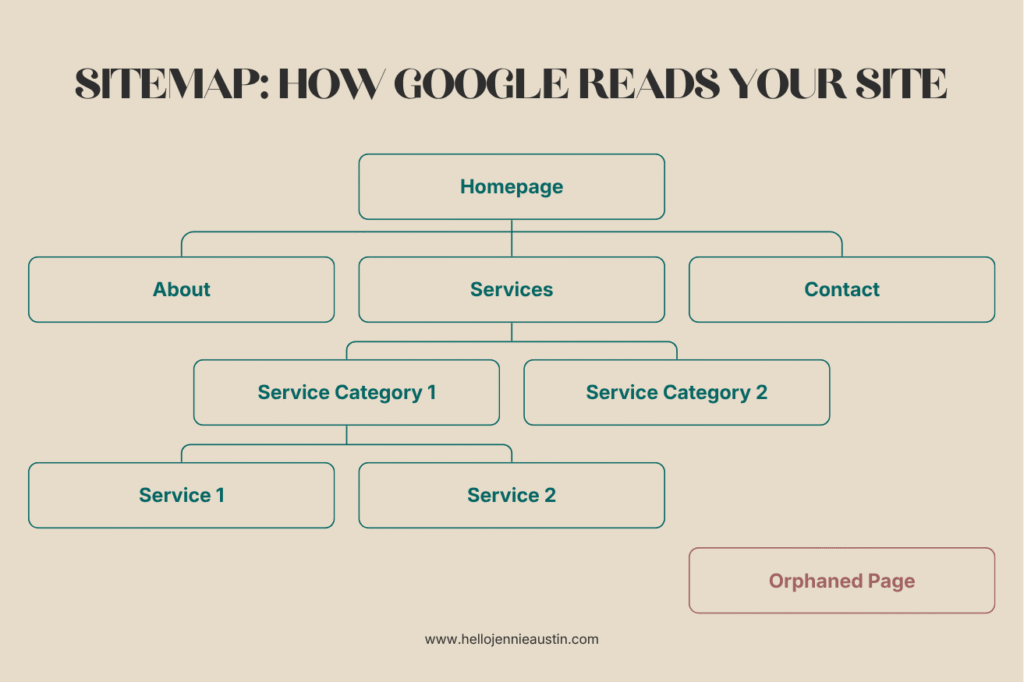
Watch out for orphaned pages, which are pages on your site that have no links pointing to them. If no one is linking to a page (including you), crawlers have no way to find it. The goal is a structure where nothing important is buried, nothing is redundant, and every page earns its place.
Content That Earns Its Place on the Page
This is the pillar I feel most strongly about, so bear with me.
Google’s job is to send searchers to the most relevant, helpful page for their query. That means when someone types a question into Google, it’s looking for a page that answers that specific question, not a page that kind of covers it alongside ten other topics.
This has implications for how you structure your website. Each service or product you offer deserves its own dedicated page. Each blog post should target one clear topic. When you try to cover too much ground on a single page, you dilute the signal Google is trying to pick up.
That said, content for content’s sake is not the answer. I’d rather see a website with eight highly intentional, well-written pages than one with fifty thin posts that don’t say anything meaningful. Every page should have a target keyword that is relevant to your business, realistic for your site’s current authority level to rank for, and genuinely useful to the person reading it.
When you’re choosing keywords, look for terms:
- that real people actually search
- that aren’t so competitive you have no shot
- that align with something you can write about with actual expertise
If you’re a small business just starting to build your content strategy, local and long-tail keywords are usually your best friends.
Internal Linking: The Glue That Holds It All Together
Internal links are links from one page on your website to another page on your website. They sound simple, and they are. But they do a lot of quiet work behind the scenes.
From a user experience standpoint, good internal linking helps people find related content and move naturally through your site. From an SEO standpoint, it helps search engines understand the relationship between your pages and distributes what’s called link equity, essentially passing some of the authority from a well-performing page to pages that need a boost.
A few things to keep in mind:
- Link to relevant pages contextually within your content (not just in a navigation menu),
- Use descriptive anchor text that tells both the reader and the search engine what the linked page is about.
- Make sure your most important pages are getting linked to from multiple places across your site.
Authority: The Hardest Pillar to Build, and the Most Worth It
If content is what gets Google’s attention, authority is what earns its trust. And trust takes time.
Google evaluates authority through its E-E-A-T framework, which stands for Experience, Expertise, Authoritativeness, and Trustworthiness. It’s essentially asking: does this website know what it’s talking about, and do other credible sources agree?
There are a few ways to build authority worth prioritizing:
Backlinks (When a Website Links to Yours)
Backlinks are still one of the strongest authority signals out there. When another reputable website links to yours, it’s a vote of confidence. You can’t reliably buy your way to quality backlinks, so the best approach is creating content worth linking to and building genuine relationships in your industry.
Social Proof (Recommendations from Other Users)
Social proof matters too, both for users and for search engines. Reviews, testimonials, press mentions, and case studies all signal that real people have had real experiences with your business.
Thought Leadership (Blogs, Articles, Whatever You Call Them)
Thought leadership is another underrated one. Consistently publishing helpful, informed content about your industry builds topical authority over time. It tells Google that you’re not just a business with a website — you’re an actual resource in your space.
Technical Health: The Foundation Everything Else Sits On
You can have great content and strong authority and still lose rankings to a competitor whose website just works better. Technical SEO is the part most small business owners skip, usually because it feels the most intimidating. But a lot of it comes down to basic hygiene.
Page speed matters more than most people realize. Mobile devices now account for over 63% of all web traffic, and if your site takes too long to load on a phone, a significant portion of visitors are gone before they’ve read a word, and Google knows it. Tools like Google PageSpeed Insights will show you exactly where you’re losing time.
Broken links create dead ends for both users and crawlers. Audit your site periodically to catch these before they quietly tank your performance.
Metadata (your title tags and meta descriptions) should be written intentionally for every page. These are what show up in search results, so they need to be descriptive, keyword-relevant, and written for a human who is deciding whether to click.
Alt text on images is both an accessibility best practice and an SEO signal. Describe what’s in the image clearly and naturally.
Schema markup is a layer of structured data that helps search engines better understand what’s on your page: things like reviews, FAQs, events, and business information. It’s what powers a lot of the rich results you see in Google, like star ratings and FAQ dropdowns. If you’re not using it yet, it’s worth looking into.
Content Freshness: SEO Is Not a One-and-Done Project
One thing that surprises a lot of people new to SEO is that publishing a page isn’t the finish line. Google actively rewards content that stays current and accurate.
This doesn’t mean you need to constantly rewrite everything. But it does mean keeping an eye on your existing content, especially your most important service pages and top-performing blog posts. If something references outdated statistics, no longer reflects how you work, or has been outpaced by better content from competitors, that’s your cue to update it.
A content refresh can be as simple as updating a stat, adding a new section, or improving how a page is structured. Reviving an older post often takes less effort than writing a new one from scratch, and it can produce real ranking movement relatively quickly.
The Bigger Picture
SEO is not magic. It’s not a one-time task you check off a list, and it’s definitely not something reserved for people with a specialized credential or a big agency behind them.
At its core, it’s about building a website that genuinely serves the people looking for what you offer, and making sure search engines can see that clearly (and there are tools that help you do this effectively). Do that consistently, across structure, content, authority, technical health, internal linking, and freshness, and you’re already doing more than most.
Good ideas are just the beginning.
Let's make something real out of them together.
