

Blog

Paid Digital Ads: Do They Still Work in 2020?
Utilizing paid digital ads in your marketing strategy can produce immediate results, but it has its own setbacks. One of these is that it is not a viable long-term solution for many small businesses. In any case, if you’re launching a new product or service, or just looking to make a splash in a new industry, here are some tips for using paid digital ads in 2020.
Photo by Brooke Lark on Unsplash
As a small business owner, if you’ve ever received an email or notification from Google, Facebook, or another online platform with free advertising credit, you might already be familiar with paid digital advertising. These companies are looking to have you spend money with them to advertise your business to users on their platforms.
Utilizing this free credit may seem tempting—although in many cases you need to spend a certain amount to access the “free” credit for the ads—but is it still worth the effort in 2020?
What are paid digital ads?
First, let’s cover what exactly falls under the term “paid digital ads”.
In short, these are online advertisements that you get to target certain users, based on certain characteristics or behaviors, and pay the platform to show these ads.
Some examples of paid digital ads are:
Google display or search ads
Video ads on YouTube
Facebook/Instagram promoted posts
LinkedIn ads
Promoted Pinterest pins
Typically, for ads on social media platforms, the more money you put behind a promoted post, the more impressions, or instances of the ad being viewed by a user, the ad will get. You have the option to narrow down which users this ad will show to through targeting. You can target users by some of the following characteristics:
If they have visited your website previously
The kind of content they’re interested in on the platform
Demographics like location, age, gender, etc.


For paid ads on Google, however, you have the option to show your ads on Google search engine results pages, YouTube, or other websites within the Google Display Network. For display and YouTube ads, like social media ads, you will typically pay for impressions.
For search ads, however, you have some options on how you’d like to pay, but most often you will pay for each click on your ad. That’s why these types of ads are also referred to as pay-per-click (PPC).
PPC allows you to choose which search queries entered into Google you’d like your ad to appear for. The highest bidder will show first. Clicks will cost anywhere from 2 cents to 50 dollars; it all depends on how competitive your industry and search terms are.
When should you use paid digital advertising?
Because paid ads usually have an immediate effect, they can help you get results very quickly. Many companies see great success by using paid advertising in the following instances:
When they are launching a new product
When they are launching a new service
When the company is new and needs to gain more awareness
Think of it this way: anytime you’d like to quickly enter a new market or catch the attention of a new type of audience, you might consider paid digital advertising. However, it has its pros and cons.
How effective is paid digital advertising?
In the short term, paid ads can be very effective in driving website traffic and revenue. You might see a great return on investment right away. However, it’s a good idea to look at other marketing tactics to set yourself up for the long term as well. Paid advertising won’t work as a primary driver in the long run.
Keep in mind that this type of advertising won’t work for all types of audiences either. Take Gen Z, for example. This generation has grown up constantly surrounded by advertisements, making it easy for them to ignore them.
A recent behavior study by Backlinko showed that only 19% of users clicked on an ad on Google’s search results pages. This number is highly dependent on the type of search performed, however, and doesn’t mean that your users won’t ever click on your ad.

Keep these things in mind when building your overall marketing strategy. You shouldn’t rely solely on digital ads to bring in traffic. Utilize other tactics for the most long-term success.
What are some tips for paid digital advertising in 2020?
When it comes to digital ads, the possibilities are endless. However, depending on what type of industry you’re in, certain types of ads might perform better than others.
My first recommendation is to use video as much as possible in your ads. Video ads have the highest click-through rate (CTR) of all digital ad types, at 1.84%. If you’re promoting a new product, advertise a demo video of the product in action. If you’re a service-based B2B company, take a testimonial video of one of your happy customers talking about how much your service helped their business.
When choosing which platform to launch your digital ads, it’s important to understand not only which platforms your target audience spends time on, but how they use it. For example, if you’re demoing a new hair product on Instagram for your ad, remember that the best-performing posts on Instagram are high-quality and visually pleasing.
Another good strategy is to promote your blog content in your ads. Run some search ads that direct more traffic to your blog posts. This increase in traffic is good for your website’s search engine optimization (SEO), which can help produce more results long-term.
Most importantly, when building your digital advertising strategy, keep in mind that users will click on things that they believe can help them. Whether it’s a cool new product or a service that fulfills their search intent, content that aims to be helpful will always win.
![[Infographic] Four Marketing Metrics to Track During (and After) a Global Crisis](https://images.squarespace-cdn.com/content/v1/523cf6c4e4b0f6b279e835d3/1587670534696-EE2UH458S0T132UBALVI/engagement-metrics.jpg)
[Infographic] Four Marketing Metrics to Track During (and After) a Global Crisis
COVID-19 isn’t just a global pandemic; it is an economic crisis for small businesses. As we work to flatten the curve of cases in the US, so begins the transition to our “new normal”. If you’re a small business, here are four marketing metrics that I would recommend you start monitoring now in order to help you understand where your marketing budget should be.

The coronavirus pandemic has changed the way many small businesses have had to operate over the last month or so. Although there is discussion of some local governments lifting stay-at-home orders soon in order to improve their economies, we will be seeing the effects of this crisis for quite some time.
This “new normal” will be much different from the way things were before. Many small businesses will feel the need to cut back on costs, and may look to marketing costs firsts. As a marketer, this breaks my heart, because as my favorite quote by Henry Ford says:
Stopping your advertising to save money is like stopping your watch to save time.
Nonetheless, your marketing budget will need to change. Here are some metrics that you should start tracking now to help you understand how to evolve your marketing budget in this “new normal”.
Change in Customer Lifetime Value
Customer lifetime value (CLV) is the total amount of money that a customer is expected to spend with your business during their lifetime. CLV can be calculated in different ways based on the type of small business you own, but the basic formula is:
[average value of a purchase] X [number of purchases from a customer per year] X [length of customer relationship in years]
If you have seen a drastic decrease in business from repeat customers, your CLV has probably decreased as well. For example, if you own a small coffee shop, and your regular customers have been coming in less frequently because they are working from home, the average amount of money they spent with you has gone down.
The specific metric you should identify here is the change in CLV that you have seen since the pandemic started affecting our country. This will help you determine how much money you should be spending to acquire new customers (which we will talk about in the next section).
To Track: Use sales numbers from before the year 2020 to see what your CLV was pre-COVID-19. Then calculate CLV using sales numbers from this year to compare the change. As local shelter-in-place mandates are lifted, it would be a good idea to contine tracking this metric as your local economy opens back up.

Change in Customer Acquisition Cost
Customer acquisition cost (CAC) is how much it costs your business to acquire a new customer. This is calculated by by adding up all of the marketing and sales costs associated with earning new customers (or converting existing customers into repeat customers) and dividing that number by the total number of customers won over from those efforts. Here is the formula written out more clearly:
[total amount spent on marketing and sales] / [number of customers won from those efforts]
Again, in the midst of this pandemic, we want to track the change in CAC. When you compare this number to the change in customer lifetime value, you will be able to effectively determine how much money (and time) you should be spending on your marketing efforts to attract new customers.
Going back to the coffee shop example, if your CLV has dropped from $250 to $150, you want to make sure that your CAC hasn’t increased to above that number. So if a $150 Google Ads campaign doesn’t bring you any customers, it’s time to reduce that budget, or look for other ways to spend that money that will be more effective—like SEO!
To Track: First, track all of the hours spent on marketing, as well as the costs associated with that time. Add it to any other marketing costs—think ads on Google or social media, email marketing platforms, etc.—and divide that number by how many customers were won over from those efforts. If you’re not sure, give your best guess based on conversations you or your staff has had with new customers.
Recalculate this number any time you calculate your CLV. These two metrics go hand-in-hand when it comes to developing your marketing budget.
Social Media Engagement
Predictions show that more people are spending time on social media while staying at home, which is why it’s so important to continue communicating with your customers on social.
With this in mind, make sure to keep an eye on your social media engagement. Social engagement is defined as shares, likes, and comments on your posts on social media. This is a great way to measure the success of your social media efforts, even if sales are down. The focus here should be on building and maintaining a relationship with your audience so that when they’re in a better position to buy, your brand will be at the top of their mind.
Nancy Kapoor writes for Social Media Today that interactive content as a digital marketing strategy will skyrocket this year. That’s because interactive content like 360-degree videos, quizzes, and polls are, by nature, a call-to-action. Interactive posts on social media can not only be shoppable, but shareable as well.

Photo by ROBIN WORRALL on Unsplash
To Track: Individually track engagement metrics on each platform that your small business is active on. Additionally, don’t forget about what your goals are for each platform. For example, if you are posting on Instagram to increase awareness from users between the ages of 25-34, don’t roll those engagement numbers in with those of your Facebook posts, where you might be trying to reach a different type of audience.
Stay agile. Find which type of posts are more successful and which ones have lower engagement rates.
Email Opens & Clicks
In March consumers saw a spike in emails sent from all kinds of brands making statements about how they were handling concerns about the pandemic. Most people found this to be kind of annoying.

Unsurprisingly, Salesloft reported that sales emails with “COVID-19” or “Coronavirus” in the subject line saw a 40% reduction in reply rates.
With this in mind, you may be thinking that email is a no-go right now. However, just like social media, email has the potential to help you create a much stronger relationship with your customer base (if you do it with the right intentions). Here are my three best recommendations:
Don’t try to incite fear.
Be positive, but...
...don’t be ignorant.
To Track: If you’re still sending marketing emails at this time, it’s important to keep a close eye on the open rates and click-through rates of your emails. If you’re seeing a significant drop in these metrics from before, you might want to think about changing up the content or just taking a break for a few weeks. Otherwise, you may see your unsubscribe rates shoot up, and those are contacts you may not be able to win over again.

As the economy starts to open back up in your area over the next few months and you adjust to your “new normal”, I hope you use these metrics to make re-budgeting less daunting and easier to understand on the marketing front.
If you’re a small business wondering where to go next, I’m happy to provide a free 30-minute consultation to talk about your goals and develop a plan of attack. Fill out the form below to sign up!

11 Free Marketing Courses That You Can Do While Staying Safe at Home
Health officials have asked Americans to stay home to help prevent the spread of COVID-19. This has left many business owners and marketers with much more time on their hands. One way to come out of all of this better is to use this extra time to continue learning. Thankfully, there are a ton of free marketing courses available online. Here are some that are on my “quarantine list".

Photo by Christian Lambert on Unsplash
The COVID-19 pandemic has resulted in so many drastic changes in the past few months, and one of the biggest adjustments that working Americans have had to face is staying home in order to practice social distancing. This had led businesses of all sizes to see a drop in sales, cutbacks to their workforce, or having to shutter their doors altogether.
Let’s face it: we’re all going to have to stay home in order to flatten the curve of cases of COVID-19 and to stay safe. For introverted homebodies like me, this hasn’t been much of a problem (so far). Those that are more extroverted, however, may be getting a little stir-crazy already.
A lot of people are finding themselves with a lot more time on their hands right now, and one way marketers like me can help pass that time is to take advantage of the free online resources and learning opportunities offered by big names in the marketing industry. After all, we might as well use this extra time to sharpen our minds and come out of all of this stronger than ever!
Whether you’re a marketing professional looking to learn a new skill or a small business owner building a re-launch plan for once this all passes, here are 11 free marketing courses that you can do in your pajamas during your extra time at home.
HubSpot Academy Certifications
HubSpot is the leading name in marketing automation platforms, and I’m obsessed with the free marketing and sales courses and certifications offered on HubSpot Academy. These lessons can be taken individually, or as part of a full lesson plan to get certified in a particular subject matter. Here are some great certifications:
Inbound Marketing Certification: I would recommend taking these lessons first, as they give a great explanation of HubSpot’s marketing methodology and why it can be so successful. I’m a huge fan of inbound marketing myself, and earning this certification helped me understand how to deploy inbound strategies for my clients to help them increase their marketing ROI.
Content Marketing Certification: “Content” is a huge word when it comes to marketing because it encompasses so many different tactics. This certification goes over how to build and launch a strong content marketing strategy, step-by-step.
Social Media Marketing Certification: Another hugely important term in digital marketing, these lessons on social media teach you how to leverage social media to complement the rest of your inbound marketing strategy.

HubSpot Academy Inbound Marketing Certification Course
SEMrush Academy Courses
SEMrush was introduced to me by a colleague as a great SEO tool for marketers, even for those like me that are just beginning to learn about SEO. Here are two lessons that I really enjoyed taking from the platform:
SEO Fundamentals: If the concept of SEO is completely new to you, this is a great course that provides an overview of what SEO is and how it can drive more organic website traffic for your business or your client’s business.
Keyword Research: Keyword Research is an important step in building a strong SEO strategy, and this course, taught by Greg Gifford, breaks down some best practices for building a list of keywords that you’d like to rank for.

SEMrush Academy Keyword Research Course
Skillshare Courses
Skillshare offers some free courses on their platform that are great for people looking for an introduction on new marketing tactics (and even some other creative skills like video and graphic design). You can also sign up for a free trial to access all of the courses in their library. Here are two courses in their “free” section:
Getting Started with Email Marketing: Mailchimp’s Senior Marketing Manager, Allyson Van Houton, teaches viewers how to implement an effective email marketing strategy with lessons on best practices.
Growth Marketing Essentials: Build Effective Acquisition Funnels: Cam Lay teaches this course that is great for entrepreneurs that want to understand what the marketing funnel is and how to approach this process for their business.

Skillshare Email Marketing Course with Mailchimp
Codecademy Courses
Codecademy is an amazing platform for developers looking to learn more programming languages and perfect their craft. However, learning HTML and CSS can help marketers become more well-rounded in their skillset, especially if you’ll be looking for a new job this year. Like Skillshare, Codecademy offers some free introductory courses as well as a free trial of their Pro subscription.
Introduction to HTML: This course reviews the most common HTML tags used to build web pages. There are also three “projects” to help you put what you learn to practice.
Learn CSS: This is another hands-on course that builds off of the HTML course with CSS rules. CSS allows you to stylize web pages with colors, typography, and more.
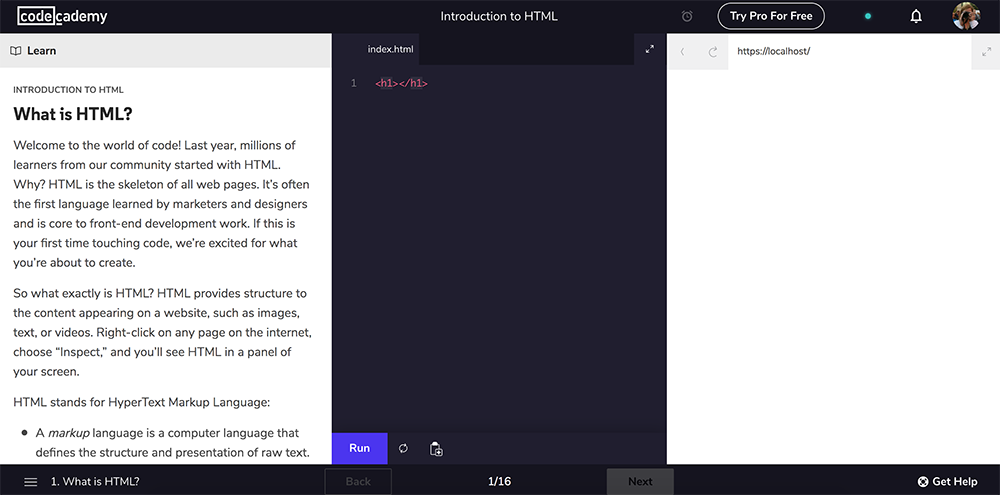
Codecademy Introduction to HTML Course
Facebook Blueprint Courses
We know that Facebook is the largest social media platform in the world, as well as a powerful tool used by marketers everywhere. Facebook offers free courses and certifications to help marketers and business owners learn how to run ads, retarget customers, and more.
Guide to Creating Facebook Ads from Your Page: This course is perfect for someone that has never used Facebook Ads before. It walks through the entire process, step-by-step.
How to Advertise on Instagram: Instagram, which is owned by Facebook, is the social media platform known for its high engagement rates. If you’d like to learn how to run ads specifically for Instagram, this course is for you.

Facebook Blueprint Instagram Advertising Course
Most of these lessons are courses that I have either completed myself or that are on my “quarantine list”, but I’m always looking for more! If you have any suggestions on free online courses or certifications that you would recommend, drop a comment below.

Adapting Your Marketing and Communication Strategies in Light of COVID-19
This is a scary and uncertain time for small businesses, but the COVID-19 outbreak doesn’t mean you should pause all communication with your customers. You can continue to serve them while supporting yourself and your brand’s reputation. Here are some examples of how some of my favorite local businesses are weathering the storm and adapting.
COVID-19 has already had a major impact on our country’s economy, and it’s likely that small businesses will need to weather this storm for the next few months as we get through this.
With the CDC encouraging consumers to stay home and avoid big groups of people, we’ve seen many small businesses elect to close their brick-and-mortar storefronts for the safety of their staff and customers.
That doesn’t mean that you should stop communicating and serving your audience. Not only is the current situation the perfect time to serve your community, it’s also a great time to review your current tactics and see how you can adapt.
Take a moment to read some tips on how to best adjust your marketing messaging during the coronavirus pandemic. I’ve also included some creative strategies from some of my favorite local brands as examples. Feel free to use some of these tips to implement creative tactics of your own!
Listen to your customer base.
I know that I’m not the only consumer who has received tone-deaf emails from credit card companies or banks in the last week. They sound something to the tune of “We want to let you know that we are dedicated to supporting you during this difficult time. You can pay your bills online!”
What these brands are failing to do is really listen to the concerns of their customer base, think of what their expertise is, and find ways to serve them during this time of uncertainty and confusion.
I’m not saying that you should be giving away all the free things if it would significantly impact your cash flow for the coming months. Your brand can serve your customers and community members by curing something as simple as boredom. Brick Road Pizza Co., a restaurant here in Grand Rapids, Michigan, has begun offering make-your-own pizza kits for pickup in their location. These kits are a great way for families to pass the time and bond with each other while quarantined at home.

Other local pizzerias like Lombardo’s Pizzeria and Vitale’s Hudsonville offer pizza kits as well. I have also seen bakeries offering cookie and cupcake decorating kits that play off of the same idea.
Be helpful, not greedy.
The COVID-19 situation is very serious, but once all of this has passed, people will remember which brands aimed to serve and which brands used fear-mongering tactics to squeeze more money out of people.
Your marketing efforts right now need to be focused on helping your community make the best of the current situation. If you’re a business that typically relies on in-person visits, think about ways you can use technology to continue offering those services, especially if they can be helpful to people right now.
Funky Buddha Yoga Hothouse, one of my favorite hot yoga studios in the area, has been offering free live classes on their Facebook page. This is an awesome way to continue serving their current customers and give a taste of what they offer to non-customers as well.

Another awesome yoga studio offering free live videos of their classes is AM Yoga, who is incorporating positive messaging in their recent social media posts as well.
Go virtual.
Small businesses that sell goods are quickly adjusting their strategies to focus more on their web stores. While many states have discouraged retail shops from staying open, it’s still perfectly safe to order goods online to ship to your house.
Dime & Regal, my favorite local handmade goods store, thought of a creative way to encourage their customers to buy online by holding a daily (virtual) scavenger hunt. They post a clue of a particular product on their website, and visitors that guess the product correctly receive a prize.

One thing that makes this tactic so ingenious is that it not only drives more traffic to their online store, but is a great way for the brand to engage with its customers and break up the monotony of being cooped up inside.
Stay positive.
Again, attempts to ensue panic in your customer base will not end well for the reputation of your brand. Positive, helpful messaging will land well with your audience, even if you sprinkle in a bit of (tasteful) humor.
Bit Baking Co., a local vegan bakery, started offering vegan “Quarantine Survival Kits” with free shipping to those that ordered on their website. Here, they’re playing off of families that are feeling a little “stir-crazy” while staying at home with the kids.

One important thing brands need to be aware of is that many people are scared for their health and that of their loved ones right now. Jokes about the severity of this virus would be seen as tactless, so make sure that any jokes you incorporate in your messaging are in good taste. Just use your best judgement.
If you’re not sure how to adjust your marketing messaging at this time, I’m happy to help. Sign up for a free 30-minute consultation below!

Top 7 Biggest Myths About Social Media Marketing
There are a ton of misconceptions about social media marketing best practices, and what generates the best results. I’m here to debunk some of these myths, as well give you some tips to help you get the most out of your small business’s social media marketing strategy.

It’s 2020, and by now we know that social media isn’t just a fad, but something that is ingrained in the lives of nearly every single person on the planet that has internet access. As a small business, social media can be used to get in front of a new audience and connect with them on a deeper level. Here are some common misconceptions about social media marketing for small businesses, along with some tips to make your social media efforts go even farther.
Myth #1: Your business needs an active presence on every platform.
In the real world, you can’t be everywhere at once, and the same applies to social media. It’s much better to have a strong presence on 2 or 3 platforms where you’re fully engaged rather than 7 or 8 platforms, most of which are not supporting any customers or potential customers that are reaching out to your brand. Decide which platforms are most popular amongst your target audience (here is a post to help you), and work on having a strong, consistent presence on those networks first.
Myth #2: You need to post something every single day.
Notice the word I just used: “consistent”. The secret to social media success doesn’t rely on posting the most often, but the most consistently. Consistency is what creates an audience of captive followers, because over time, they will find that they can rely on you to share something valuable to their feeds.
If your business is just starting out, don’t sweat it. Even one post per week is an improvement from zero. Start there and work up to posting more often as you feel more comfortable with hitting that goal.
Myth #3: You need to use as many hashtags as possible.
Hashtags are a great way to get your posts in front of more people, but sometimes, less is more. Stuffing your posts with tons of hashtags that aren’t all related to the content of your post could end in spam reports of your content, and ultimately, less trust in your brand. Additionally, some platforms like LinkedIn might mark your post as spam right off the bat if you use more than five hashtags in a single post.

A good rule of thumb is to focus on the relevancy in your hashtags. If you were searching for posts with the hashtag #AffordableWeddings, you would want to see content that gives tips and examples on how to save money when planning a wedding, not price lists from drone companies.
Myth #4: You need a call to action in every single post.
Ask yourself this: when YOU are on social media, what are you looking for? More times than not, the answer is interaction and entertainment. Social media users are looking to be entertained, not to be told to buy something. Even so, you can be strategic about the posts from you and your brand on each of the different platforms.
Even if you’re not linking to your website, talking about your products or services, or asking people to give you a call or email, you can create value for your target audience that will (over time) equate to revenue. Share some insights or information that will appeal to them and that aim to create trust. Interact with them by asking questions. Take some time to actively listen to what their daily struggles are. This helps build the strongest business-customer relationships.
Myth #5: You can’t really measure the success of your social media efforts.

Photo by Georgia de Lotz on Unsplash
There are a ton of metrics and KPIs that you can track to help you build a better social media strategy for your small business. Here are just a few of them:
Engagement (likes, shares, comments)
Reach
URL clicks & referrals to your website
Video views
Conversions
You’ll want to track a combination of these metrics for posts on each of your accounts. There might be additional metrics that are unique to your marketing goals, such as mentions of your company in forums that relate to your industry.
As you grow your business, it might be worth investing in additional software, like HubSpot, that will help you track your customers’ acquisition and behavior on your website much more closely.
Myth #6: Posts from your company page will always be the most successful.
This myth may be surprising until you think about it this way: it’s easier for people to connect with other people rather than a faceless business. We see a great example of this on LinkedIn, where individual profiles outshine company pages in terms of both reach and engagement. This is also why 80% of marketers say that they find influencer marketing to be an effective strategy. People listen to people because people like people.
As a small business owner, think of yourself as the “face” of your brand. Switch up some of your social media tactics by sharing content from your individual account, as well as by commenting on other pages and posts relating to your industry.
Myth #7: B2B companies won’t see any success from social media marketing.
Like I said at the beginning of this article: it’s 2020. Your target audience is most likely spending some time on social media, and it’s your job to find them, connect with them, and create enough value to convert them to customers. If you’re a B2B company, there are likely groups or forums on social media where people in your industry connect and share ideas with each other.
It’s still important to have a profile for your company on these networks, but think about having an active presence as an individual as well. Remember what we’ve already talked about: people like people. It will be easier for other business owners to take advantage of your products or services when they see value in what you bring to the conversation as well.

Social media marketing really isn’t a one-size-fits-all solution. Every business will have different goals and strategies for success. One thing that applies for any business, however, is that when you shift your focus to having a presence on social media that is relevant, consistent, and valuable, it will be easier to see a return on the time and money that you invest in social media marketing.
Hi! I’m Jennie.
Thank you for visiting my blog! I write about marketing tips for small businesses and how to succeed as a female professional. I write from experience about the things that I love.