

Blog

Paid Digital Ads: Do They Still Work in 2020?
Utilizing paid digital ads in your marketing strategy can produce immediate results, but it has its own setbacks. One of these is that it is not a viable long-term solution for many small businesses. In any case, if you’re launching a new product or service, or just looking to make a splash in a new industry, here are some tips for using paid digital ads in 2020.
Photo by Brooke Lark on Unsplash
As a small business owner, if you’ve ever received an email or notification from Google, Facebook, or another online platform with free advertising credit, you might already be familiar with paid digital advertising. These companies are looking to have you spend money with them to advertise your business to users on their platforms.
Utilizing this free credit may seem tempting—although in many cases you need to spend a certain amount to access the “free” credit for the ads—but is it still worth the effort in 2020?
What are paid digital ads?
First, let’s cover what exactly falls under the term “paid digital ads”.
In short, these are online advertisements that you get to target certain users, based on certain characteristics or behaviors, and pay the platform to show these ads.
Some examples of paid digital ads are:
Google display or search ads
Video ads on YouTube
Facebook/Instagram promoted posts
LinkedIn ads
Promoted Pinterest pins
Typically, for ads on social media platforms, the more money you put behind a promoted post, the more impressions, or instances of the ad being viewed by a user, the ad will get. You have the option to narrow down which users this ad will show to through targeting. You can target users by some of the following characteristics:
If they have visited your website previously
The kind of content they’re interested in on the platform
Demographics like location, age, gender, etc.


For paid ads on Google, however, you have the option to show your ads on Google search engine results pages, YouTube, or other websites within the Google Display Network. For display and YouTube ads, like social media ads, you will typically pay for impressions.
For search ads, however, you have some options on how you’d like to pay, but most often you will pay for each click on your ad. That’s why these types of ads are also referred to as pay-per-click (PPC).
PPC allows you to choose which search queries entered into Google you’d like your ad to appear for. The highest bidder will show first. Clicks will cost anywhere from 2 cents to 50 dollars; it all depends on how competitive your industry and search terms are.
When should you use paid digital advertising?
Because paid ads usually have an immediate effect, they can help you get results very quickly. Many companies see great success by using paid advertising in the following instances:
When they are launching a new product
When they are launching a new service
When the company is new and needs to gain more awareness
Think of it this way: anytime you’d like to quickly enter a new market or catch the attention of a new type of audience, you might consider paid digital advertising. However, it has its pros and cons.
How effective is paid digital advertising?
In the short term, paid ads can be very effective in driving website traffic and revenue. You might see a great return on investment right away. However, it’s a good idea to look at other marketing tactics to set yourself up for the long term as well. Paid advertising won’t work as a primary driver in the long run.
Keep in mind that this type of advertising won’t work for all types of audiences either. Take Gen Z, for example. This generation has grown up constantly surrounded by advertisements, making it easy for them to ignore them.
A recent behavior study by Backlinko showed that only 19% of users clicked on an ad on Google’s search results pages. This number is highly dependent on the type of search performed, however, and doesn’t mean that your users won’t ever click on your ad.

Keep these things in mind when building your overall marketing strategy. You shouldn’t rely solely on digital ads to bring in traffic. Utilize other tactics for the most long-term success.
What are some tips for paid digital advertising in 2020?
When it comes to digital ads, the possibilities are endless. However, depending on what type of industry you’re in, certain types of ads might perform better than others.
My first recommendation is to use video as much as possible in your ads. Video ads have the highest click-through rate (CTR) of all digital ad types, at 1.84%. If you’re promoting a new product, advertise a demo video of the product in action. If you’re a service-based B2B company, take a testimonial video of one of your happy customers talking about how much your service helped their business.
When choosing which platform to launch your digital ads, it’s important to understand not only which platforms your target audience spends time on, but how they use it. For example, if you’re demoing a new hair product on Instagram for your ad, remember that the best-performing posts on Instagram are high-quality and visually pleasing.
Another good strategy is to promote your blog content in your ads. Run some search ads that direct more traffic to your blog posts. This increase in traffic is good for your website’s search engine optimization (SEO), which can help produce more results long-term.
Most importantly, when building your digital advertising strategy, keep in mind that users will click on things that they believe can help them. Whether it’s a cool new product or a service that fulfills their search intent, content that aims to be helpful will always win.

Step-by-Step Guide: Boost Your Website Conversions Using eBooks
eBooks aren’t just digital versions of your favorite book that you can download to your Kindle. They are a powerful tool that small businesses can use to attract more website traffic and convert more visitors into leads. Plus, creating an ebook is easy. Here are 6 steps to executing a successful lead-generating ebook campaign for your small business’ website.
Photo by Austin Distel on Unsplash
Before I became interested in digital marketing, I thought “ebooks” were just digital versions of actual books that I could download to my iPad or Kindle. I never imagined that one day, I would be creating my own ebooks to help businesses convert website visitors into leads.
eBooks are very powerful tools that businesses of all sizes and industries can use to engage with a wider audience and boost website conversion rates. They can help you get new leads and better understand how you can better serve your customer base.
Why eBooks?
You might be thinking that there is no way you would ever have time to create an ebook. In truth, some lead-generating ebook campaigns take a long time to fully execute.
However, think of it this way: once your ebook is finished and live on your website, in most situations, it’s there for good. You can get leads coming from it even months after it’s launched! So although it may be a time investment, you will continue to see benefits from this project long-term. Also, creating an ebook is easier than you might think!
Create Your First Lead-Generating eBook, Step by Step
1. Pick a theme.
Start by asking yourself the same question you should ask before you write any piece of content: What do your customers want to know? You want to pick a topic that you not only feel comfortable writing quite a bit about, but that answers a question or questions that your target audience might ask themselves and would want to know more about.
Keep your goals in mind as well. Your ebook should be written based on the stage of your customer journey that you’re trying to grow. For example, if you’re targeting people that don’t already buy from you and may not know about your services and offerings, you should write about something more general and less about your business. However, if you want to recapture previous customers or keep current customers engaged, you can write about how to use a new feature or product that you offer.

No matter what your end goal is, your ebook should aim to create value and essentially give your readers something “for free”. After all, they will be giving you their email address, so make sure to reward them.
2. Write about it.
It’s time to get writing! When you begin, don’t worry about sounding perfect—just focus on getting the important information down. You can always go back and better organize your thoughts once you have the main ideas out there.
If you’re struggling to get started, I will let you in on a little secret: there is absolutely no rule that says you aren’t allowed to repurpose content that you’ve already written before. If you have a number of blog posts that relate to the subject matter of your ebook, feel free to incorporate them and make any necessary tweaks, updates, and additions.
Make sure the content of your ebook flows nicely and in a way that makes sense. What I like to do is start with an outline, then fill in each section on a separate page. If you follow this order, you can use your basic outline as your ebook’s table of contents.
Once you’re done writing, read your entire ebook. Then read it again. Ask someone else to read it. Sleep on it, then read it one more time. Resolve any spelling or grammatical errors as they come up. You also want to make sure your ebook is effectively conveying the information that you’re looking to share with your readers. Does it create value? Is it something that your readers will be glad they downloaded?
3. Add visuals.
Sometimes, people get really intimidated by walls of text. You want to make sure that your ebook caters to all types of readers (or non-readers). Great ebooks have plenty of visual aids and other images to help break up your text.
If you’re citing a study or statistic in your content, think about adding a graph from that study to give the full picture. If you’re explaining a process, would a visualization of that process help you convey how it all works?
Think about incorporating images in your layout that relate to your subject matter but add to the overall design and look of your pages. I love using the website Unsplash for free stock images. You can also do a search on Pixabay for free photos and illustrations.
Photo by Austin Distel on Unsplash
4. Design your book.
Make your ebook more visually appealing by adding your content to a template. If you’re not a designer, you can look at websites like Canva for easy-to-use design tools or templates.
Start with your cover page and table of contents. Then comes your main content and any sources used. At the end, don’t forget to add your acknowledgements and a page that briefly talks about your business and what you offer.
This page should include some contact information and a link to your business’ website so that readers know where to go to learn more about you. This is just in case your ebook is sent to others from someone else that was on your website.
5. Add it to your website.
Create a page on your website that includes a preview of your ebook and what readers can expect. If there is no information on exactly what reading this book will help them accomplish, visitors will be less likely to want to hand over their information to download it.
This page should also include a form that asks for an email address or phone number from visitors in order to gain access to your ebook. Be sure to store the submissions somewhere or add the email addresses to your newsletter list (as long as you get permission from the user in the form).
6. Promote it!
All that’s left now is to promote your ebook. Share a link to your ebook’s landing page on your social media accounts and newsletters. Track the number of page views versus submissions to see how well your page converts. Also, be sure to follow up on those leads!

The Best Hashtag Tips for Small Businesses in 2020
Since first introduced on Twitter in 2007, hashtags have become a powerful tool that brands can use to reach a wider audience with their social media content. However, recent studies have shown that the use of hashtags might actually hurt your engagement numbers if you don’t use them correctly. Here’s how your small business should be using hashtags in 2020.

Photo by John Tyson on Unsplash
If you want your social media content to be found by more people, it’s time to up your hashtag game. Since the introduction of the first hashtag on Twitter by Chris Messina in 2007, this feature has come a long way, especially after being implemented on other major platforms like Facebook and Instagram.
In short, a hashtag is a word or phrase grouped together with no spaces and begins with a pound symbol (#). Hashtags are used to group together social media content along the same theme. On many platforms, users can “follow” a hashtag to see new posts that use that particular tag in their feed. For example, when I was planning my wedding, I followed the hashtag “#DIYwedding” on Instagram to get inspired by what other people were creating for their wedding.
Using hashtags in your social media content will help you reach a wider audience and boost engagement. However, there are some important tips you should keep in mind so that you don’t actually decrease your reach and engagement by using tags the wrong way. Read more for my best advice on using hashtags in 2020.
Find the best tags first
If you go to Twitter or Instagram and search for the hashtag “#music”, you’ll find millions of posts! The shorter and more widely-used your tag is, the more competition there is to show up as one of the top posts for it when users search for it.
As a small business, you need to look for hashtags that are more specific to your target audience and have lower volume. Here is how to do that on Instagram:
Search for the tag you’d like to use.
Take a look at the “top posts” section and click on one of the posts.
If possible, check how many likes and comments are on the post. If you tend to get around the same amount of engagement on your posts, that’s a good sign that you might be able to show up in the “top posts” section of that hashtag search.
A simpler way to do this is to just pay attention to the amount of posts that use the hashtag. I would recommend using hashtags that have less than 100k posts.
Use local hashtags
People love supporting their community and being in the know of what’s happening around town. If you have a brick and mortar location or are hosting an event, think about using hashtags related to your city and surrounding areas.
If you live in a big city like Chicago, use your neighborhood or surrounding neighborhood like #LoganSquare or #LincolnPark. You can also add #ShopLocal to the beginning of your city’s name, like #ShopLocalGrandRapids or #ShopLocalGR.
Don’t go overboard on these, though. I will explain why later in this post.
Keep them relevant
Don’t use hashtags that aren’t related to the content of your post. This can hurt your engagement numbers, especially if you use something spammy like #Follow4Follow or #ShopNow. Some platforms like Instagram actually ban hashtags like these. (Click here for a list of hashtags that are currently banned on Instagram.)
For optimal engagement and user satisfaction, make sure to use tags that are actually relevant to your post. Think of what users might be searching for on social media in order for them to come across your brand and actually want to buy from you.
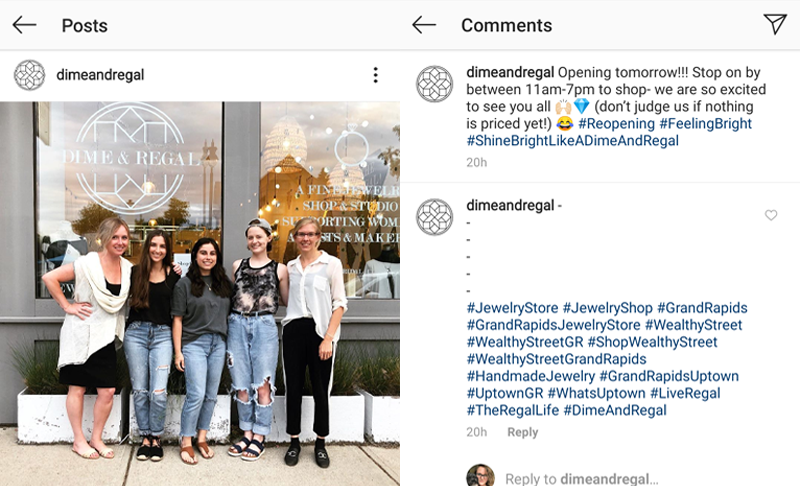
Dime & Regal puts their hashtags in the first comment of their posts on Instagram.
Put hashtags in your comments on Instagram
There is no real science behind this tip, but it helps keep your Instagram captions clean. Rather than adding your hashtags at the end of your caption, put them in the first comment of your post.
This will still make your post searchable, but will show a much cleaner caption when users click “... more” to read your full post.
Don’t use too many tags
One misconception about hashtags that some have is that the more hashtags you use, the more likely it is that your post will be found by more people. This isn’t true! In fact, a recent study by Mention showed that posts with a ton of hashtags saw way less engagement.
Instagram allows users to use up to 30 hashtags, and although some marketers might recommend that you use as many as possible, this marketer recommends focusing on quality over quantity.
Instagram: Shoot for 7 or less hashtags. Make them super relevant to your post. You can feel free to add more than 7 if you have some branded hashtags that you like to use (such as Dime & Regal’s #TheRegalLife hashtag), but keep the total number to 15 or less.
Twitter: Shoot for 2 or less hashtags. Only use them if they truly add to the conversation.
TikTok: Because TikTok is still so new, it basically runs on hashtags. However, don’t use more than 3 or 4 hashtags—mostly because any more than that simply looks cluttered on posts on the platform.
LinkedIn: Definitely don’t use more than 7 hashtags, but again, only use them if they add to the conversation.
Facebook: Don’t use hashtags on Facebook. They won’t make much of a difference for your reach and engagement numbers.

Photo by Thought Catalog on Unsplash
Change it up
Another strategy that might hurt your engagement or reach is using the same hashtags over and over. Instagram might penalize you for this spammy behavior. Instead, create hashtag groups for the different things you post and change them up every single time you publish something.
There are a few benefits to this. Especially if you’re just starting out, you’ll be able to see which hashtags perform best in gaining new likes and followers. Not only that, but the Instagram algorithm won’t mark your account as spam and limit the number of people who can see your posts.
If you’ve read my previous posts about search engine optimization (SEO), you might be thinking that building a strong hashtag strategy sounds very similar to finding the best keywords for your website. That’s because many of the algorithms used by social platforms are using the same factors that Google uses to rank search results. Employing the same type of mindset for each category of your digital marketing strategy will help you better understand the best course of action for your business.

8 Digital Marketing Trends and Predictions for a Post-Pandemic World
Summer 2020 is going to be very different from summers in the past, thanks to the COVID-19 pandemic. While small businesses may be seeing less foot traffic and in-store visits, that doesn’t mean sales have to decline. Here are my predictions on which marketing trends will boom this summer. Get ahead of the game and start implementing them now!

Photo by Kseniia Ilinykh on Unsplash
As more states lift stay-at-home orders and restrictions, businesses across all industries are starting to open their doors once again. For businesses that rely on in-person services and settings, the customer experience will likely be very different.
Leveraging more digital marketing tactics is becoming exceedingly crucial for small businesses this summer, as our country recovers physically, socially, and economically from the COVID-19 pandemic.
Here are eight digital marketing trends that will be hugely important for small businesses this summer. Although adapting all of these strategies may not be the answer for you, it’s worth it to spend some time considering which of these tactics will work best for your business.
Video marketing is essential.
If you’re not incorporating video in your digital marketing efforts, make this summer the time you start. Videos are an easy way to convey information and are proven to perform better on social media. For example, a 2019 study by quintly reports that videos receive 49% higher interactions on Instagram.
When people are hanging out on social media, their attention span may not always be able to carry them through a long text or blog post. A video is more likely to grab their attention and keep them around longer to see what your business has to say.
Plus, with video sharing platforms like TikTok on the rise, adopting a video strategy can help you reach a wider audience on new platforms. You can even repurpose or cross-post these videos to duplicate your efforts.
Authenticity is king.
As younger generations—who have been bombarded with ads their entire lives—enter the workforce and start making more purchasing decisions, we’re seeing consumers flock to brands that are more genuine in their messaging.
Making a shift to more authenticity in your marketing will pay off for your small business, especially if you cater to a younger audience. We already know that this shift has been paying off for brands on Instagram, but how else can you adopt this strategy?
One way to start is to think of your brand’s social media presence as that of an easygoing friend. Stay professional, but don’t obsess over every single picture or creating the perfect sentence. Focus on making connections and building relationships.
AI is the future.
Yes, I’m talking about artificial intelligence! AI is more commonly used in marketing than you might think. AI is present in the algorithms that show related products or videos on YouTube, Google, and eCommerce websites.
How can your business implement AI in its marketing efforts? One word: personalization. Even something as simple as personalizing the marketing emails that you send to your customers can go a long way.
If you have a widely used website, chatbots might be a good idea. Chatbots are website add-ons that allow customers to ask questions 24/7. The application automatically performs tasks or answers questions according to keywords your website visitors use. This is a great way to improve your customer experiences and convert more sales in a more automated way.

Photo by Kevin Bhagat on Unsplash
Social proof pays off.
I think a lot of small businesses still underutilize the power of social proof in their marketing. As a refresher, social proof is the psychological phenomenon that people will adopt the same behavior that they see from their friends and peers.
Social proof exists in forms like customer reviews, influencer marketing, and earned media. Even word-of-mouth marketing is an example of social proof in action.
Make sure to respond to reviews (good and bad), share customer testimonials, and send a “thank you” to customers that refer your business to their friends and family. You’ll see that these simple changes require very minimal effort but can make a huge difference in customer acquisition.
Corporate social responsibility creates stronger relationships.

It’s impossible to ignore everything that is happening in the world, and we’ve seen how big companies taking a stand has paid off in creating stronger advocates for their brand. We also know that younger generations value social responsibility. As stated in Deloitte’s Global Millennial Survey:
Millennials and Gen Zs start and stop relationships with companies for very personal reasons, often related to a company’s positive or negative impact on society.
Even something as simple as a strong statement of support can go a long way. For example, in Reebok’s response to the recent protests against police brutality across the nation, they even stated “We’re not asking you to buy our shoes. We are asking you to walk in someone else’s.”
If you haven’t already, and if you’re financially able, make this the summer your business gives back. Choose a cause that aligns with your brand’s mission statement and get involved.
PPC is out; SEO is in.
When was the last time you clicked on a Google search or display ad? Unless the content of the ad included information you were looking for, or an unbelievable promotion that you couldn’t pass up, it’s unlikely that you have clicked on one of these ads in a while.
It has become increasingly easy for internet users to tune out pay-per-click (PPC) ads, whether it be through the use of technology or just being able to ignore them. As consumers see more and more of them, interruptive digital ads just don’t do it anymore.
Search engine optimization (SEO) however, which aims to rank your website first on search engines organically, won’t be going anywhere. In fact, over 55% of marketers surveyed by HubSpot for their 2020 State of Marketing Report say that SEO is either “very important” or “extremely important” to their overall marketing strategy.
Focusing on your small business’s SEO efforts will help you bring more traffic to your website over time. Plus, this traffic will be more prepared to make a purchase from you.
Content marketing isn’t going anywhere.
Along the same vein of SEO is content marketing. Creating content that aims to help your target audience answer their questions will create trust, boost website traffic, and ultimately help you build stronger customer relationships.
It’s obvious that people won’t stop using the internet as a resource for helpful information, and the more your business aims to be helpful, the more success you will see from your marketing efforts. Start with your small business’s blog. Blogs don’t need to be updated constantly to be effective. Focus on quality over quantity, and you’ll see your traffic (and quality of customers) improve.

Photo by Nick Morrison on Unsplash
Less foot traffic doesn’t have to mean less sales.
This summer, it’s likely that people will still be practicing social distancing, at least until a vaccine for the coronavirus becomes widely available. If your business relies on foot traffic and in-person interaction to make sales, it’s time to get creative. How can you bring these important interactions to the digital world instead?
Look to new digital methods that aim to attract more of this “foot traffic” to your website instead of your brick-and-mortar location. It can be any of the aforementioned techniques, or something new like a virtual event.
As far as other customer experiences, what are some things you can implement on your website that will make their lives easier? If you’re offering something like a speedy online reservation or checkout system and your competitor isn’t, which business do you think your customer is more likely to want to support?
Summer 2020 will be very different from summers that we’ve seen in the past. In order to adapt, small businesses will need to adopt more digital strategies for customer acquisition, engagement, and retention. I may not have a crystal ball to see exactly which trends will excel and which will flop, so make sure to stay agile in implementing these efforts!

Race in the Workplace: Resources for Leaders that Want to Build More Inclusive Work Cultures
It’s 2020, and recent events in our country have reopened discussions about racism in the United States. This racism exists everywhere, even at work. In fact, most complaints processed by the US Equal Employment Opportunity Commission are racially-based, and yet only 15% of those cases end in success for the employee. Here are some resources and other things to keep in mind to help you build a more inclusive workplace.

Photo by Christina @ wocintechchat.com on Unsplash
Events that have unfolded over the past week in the United States have reopened a lot of conversations about racism in our country.
Like many others, I have been reflecting on my whiteness and what role someone like me can play in working to dismantle racism. One thing I kept going back to is how to combat it in the workplace.
As a leader, there are steps you can take to combat racism and better support current and future colleagues of color. These steps will help you create a more inclusive workplace with happier employees and, ultimately, stronger customer relationships.
Keep in mind that I am white, and in this post I am hoping to bring certain issues to light to my fellow white professionals. If you’re also white, I would encourage you to do some additional reading of articles and books by people of color to better understand their perspective and solutions. I have some links to these resources later in the post.
Racism at work still exists in 2020.
Although workplace discrimination is illegal in our country, the US Equal Employment Opportunity Commission (EEOC) receives hundreds of thousands of complaints each year. Granted, these complaints range from all types of discrimination other than race, such as gender, sexuality, religion, and more. Vox reported in 2018 that of these over 100,000 closed cases, only 18% of workers receive some sort of assistance, such as financial compensation or a change in work conditions. Additionally, race claims are the most commonly filed complaints and have the lowest success rate at just 15%. This is due to the lack of funding and resources available to the EEOC for properly investigating claims.
Keep in mind that these complaints aren’t always overt threats or racial slurs; workplace discrimination can manifest in more subtle ways as well. Differences in compensation, certain work assignments, or performance reviews can sometimes be examples of discrimination.
Racial bias exists in terms of what many in our country view as “professional” standards as well. As a white person, what comes to mind when you think of “professional” dress code or speech?
Traditional Western views of professional attire are often built around white appearances: straight, “neat” hair and suits, which excludes minorities with natural hair or dreadlocks, or people that wear hijabs or saris. These implicit biases have deep roots in the history of the American workforce, and cannot be conquered overnight. However, addressing these biases and being more inclusive in dress codes and other workplace policies can be a great start.
Build an inclusive workplace.
I will be honest: creating a workplace that is more inclusive and that celebrates diversity can take some time, and it definitely takes buy-in from multiple leaders and stakeholders of your company.
Unfortunately I don’t have a simple six-step process for transforming your company’s culture to be more inclusive. I do, however, recommend starting with your company policies, as stated above. Are there any words or phrases that exclude minorities? Even something as simple as making a certain phrase more inclusive will go a long way in making people from more diverse backgrounds feel more welcome in your workplace.
Diversity training with your employees will also help you get on the right track. Look for companies in your area that specialize in this. This will make for a fun and engaging experience for your staff. Plus, it will make them feel more bought-in to you as their employer working to improve the culture of your workplace.
Be open to discussion and—most importantly—listening.
As white people, it’s important now more than ever to sit down with people of color and listen to their stories. Just be mindful that not all people of color will inherently be open to discourse, especially during a traumatic time like this.
However, if you find yourself in a discussion with a person of color, make sure to listen. Don’t feel like you need to respond to every single thing they say with your own experiences. Listening to their stories will help you better understand why building an inclusive and diverse work culture is so important.

Photo by Christina @ wocintechchat.com on Unsplash
Be open to this type of discourse in the workplace as well. Understand that it’s so much easier for white people to ignore or tune out what is happening in the world than it is for a person of color. Make it clear to your colleagues that you are available to lend an open ear and open mind if they want to talk about what has been happening, but don’t single anyone out either.
Do some reading.
Take advantage of any spare time you have to do some research on racism, particularly from black writers and other content creators. Here is a very brief list of things you can dive right into to learn more:
Books
White Fragility: Why It's So Hard for White People to Talk About Racism by Robin DiAngelo
So You Want to Talk About Race by Ijeoma Oluo
We Can’t Talk About That at Work! by Mary-Frances Winters
The New Jim Crow: Mass Incarceration in the Age of Colorblindness by Michelle Alexander
Articles
The Bias of ‘Professionalism’ Standards by Aysa Gray (June 4, 2019)
Who Gets to be Afraid in America? by Dr. Ibram X Kendi (May 12, 2020)
Podcasts
Code Switch by NPR
1619 by The New York Times
No Bad News by Dom Davis
Strong Black Lead by Tracy Clayton and Netflix
Films/Documentaries
When They See Us (Available to watch on Netflix)
Kingdom Men Rising (Available to watch for free on IMDb)
The Hate U Give (Available to watch on Hulu)
Understand that you may never understand.
Many of the struggles that American people of color face on a daily basis are struggles that we as white people will never experience. This isn’t anything that we should feel guilty about, but that we should acknowledge and accept.
We also need to recognize that just because we don’t see or feel the pain that they feel, that doesn’t mean that it isn’t valid. In times like this, it’s so important and helpful for all of us to come together to enact change—the type of change that every single one of us can benefit from.
By creating a workplace that is more culturally diverse and welcoming to people of color, you are doing your part in creating a more level playing field for all Americans. These changes will not happen overnight, but will help make the American workplace leaps and bounds better than it was yesterday, which is progress to be celebrated.
Special thanks to my friend Dom Davis of the No Bad News podcast for reviewing this post for accuracy.
Hi! I’m Jennie.
Thank you for visiting my blog! I write about marketing tips for small businesses and how to succeed as a female professional. I write from experience about the things that I love.