

Blog

Earned Media: The (Mostly) Free Marketing Strategy that Generates Results
We’re entering a tough market for small businesses, which means that marketing budgets are going to be tight. One digital marketing strategy that can help small businesses make the most of their marketing dollars is earned media, which is content or coverage that you don’t own or pay for. Here are some ways that you can implement a better earned media strategy that will help you reach a wider audience and convert more customers.

Photo by Christine von Raesfeld on Unsplash
Free marketing: two words that are music to a small business owner’s ears. It does exist, to some extent, in the form of earned media. Not only is it low-cost, but it can help you onboard much more engaged and empowered customers.
Although I can’t say that earned media is 100% free—you’ll learn why later—it’s a great strategy to build for your small business if you’re looking at a smaller marketing budget right now.
Let’s take a closer look at how your business can “earn” earned media. You might already be doing these things, but putting more focus on them can generate some fantastic results in today’s marketing landscape!
What is earned media?
In short, earned media is free publicity. It’s the type of media coverage or other type of publicity that you don’t own or pay for. Media that you own, like your website or blog, would be considered owned media. Media that you pay for, like advertising, is considered paid media.


To give you a better idea, here are some more specific examples of earned media:
A customer has a great experience in your store and gives your company a positive shout out or testimonial on their Facebook or Twitter.
You make a food donation to frontline workers in your community, and your local news publication does an article or even a TV segment on your business.
You (or someone else within your company) are asked to do a presentation or panel for a trade show or another industry event. Attendees tag your business on their social media accounts when they share the great things you have to say.
A disgruntled customer leaves a negative review on your Yelp page. (Yes, negative things like this are an example of earned media too—just not the type that you should be going for!)

Why is earned media important?
Earned media is great for small businesses with small marketing budgets to leverage because, as I said earlier, it’s free (sort of)! When done right, you will start to see these types of strategies really pay off for your brand. Here’s why:
As I mentioned in my previous post about social proof, people tend to base purchasing decisions and other behaviors off of what they see other people doing. According to research performed by HubSpot, 53% of US consumers hear about new products or companies from friends and family, and 57% of consumers trust information about these new companies from friends and family the most.
Earned media can help you with your search engine optimization (SEO) efforts—also known as how high your website ranks on Google’s results page. More outside sources linking to your website will positively affect your ranking factors because it shows Google that you have a high-quality website that people find valuable.
Earned media serves as a way to empower your target audience, rather than interrupting them. Although there is nothing wrong with the more traditional digital advertising tactics like display ads and search ads, younger generations that are starting to make more purchasing decisions grew up with these interruptive ads and are very much “immune” to them. Things like earned media come off as more organic and less forced to your prospective customers.
How can I build a better earned media strategy?
If you’d like to implement a better earned media strategy to attract and engage with more customers, here are my step-by-step recommendations.
1. Identify your objectives. As with anything, make sure you have a clear goal in mind for your earned media strategy. Do you want to make a big splash with your next product release? Do you want to drum up more interest from the local community? Do you want to increase brand awareness from a new audience? Starting off this way not only helps you understand what success looks like, but also helps you know where to go next.

Photo by Roman Kraft on Unsplash
2. Learn more about your target customer. Where are they spending time online (or offline)? What places or platforms are they going to to ingest media? For example, if you have an older audience, it’s possible they will look at reviews of your business left by previous customers. If you have a younger audience, they might follow the word of their peers on social media. If you target other businesses, they probably read blogs related to your industry.
3. Tell great stories and build great experiences. This is where your earned media strategy takes the most time and patience. You want to build advocates and evangelists of your brand by taking the time to give every single customer a 5-star experience. What are some changes you can make to your customer-facing processes or products that will have them shouting your praises from the rooftops?
4. Reach out to your community, the local media, and fellow industry members. As a small business, there are so many ways that you can reach out and connect with your local community. We already know that customers feel more empowered when they shop with a business that is socially responsible and gives back to the community, so what are some ways that you can give back that align with your mission statement? Remember, in order to gain local media coverage (if that’s what you’re looking for), you need to do something newsworthy. Additionally, if you’re a B2B business, you can reach out to other members of your industry to get involved as a speaker or panelist at your next industry trade show. (However, if you elect to sponsor an event, remember that since you paid for that coverage, that is paid media, not earned media.)
5. Make the most of each opportunity. You may not have the local news station giving you a call right away, and that’s okay. Even coverage opportunities like a shoutout from a small blogger can pan out to be very powerful. Maybe that blogger won’t be so small-time in the next 3 years! Focus on building relationships with as many writers, influential community members, industry experts, and brand advocates as possible. Engage with your customers that post to your wall on social media. Represent your business at a small community event. Share with your followers where you’ve been featured in the media (no matter what size the publication is).
Now that you know more about earned media, hopefully you now understand why it’s not 100% free: it takes time! The benefits that you’ll see in brand awareness and quality of customers gained from these tactics, however, make all of that time and energy worth it for your business. With everything going on in the world today, now is a great time to start putting more focus on your earned media efforts. By next year, you’ll be thankful that you did!
![[FREE Worksheet] Four Things to Consider Before You Rebrand Your Small Business](https://images.squarespace-cdn.com/content/v1/523cf6c4e4b0f6b279e835d3/1589475277944-EGTWFUIU470JYRC5JRVE/brand-identity.jpg)
[FREE Worksheet] Four Things to Consider Before You Rebrand Your Small Business
If you decide to rebrand your small business, it’s important to remember that all successful rebranding campaigns are more than just a new look. Before you jump in, there are a few things you should ask yourself to get the most out of rebranding and make sure you’re set up for success. Take a look at my free worksheet for rebranding small businesses to get started on the right track!

When you think of your small business’ brand or identity, what do you think of? Do you think of your name and logo? Do you think of the sign in front of your storefront or office?
In truth, your “brand” is so much more than this! Think of your brand as the personality of your business. It’s about how you relate to your customers, and how they feel about your business. It’s about how you stand out from your competition. It’s even about how your employees feel about working for your business.
A rebranding campaign is (and should be) more than just a new logo, location, or name. Although all of these things may play a role in your rebrand, there are plenty of other things to acknowledge and plan if you think you’d like to give your company a bit of a “facelift”.
Start here: Why do you want to rebrand?
There are plenty of reasons why you might be thinking about rebranding. Here are some ways your small business might benefit from a rebrand:
You’ve been in business for a long time, but sales are more recently dwindling. This is an indication that your brand could use a refresh or—as I said before—a bit of a “facelift”. This is especially true if you first opened your doors over 5 or 6 years ago. Sales may be decreasing for a number of different reasons, but one thing that can grab the attention of your target audience again is a new look and feel.
Your business has evolved and you’d like your brand to match. Is your business offering something new or different than it was when you first opened? Maybe you’ve slowly made some changes to your customer-facing processes and feel that your current branding should catch up.
You’d like to better differentiate from your competition. If you notice more potential customers choosing your competitor(s) over your business, think about why. A rebrand may help you better stand out as a better option to those potential customers.
You’re making another massive change to your business. If you’re moving locations or introducing a new product or service, a rebrand can help you make an even bigger splash with that campaign.

You’d like to reach a new audience. If you’ve already captured the attention of a particular target audience and would like to expand, a rebrand can make your business more appealing to a new type of audience, like Gen Z.
Understanding your specific reason for a rebrand will help you create a campaign that makes the most sense for your business and goals.
What are your goals?
Any successful campaign starts with setting SMART goals, because otherwise, how would you know if it was successful? You may remember me talking about SMART goals in my previous post about building a product launch campaign. If not, here is a bit of a refresher.
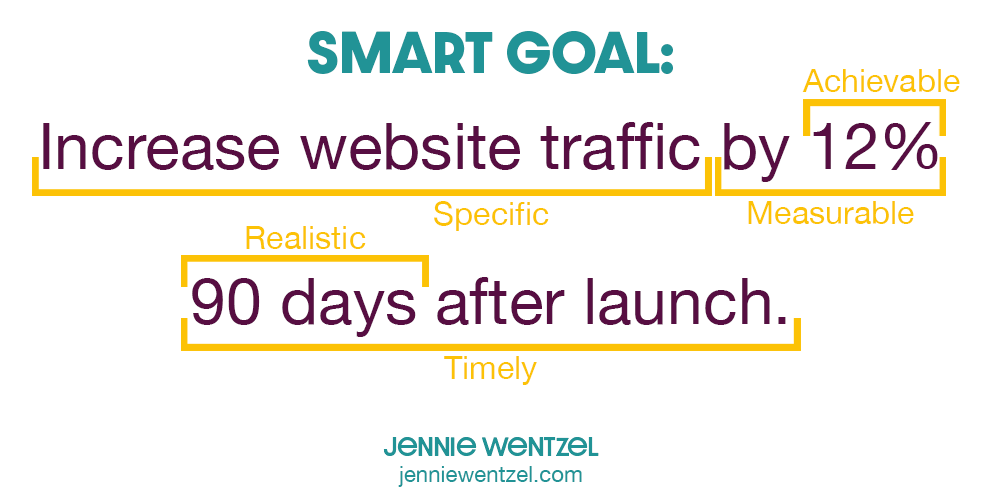
Remember why you chose to rebrand in the first place, and write down goals that are specific, measurable, achievable, realistic, and timely.
After the launch of your rebranding campaign, track the success based on these goals that you’ve written down.
How will this rebrand tie in with your mission statement?
Keep your rebranding true to your original mission and values. How will this help you accomplish the vision you had in mind when you first started on this adventure?
Moreover, if you think that your original mission has changed, make sure to identify and communicate your new mission statement to both your customers and employees.
Having a clearly communicated mission statement helps boost employee engagement. According to a report by Deloitte, 73% of employees that work at a “purpose-driven” company are engaged, compared to only 23% of employees that don’t work at a company with a clear purpose and mission.
A more engaged workforce leads to more productivity and ultimately, better customer service. It’s a win-win for everyone!

Photo by Patrik Michalicka on Unsplash
Why should your customers care?
Speaking of your customers, how will you get them bought into this rebrand? Are there other changes that will improve their experience that you can launch with your campaign? How can a new brand identity help make their lives easier? After all, the goal here should be to convert more sales and maybe even make your customers so pleased that they turn into vocal advocates for your business!
Here are some ideas to get your customers excited for your new brand identity:
Launch a new, more streamlined website that your customers can use to buy your products or book your services.
Introduce a new program that can help them save money, such as a rewards program, referral program, or a recycling program.
Start using supplies or processes that are more environmentally friendly—think recycled packaging or a “go paperless” option for statements and invoices.
Boost engagement and hype on social media by hosting a giveaway or contest related to your upcoming launch.
Remember, your rebrand is more than just a new look and feel; it should be something that truly improves the customer experience, drives employee engagement, and helps you achieve your vision for your small business.
Now that you’ve put some thought into these things, it’s time to plan and launch your rebranding campaign! I have found it’s best to collaborate with your teammates on projects like this because not only does it help them feel more bought in, you can get some great ideas and new perspectives on the direction to head in.
Take a look at my free rebranding worksheet that will help you get started on the right track.

Four Ways to Leverage Social Proof for Your Small Business Marketing
Social proof is the psychological phenomenon in which people adapt their behavior or decisions according to those of other people. Small businesses can reach their marketing goals by building social proof using a number of different tactics. Here are four ways that your small business can build social proof to reach a wider audience and gain more customers.

Photo by You X Ventures on Unsplash
I am a member of a Facebook group for vegans in the Grand Rapids, Michigan area. Almost every Saturday this past winter, a ton of members would post pictures of these vegan donuts from a local business called Donut Garden.
As a self-proclaimed donut connoisseur, I was a little skeptical. Most vegan donuts that I had tried in the past were really cakey. However, with all these other vegans saying how amazing these donuts were, I had to visit Donut Garden’s booth at the farmer’s market to try them for myself.
Guess what? The donuts are amazing and I order from them almost every chance that I get! If I hadn’t received so many recommendations from my fellow vegan peers about these donuts, I may not have ever tried them!
This is an example of social proof in action. The term “social proof” was first coined by Robert Cialdini in his 1984 book Influence: the Psychology of Persuasion. The basic premise of social proof is that people will adapt their behavior according to what other people are doing.
This rings true in marketing and business! According to a report by Chatter Matters, 83% of consumers say that a recommendation from a friend or family member would make them more likely to purchase a product or service.
Building Social Proof for Your Small Business
Social proof comes in many different forms, but not all of them are ideal for small businesses. Here are the top four strategies of building social proof that you can implement.

Customer Reviews
When potential customers see positive reviews from your past customers, they will already be more likely to want to check out your products or services.
There are many ways to use customer reviews to build social proof. First, make sure to encourage customers to write a review of your business on Google, Yelp, Facebook, and other platforms if they have had a positive experience with you. More times than not, if you used the angle of helping support a small business, they will happily oblige.
Depending on the type of products or service you sell, you can add this type of social proof to your website. If you sell products, try adding the option for customers to leave reviews on the product level to share their experiences.
If you own a service-based business, ask customers for a testimonial that you can share on your website, social media platforms, or even video content.
Influencer Marketing
Yes, influencer marketing is an example of building social proof. Why? Because that person has the power to influence the decisions of their following by reviewing your product.
Identify micro-influencers in your industry—or really anyone that has a significant following on social media comprised of your target customers—and introduce your product or service to them.
Aside from a product review or unboxing post, you could ask your influencer to do a “social media takeover” for 24 hours. This is when you grant them access to your social media account and allow them to post content to attract more followers.

Expert Reviews
Are there experts in your industry that will endorse your brand in some way? Is there anything you can do to get that stamp of approval?
Additionally, maybe there are opportunities to partner with another business that offers something different to your target audience. Both of you will not only enjoy more traffic, but also added trust in each of your brands.
Once you’ve identified and established a more synergistic partnership with another business, create some content together. You could do social media takeovers of each other’s brands here too!
Earned Media
Earned media is any sort of publicity or content that is created about your brand that you don’t pay for or create yourself.
A more traditional example of earned media is an interview segment with the local news station. How do you land something like this without paying for it? Well, your business needs to do or accomplish something newsworthy.
It’s the same thing with being featured in a news article. Keep your business active with community engagement and making moves in your industry, and you might catch the attention of the local media.
Building social proof can help you reach your small business’ marketing goals, like reaching a wider audience or converting more website visitors to customers. Once you have a better idea of these goals, you can get started with some of these recommendations.

The RIGHT Way to Market Your Small Business on TikTok
TikTok has seen explosive growth in popularity over the last two years, and its primary users are the elusive yet highly-influential Gen Z-ers. If your small business is looking to connect with more of your Gen Z audience, you might benefit from developing a presence on TikTok. However, I wouldn’t recommend spending any money on the app at all… follow these tips instead.

Photo by Aaron Weiss on Unsplash
If Gen Z is part of your target audience, you may hear about the app TikTok in your market research. You might find out that TikTok is one of the fastest-growing social media platforms in the world, currently standing at over 800 million users worldwide.
What the heck is TikTok?
TikTok is a short-form video-sharing platform where users are encouraged to share stories in 60 seconds or less. Creators range from celebrities, influencers, artists, and more. Content on TikTok ranges from the funny to the weird and from the insightful to the heartwarming.
In 2017, the app merged with a lip-synching app called Musical.ly, so most videos that are shared are recorded over other videos’ sounds.
Creators can add text or use in-app filters on videos they record and share. Additionally, users can “duet” with other videos, which will show their own video alongside the original.
I could go on and on with what the app is like, but I encourage you to download it and do some research of your own to understand the types of videos that are on there. Be careful, because it can be addicting!
TikTok is most popular amongst Gen Z, with 41% of its users aged 16 to 24 years old. Gen Z is quickly becoming the most financially influential generation, so connecting with this audience now is more important than ever.

With all this in mind, you might be thinking about creating some paid ads on the platform to advertise your business. However, this is NOT what I would recommend in order to reach and engage with users on the app. The reason? It’s incredibly easy to ignore the ads and promoted content on the app. They stick out like a sore thumb and are disruptive in a bad way.
Here’s what you should ACTUALLY do…
First off, if you haven’t followed my advice and downloaded the app to explore, make sure you do so right now. Don’t feel silly; there are plenty of adults over the age of 25 (myself included) that have spent a decent amount of time on there. Even Gary Vaynerchuk has a profile (and he sees a lot of potential in it). Carve out some time to do the following:
Scroll down the “For You” page and like some videos.
Pay attention to the way certain sounds and visual effects are used.
Notice how easy it is to scroll past or skip ads in the app.
Follow accounts you like by tapping the + icon on the right side of the video.
Now, think about some ways that your brand can contribute to the content being shared on TikTok. Are there trending sounds or hashtags that you can participate in?
If you’re still feeling lost, here are some content ideas from brands that are doing it the RIGHT way.
(Pro tip: You’ll notice that most of these types of videos have been suggested in some of my previous posts on social media. Get the most out of your content by cross-posting these videos to multiple social media platforms!)
How-To Videos
Although I am located in Michigan, there is a cafe called Bagel & Deli Shop in Oxford, Ohio whose account I follow. Why? Because they share videos of how they make some of their locally-renowned bagel sandwiches on the app.
The videos are oddly satisfying to watch, and they make me wish I was in Ohio so I could try one of their sandwiches! I’m not the only one who feels this way either. This account first started posting content on April 17th, and as of today, they have around 37,000 followers!
What you can take away: Don’t expect to go viral in your first month, but the more helpful your content is, the more likely you are to gain a following. What is something you can teach a potential customer about what you do in less than 60 seconds?
Helpful Tips
After spending some time on TikTok, you’ll start to hear that certain sounds and songs are more popular than others. I recently came across the account of a chiropractor by the name of Dr. Jordan Estrada who has built a following by posting his own remixes to these popular songs. His videos include recommendations and stretches for people experiencing back pain, neck pain, headaches, and more.
Are his videos cringeworthy? Yes. Does he have almost 400,000 followers? He sure does! Also, people find his content to be genuinely helpful. Imagine coming across this account and realizing that Dr. Jordan practices in your area. You would probably be calling his office for an appointment!
What you can take away: I wouldn’t recommend posting your own remixes of songs on TikTok, but you can follow Dr. Jordan’s lead by sharing helpful information and sharing your expertise. This will create trust in your brand and your services.
Demo Videos
Never underestimate the power of a demonstration video! Have you ever found your eyes glued to the screen of a “How it’s Made” video? What about a video showing how to use a cool product?
This account belongs to someone that sells customized water bottles, mugs, and more. Their videos have a ton of views, and if you look at the comments, there are a lot of interested potential customers too!
What you can take away: People that are scrolling through TikTok are looking to be entertained, and learning something new in the process is just a bonus. Play on both of these things by showing a video of your product in action, or by showing your process in creating something behind the scenes. Make sure to use the hashtag #oddlystatisfying to target the right kind of audience!
Influencer Marketing
I touched on influencer and micro-influencer marketing in my previous post about marketing to Gen Z, and those types of videos have a place on TikTok too.
Believe it or not, this dog is an influencer on TikTok! With over 5 million followers, Tucker the Golden Retriever brings joy to his followers with hilariously cute “review” videos. Influencers like Tucker have the power to introduce your product or service to a much larger audience.
What you can take away: Identify influencers or micro-influencers related to your industry. Reach out and see if they would demo your product and what their rates are. If influencer marketing is way out of budget, brainstorm ways to develop a product or service that people genuinely want to talk about on their own. Are there people out there promoting your brand already? Give them more of a voice.
What’s great about TikTok is that you can use it as a sort of “test kitchen” to play around with different forms of content to see what works and what doesn’t. By focusing on entertaining and informing your viewers, you’ll create a strong following of potential customers and ambassadors that trust your brand.
![[Infographic] The Small Business Guide to Google Analytics](https://images.squarespace-cdn.com/content/v1/523cf6c4e4b0f6b279e835d3/1588538232718-QARIF3QRPOEKPHIHGXRZ/google-analytics-post.jpg)
[Infographic] The Small Business Guide to Google Analytics
What role does your website play in attracting and converting new customers? If you’re not sure, you should check your Google Analytics dashboard to get a pulse of who is coming to your website, where they are coming from, what they are doing on your website, and more. Here are some tips for small business owners on how to use GA to reach their digital marketing goals.
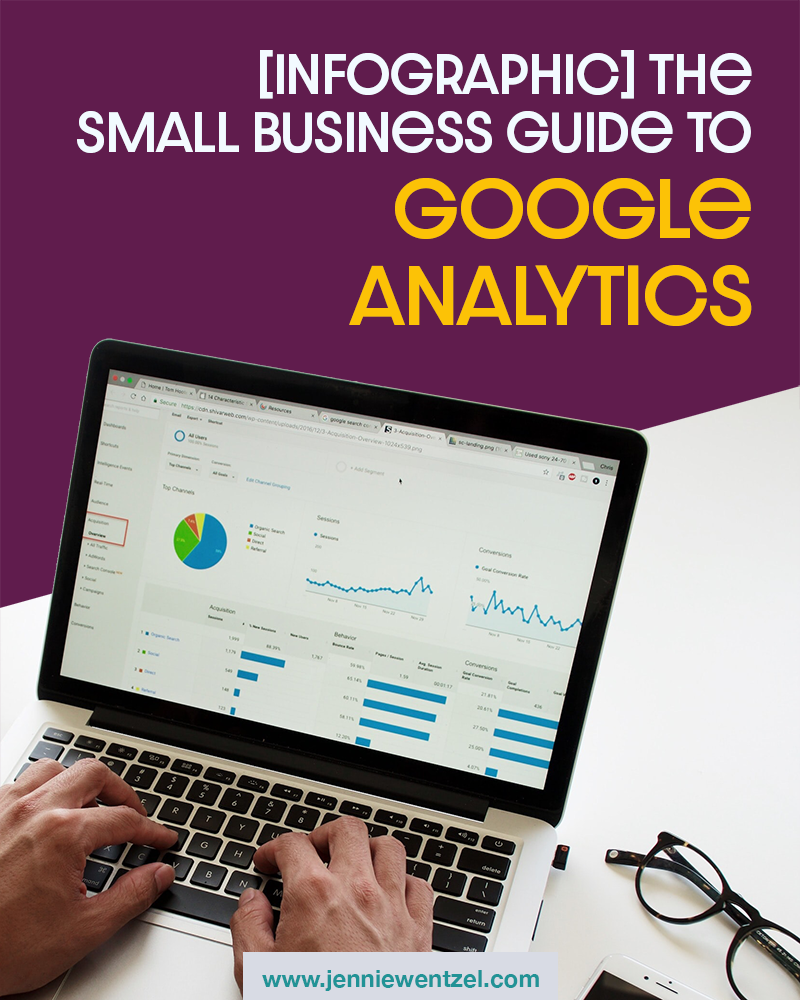
Photo by Campaign Creators on Unsplash
Picture this: you’ve noticed that you’re having a hard time attracting new customers lately. You’ve been able to identify that the problem probably lies in your website, so you decide to make some adjustments. Where do you start, though?
There is almost nothing worse than blindly making changes to your website without concrete data to back those changes up. Do you know what’s working well already and driving conversions? Do you know who exactly is visiting your website? Do you know how they’re even finding your website?
Enter Google Analytics, one of the most powerful tools out there to help you answer these questions. The best part? The tool is 100% free and easier to set up and use than you might think.
Why Use Google Analytics?
First, let’s specify exactly why it’s so important for you to keep tabs on your Google Analytics (GA) metrics. GA can provide some valuable insights on three main categories of your small business’ marketing:
Your customers / website visitors
Your website performance
Your industry benchmarks
You may already have an idea of the demographics of your target audience, but does this match the demographic of your website visitors? GA can help you see if it’s all adding up.
We also know that certain aspects of your website are important to keep an eye on to monitor your search engine optimization (SEO) efforts.
GA can also provide some great insights on analytic benchmarks in your industry. Things like average session duration and bounce rates in your industry are made available to help you understand how you rank amongst your local competitors.
All of these different metrics can help you understand the role that your website plays in converting new customers, and provides actionable data to help you make changes as needed.
How to Set Up Google Analytics
If you don’t have GA connected to your website yet, here is a quick run-through of how to do so.
Start by visiting the Google Analytics homepage and logging in to your account. You will then be asked to enter your website name and URL.
To verify that you are the owner of your website, Google will ask you to install a tracking code in the source code of your website. The steps to do this all depend on your website platform and where the code of your website is located.
Once the tracking code has been installed, you will see your analytics data start to populate!
Another helpful step to follow once you’re set up is excluding your IP address(es) from your analytics view. This allows you to see only the data from real website visitors and not just yourself or your employees.
To do this, scroll down to “Admin” in the bottom left corner of your dashboard. Under the “View” section all the way to the right, click on “Filters”.
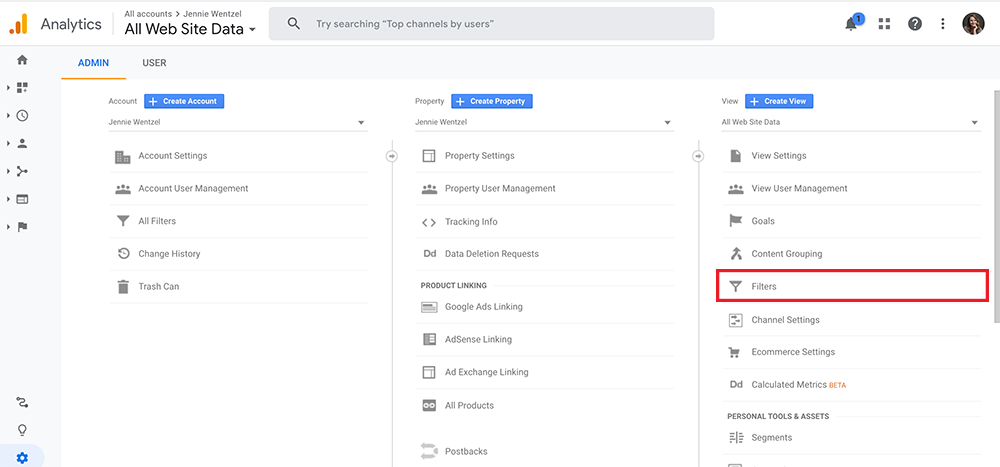
You will make a filter for each IP address you want to exclude from your data. Click to add a new filter for your first IP address. Make sure the following information matches this screenshot:
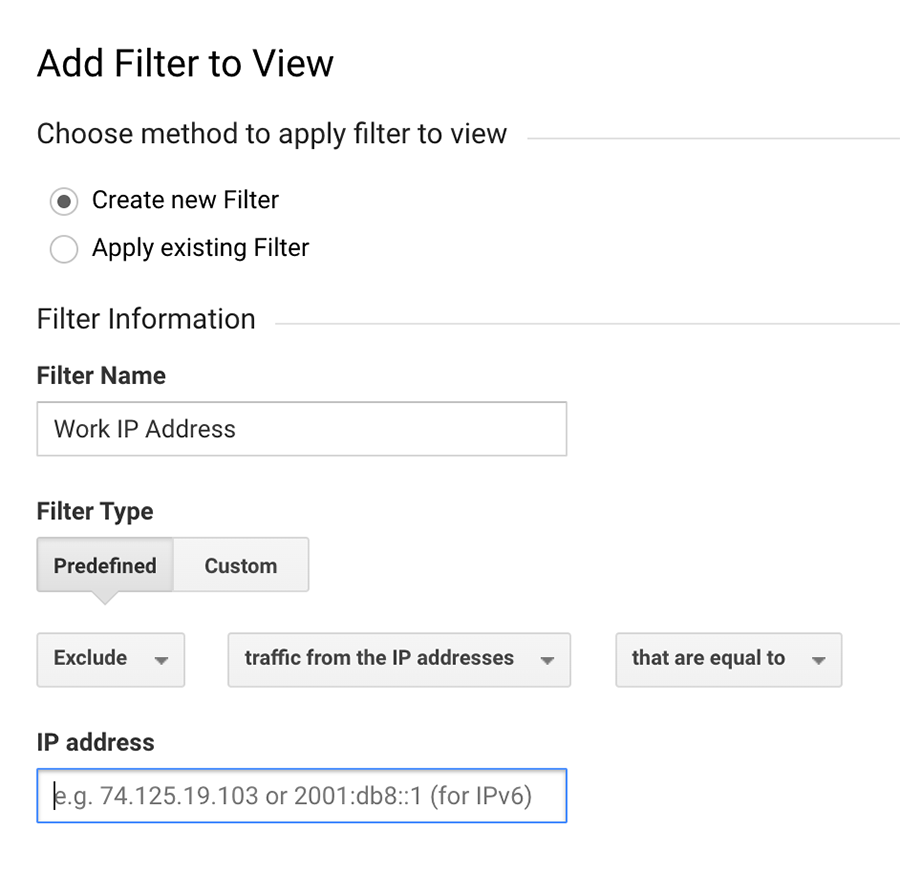
Filter Name: Make this something you will remember, such as “Work IP Address”
Filter Type: Select “Predefined”
Then select “Exclude”, “traffic from the IP addresses”, and “that are equal to”.
Then, enter the IP address. If you’re not sure what your IP address is, just type into Google “what is my IP” and copy that number.
Click “Save” and repeat this process for every IP address that you want to exclude. Now your data in Google Analytics won’t be skewed!
Metrics to Track in Google Analytics
Looking at the GA dashboard for the first time can be a little overwhelming. Here are my recommendations for the most important metrics to view and track in your website’s Google Analytics reports.
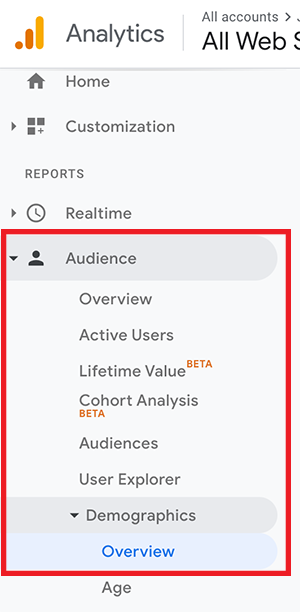
1. Visitor Demographics
In the “Audience” tab on the left, scroll down to “Demographics”, then “Overview”. You may or may not have some data here, depending on if this feature is enabled for you or not. Feel free to enable it and check back later to keep tabs on the demographics of your website visitors. If these demographics don’t seem to match your typical target audience, it might mean that you need to make some changes to your website to attract more of those target visitors. It could also mean that you need to make some modifications to your business model to cater to your current visitors, too.
2. Average Session Duration
This metric can be found in the “Audience” tab as well, right in the “Overview” section. Average session duration will help you know if your website content is serving the needs of your visitors. The longer the session duration, the more likely it is that your website is engaging enough to keep your visitors around. This metric can also impact your website’s SEO. A good rule of thumb is to shoot for an average session duration of 2-4 minutes.

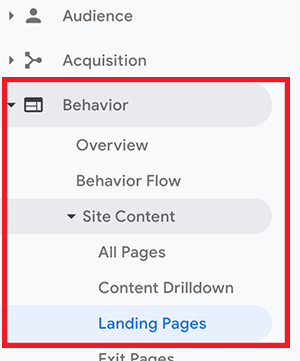
To drill down and view session duration on a page-by-page basis, visit “Behavior” (we’re looking for the section nested outside of the “Audience” category), “Site Content”, “Landing Pages”. This will show which pages have a longer session duration and which ones might need to be changed.
3. Bounce Rate
This metric can be found right next to your “Average Session Duration” in “Audience” > “Overview”. When a user visits your website and then exits without clicking on other pages, this is known as a “bounce”. This basically means that they didn’t find what they were looking for when they clicked on your site. Having high bounce rates can negatively affect your website’s SEO, since this tells search engines that users aren’t finding answers that they need on your website.
If you have a bounce rate higher than 50%, try to identify problem pages by going to “Behavior”, “Site Content”, then “Landing Pages” to view bounce rates on a page-by-page basis.
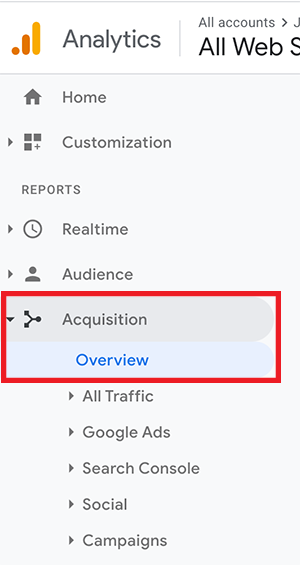
4. Acquisition
It’s important to understand how visitors are getting to your website, and the “Acquisition” section will help you with this. In the “Overview” tab, you’ll find a breakdown of which channels your visitors are getting to your website from. This section will provide some important insights on the success of your social media posts (“Social”), backlink creation strategy (“Referral”), and SEO efforts (“Organic Search”).
5. Page Load Times
Yet another metric that affects SEO, it’s important to keep your page load times below three seconds. To check, go to “Behavior”, “Site Speed”, then “Overview”.
If you’d like page-by-page suggestions, view individual load times by clicking “Page Timings” just below “Overview”. Enter the URL of any slower pages into GTMetrix to get actionable suggestions to help improve that page’s load time.

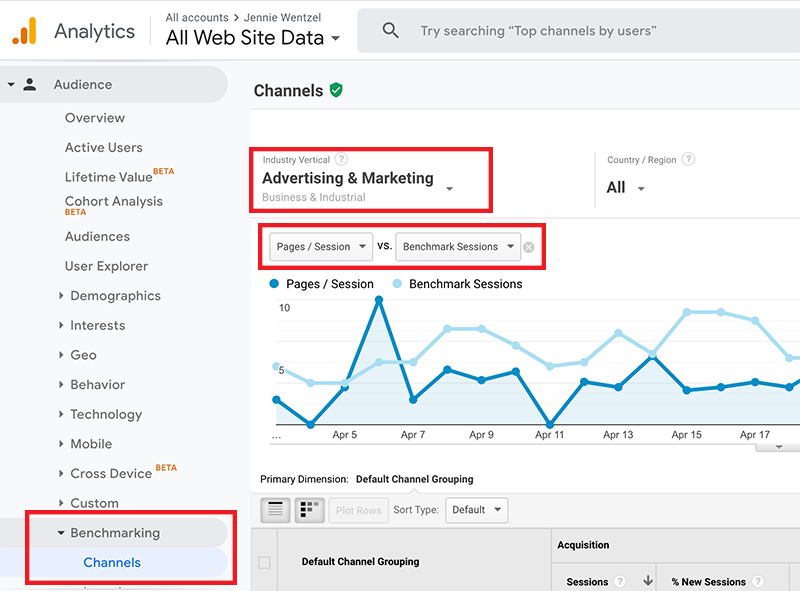
6. Benchmarking
Depending on your industry, this section can be very insightful. You will find the “Benchmarking” section in the “Audience” tab on the left. In any of the sections, you can change your Industry Vertical and Metric Dimensions at the top. Take a look at the graph as well as the charts below to see how you stack up against your competition!
Now that you have a better idea of some important metrics to track in GA, do some exploration of your own. The more familiar you become with it, the more informed decisions you can make about improving your website!
Check out the infographic below for future reference.
Hi! I’m Jennie.
Thank you for visiting my blog! I write about marketing tips for small businesses and how to succeed as a female professional. I write from experience about the things that I love.